 Today's AI Tip
Cold email with AI? Hand it 3 facts, not a company name.
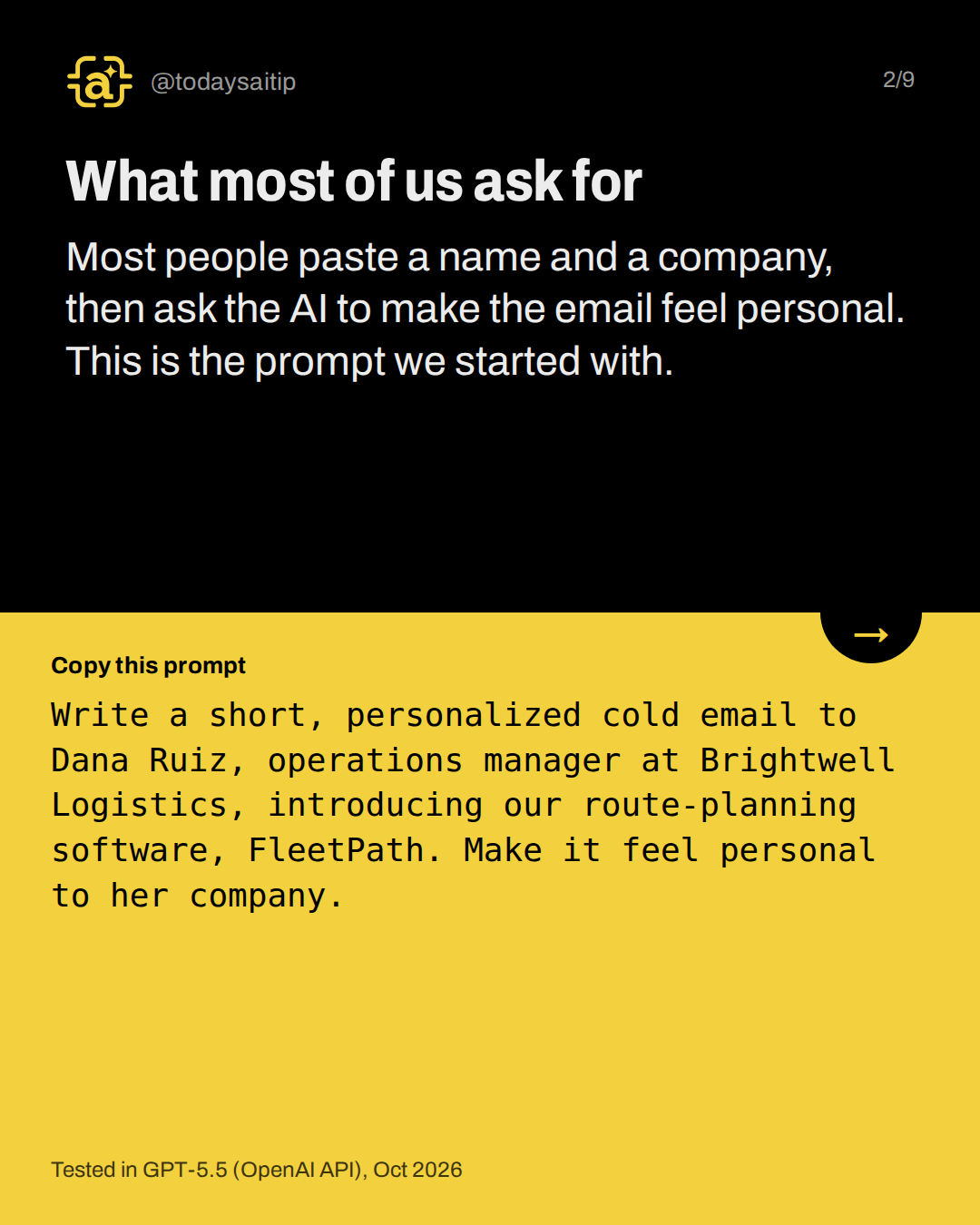
What most of us ask for
Tested in GPT-5.5 (OpenAI API), Oct 2026
Most people paste a name and a company, then ask the AI to make the email feel personal. This is the prompt we started with.
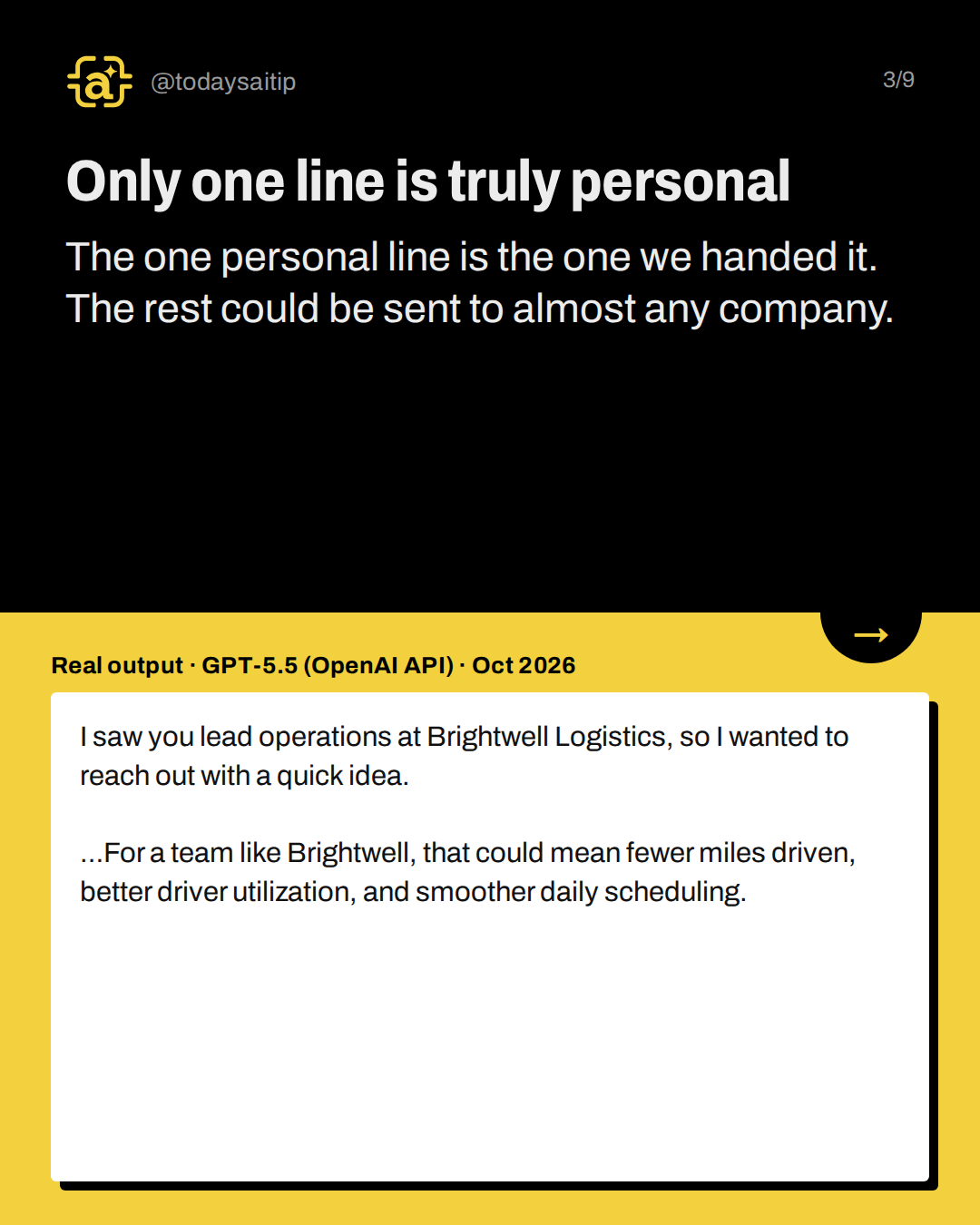
Only one line is truly personal
Real output · GPT-5.5 (OpenAI API) · Oct 2026
The one personal line is the one we handed it. The rest could be sent to almost any company.
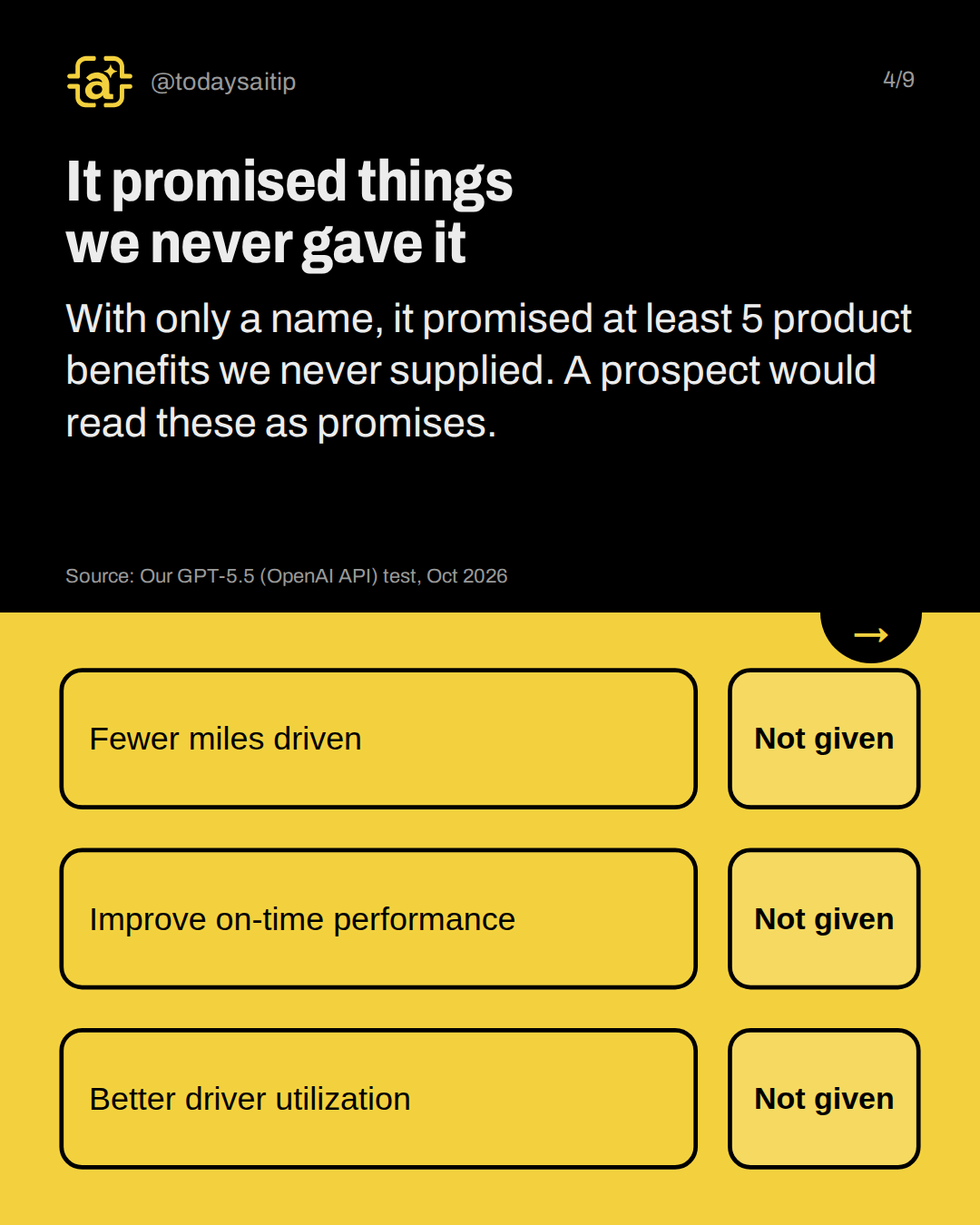
It promised things we never gave it
With only a name, it promised at least 5 product benefits we never supplied. A prospect would read these as promises.
Source: Our GPT-5.5 (OpenAI API) test, Oct 2026
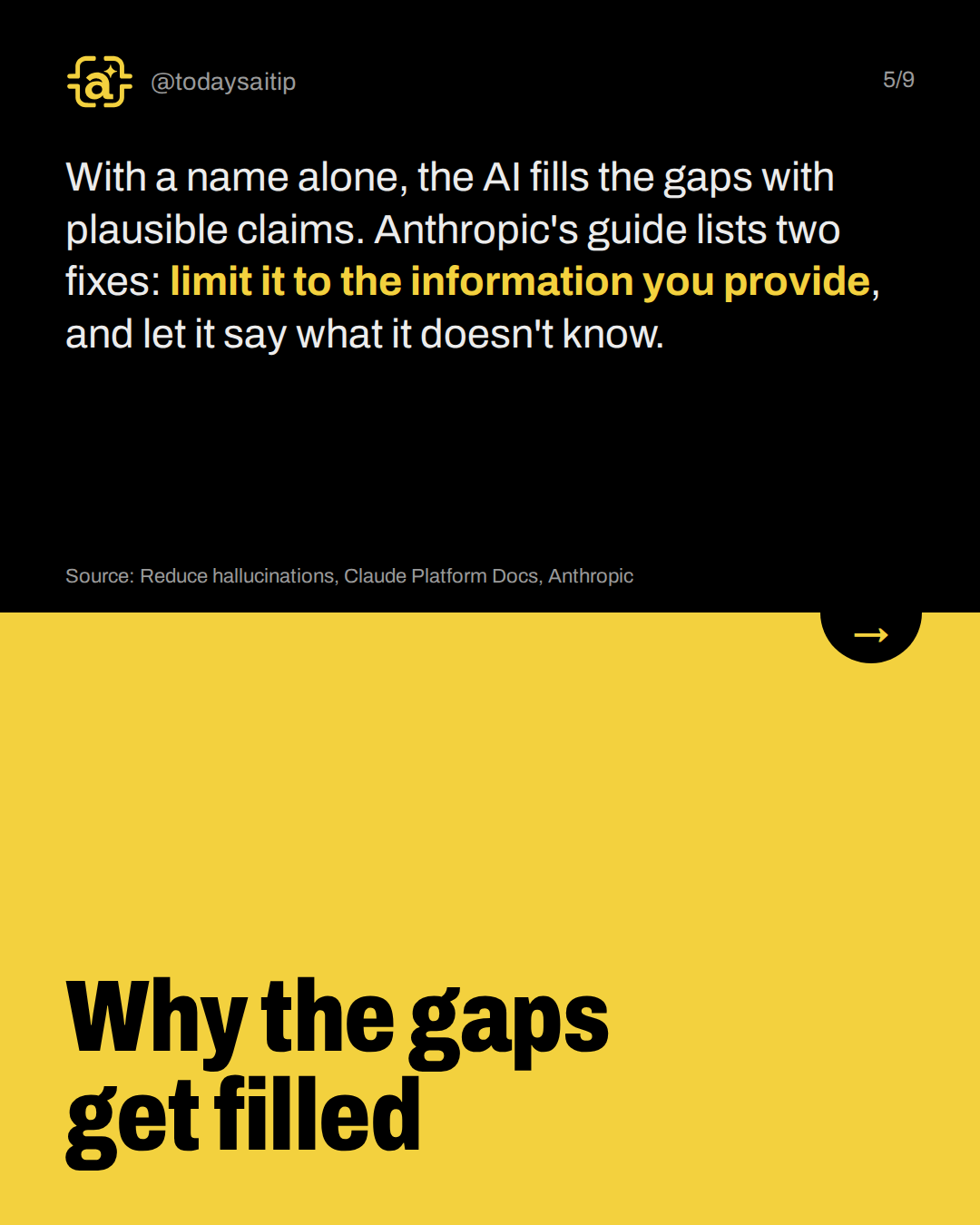
Why the gaps get filled
With a name alone, the AI fills the gaps with plausible claims. Anthropic's guide lists two fixes: limit it to the information you provide, and let it say what it doesn't know.
Source: Reduce hallucinations, Claude Platform Docs, Anthropic
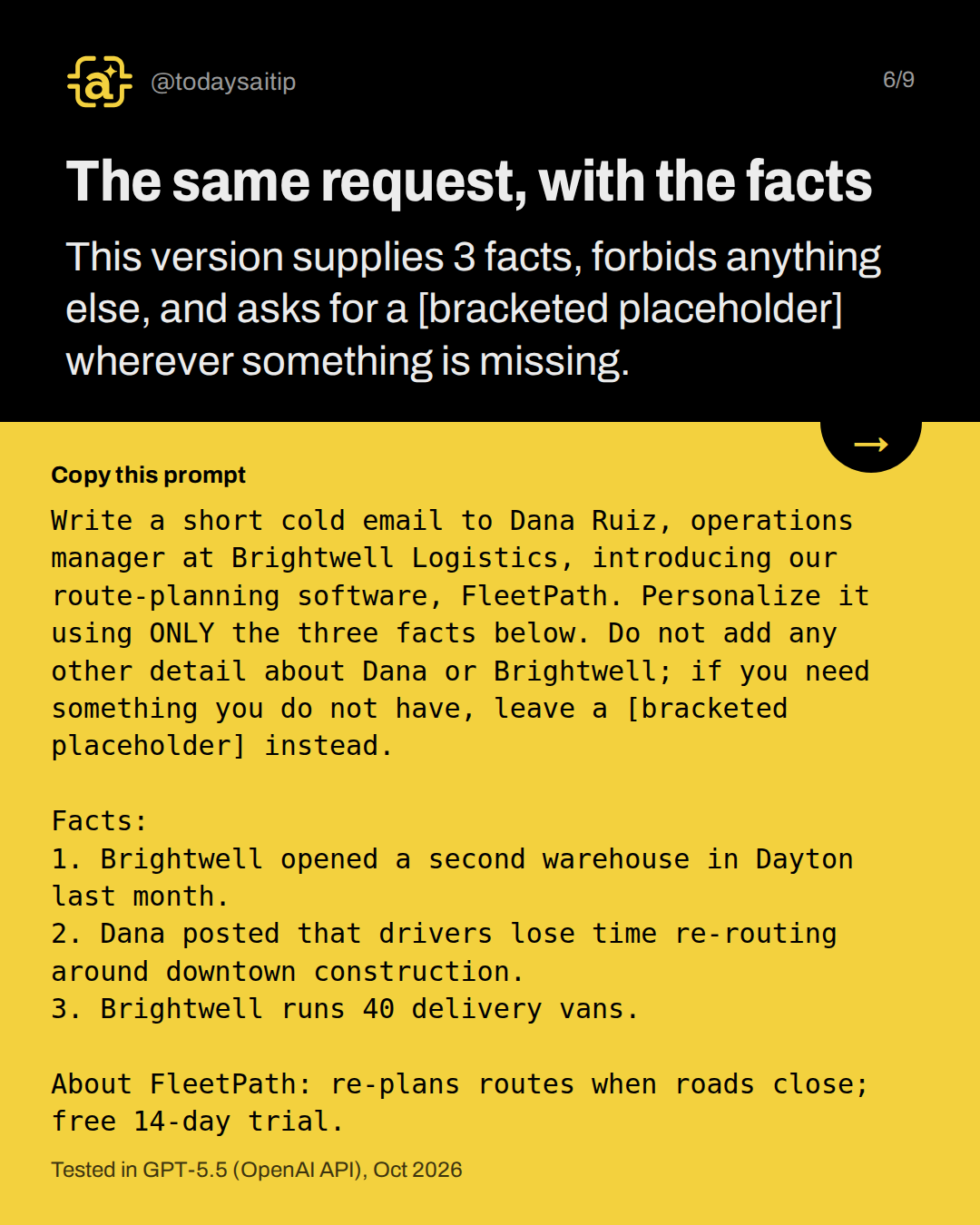
The same request, with the facts
Tested in GPT-5.5 (OpenAI API), Oct 2026
This version supplies 3 facts, forbids anything else, and asks for a [bracketed placeholder] wherever something is missing.
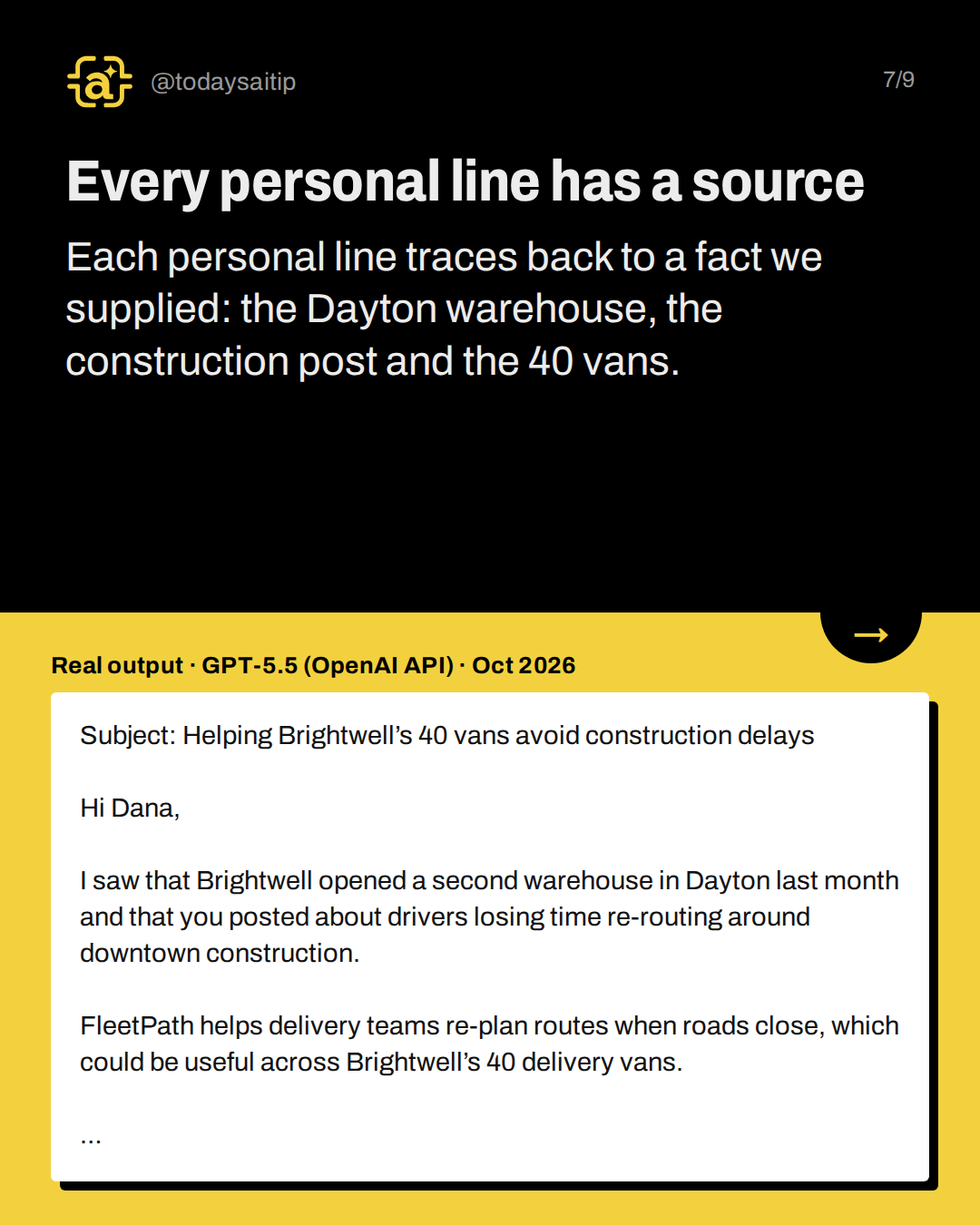
Every personal line has a source
Real output · GPT-5.5 (OpenAI API) · Oct 2026
Each personal line traces back to a fact we supplied: the Dayton warehouse, the construction post and the 40 vans.
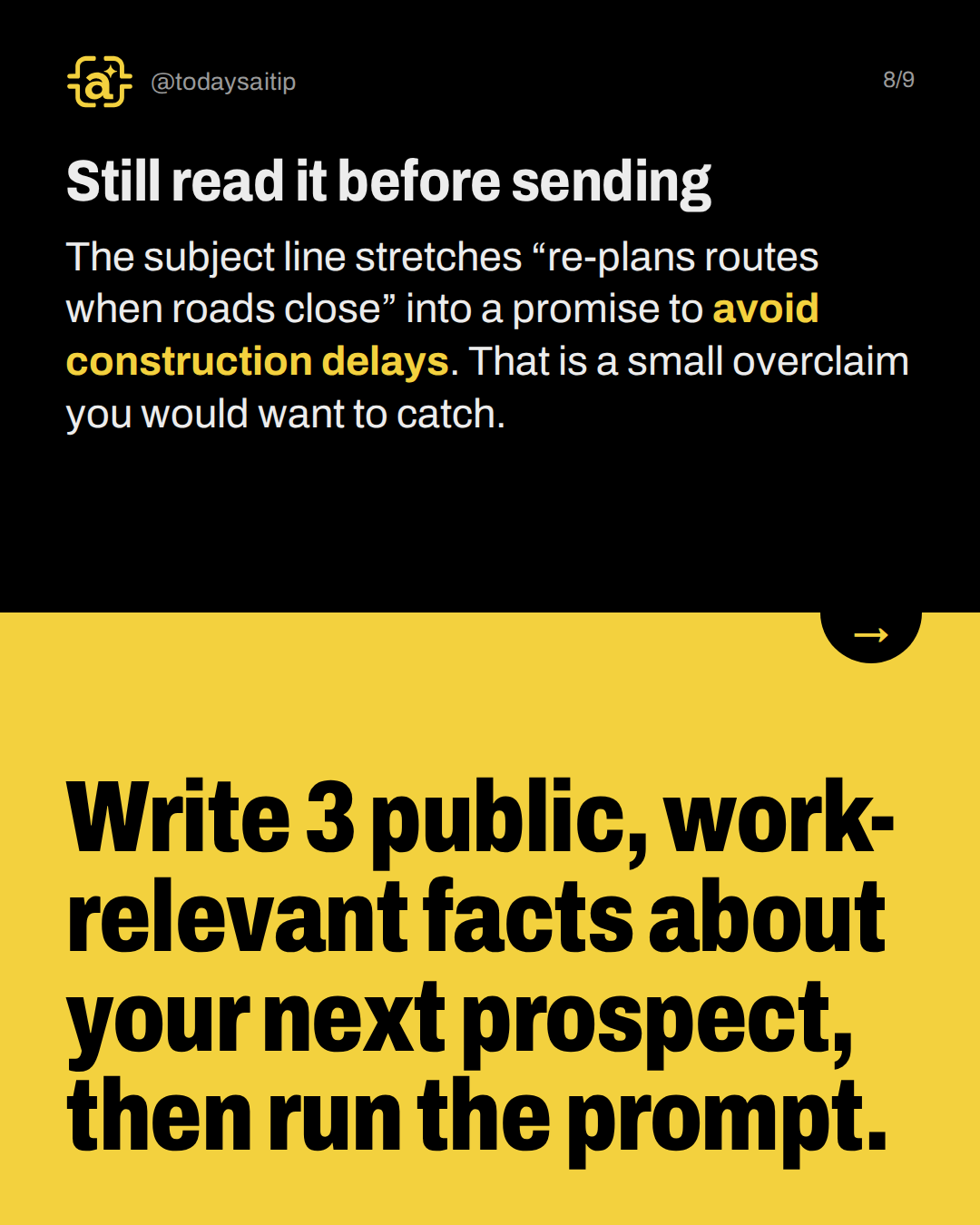
Still read it before sending
The subject line stretches “re-plans routes when roads close” into a promise to avoid construction delays. That is a small overclaim you would want to catch.
Try it: Write 3 public, work-relevant facts about your next prospect, then run the prompt.
Sources and assumptions
- Reduce hallucinations (Claude Platform Docs, Anthropic): Two separate bullets: 'Allow Claude to say "I don't know": Explicitly give Claude permission to admit uncertainty' (basic strategies) and 'External knowledge restriction: Explicitly instruct Claude to only use information from provided documents and not its general knowledge' (advanced techniques). Also the 'Verify with citations' example that marks removed claims with empty [] brackets, and the note that these techniques 'don't eliminate them entirely'. The guide is written for Claude; our test ran in GPT-5.5, so the post cites it as the technique's source, not as proof it works in GPT. (checked 2026-10-20)
Assumptions:
- Brightwell Logistics, Dana Ruiz, FleetPath and the 3 facts are fictional.
- Both runs used GPT-5.5 through the OpenAI API, one run each, on 2026-10-20 (UTC 2026-10-21). The label is 'GPT-5.5 (OpenAI API)', not the ChatGPT app. Results can vary between runs.
- Claude was not tested for this post: the claude -p test runs failed in this research session. The slides must not claim the prompt was tested in Claude.
- The 'before' prompt gave no product details beyond 'route-planning software, FleetPath', so every product benefit in that output was supplied by the model.
- The 'after' prompt's only product details were: 're-plans routes when roads close; free 14-day trial.'
The short version
- A name alone leaves the AI guessing.
- Give it 3 facts you know are true.
- Tell it to use only those facts.
- Ask for a [placeholder] where something is missing.
- Read the email before you send it.