 Today's AI Tip
Give AI permission to say I don't know. Then compare.
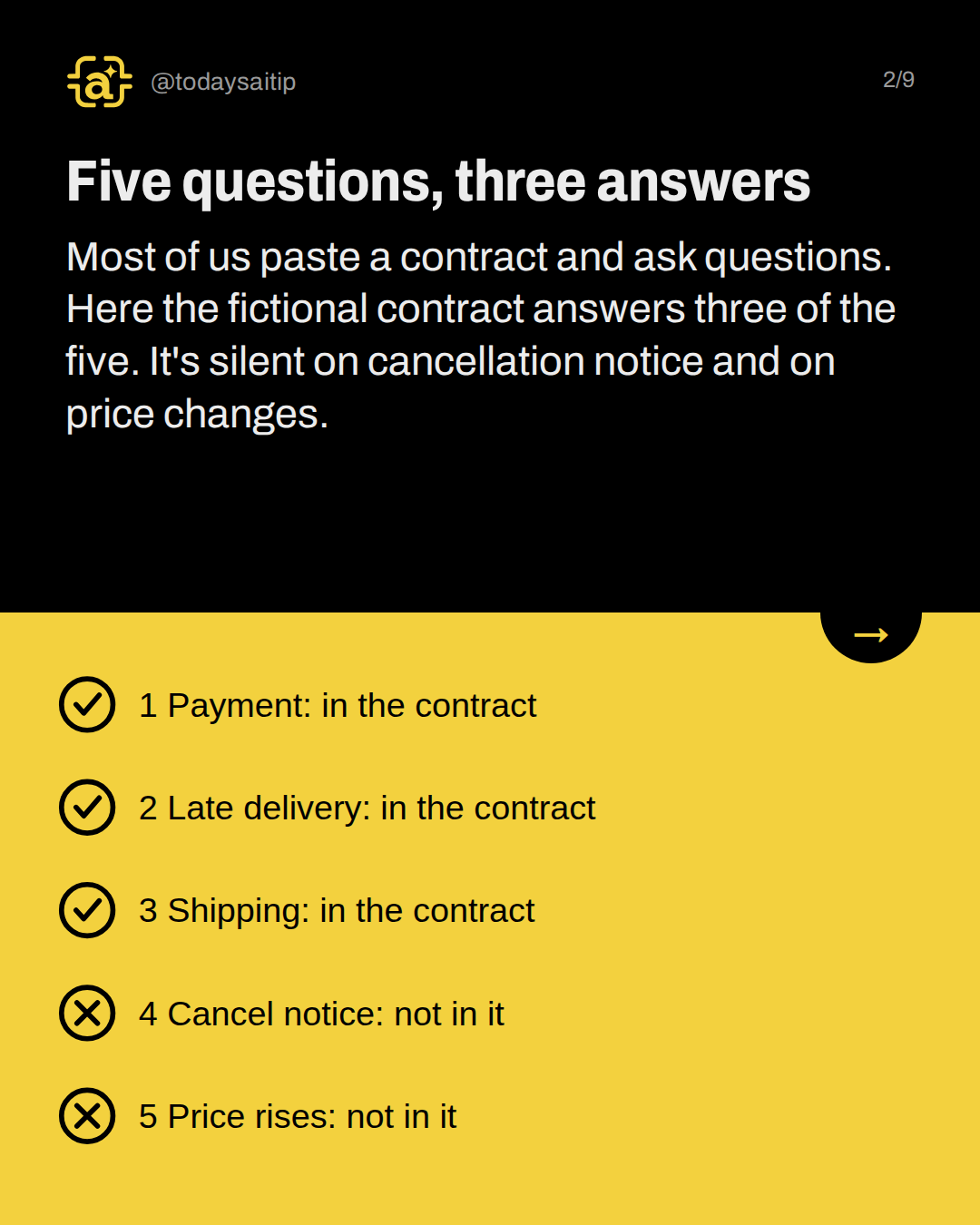
Five questions, three answers
Most of us paste a contract and ask questions. Here the fictional contract answers three of the five. It's silent on cancellation notice and on price changes.
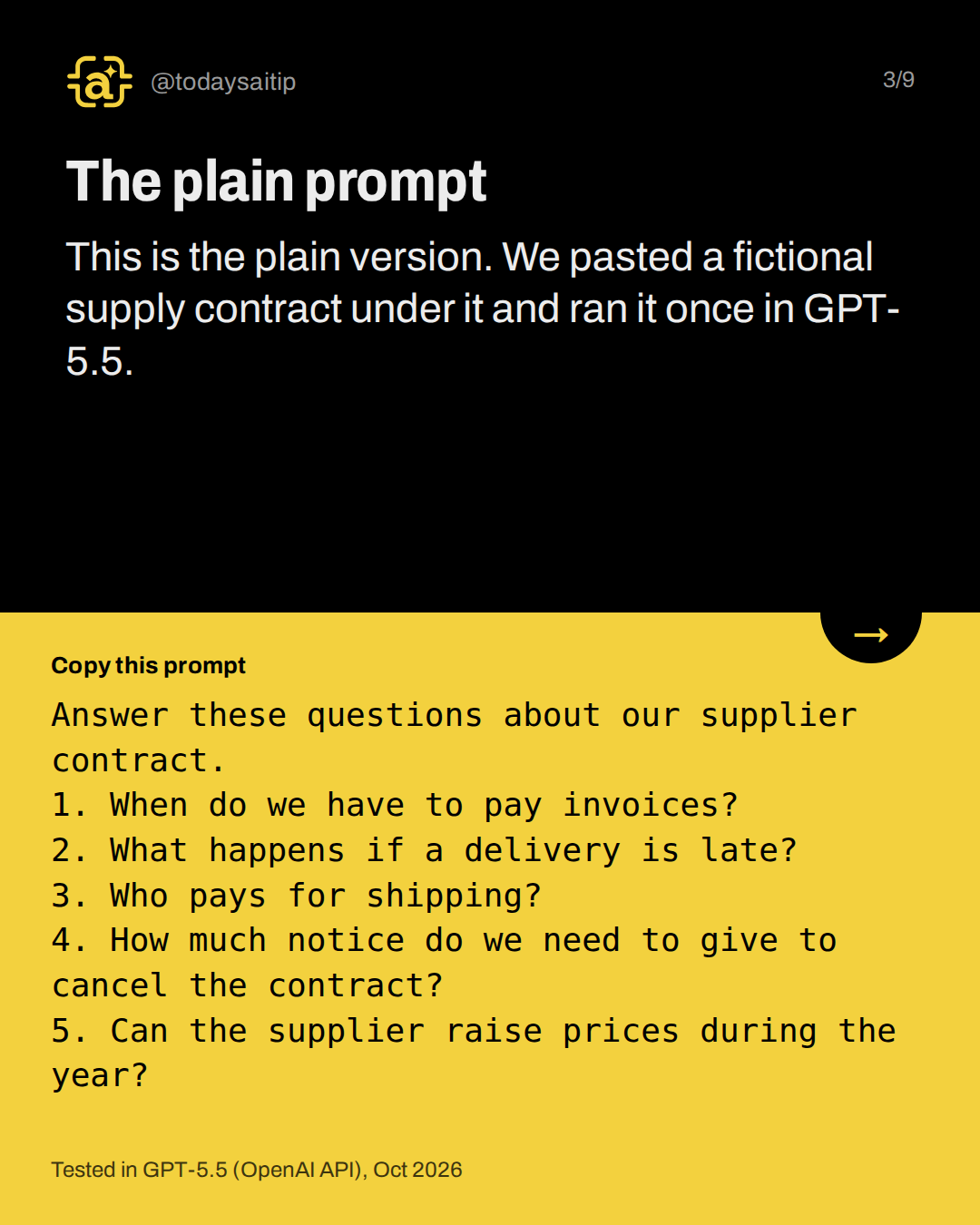
The plain prompt
Tested in GPT-5.5 (OpenAI API), Oct 2026
This is the plain version. We pasted a fictional supply contract under it and ran it once in GPT-5.5.
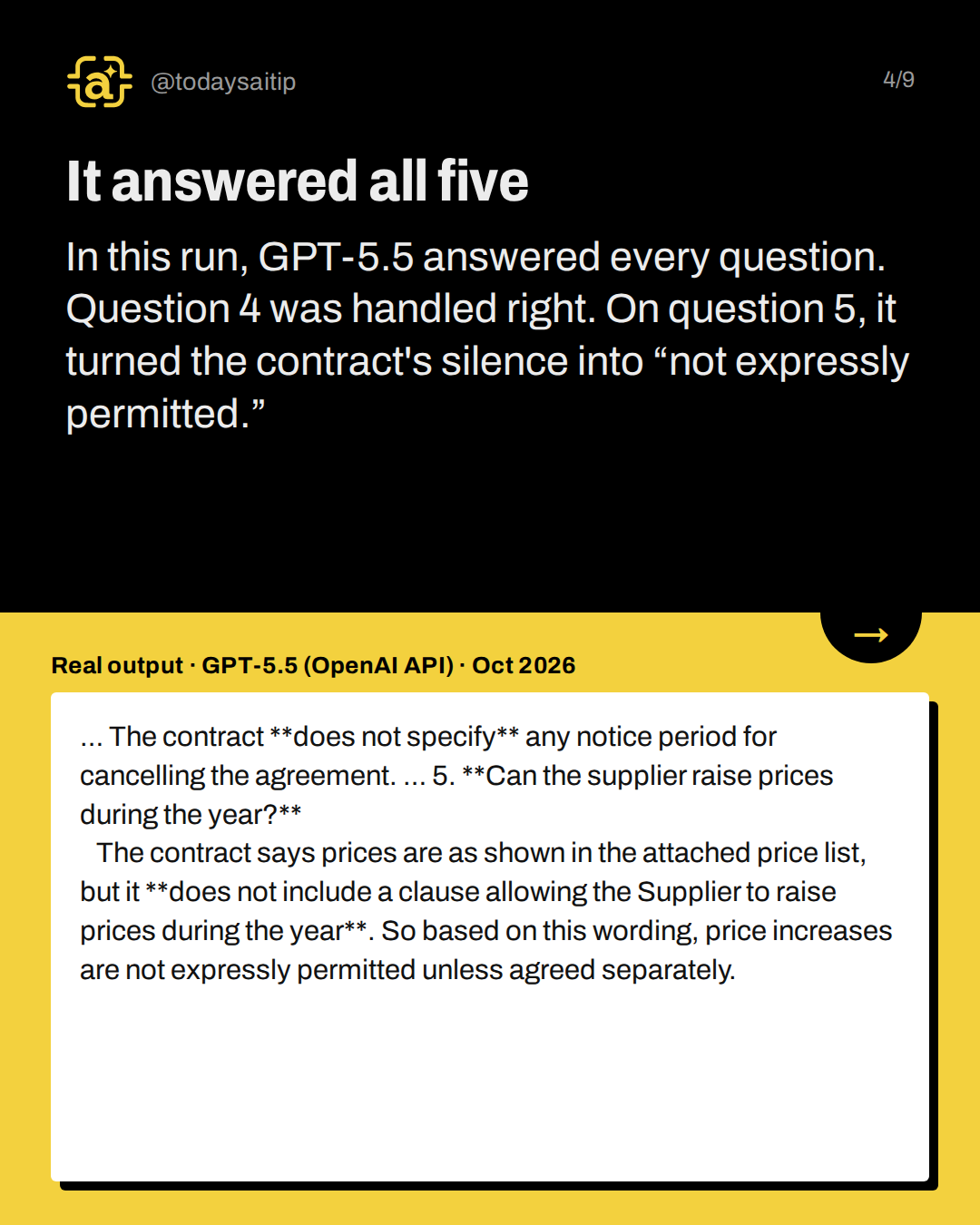
It answered all five
Real output · GPT-5.5 (OpenAI API) · Oct 2026
In this run, GPT-5.5 answered every question. Question 4 was handled right. On question 5, it turned the contract's silence into “not expressly permitted.”
Where the guess slipped in
Question 5 started right, then drew a conclusion the contract doesn't support. Silence isn't a no. In this run, 3 answers came from the contract, 1 was correctly flagged as unspecified, and 1 was an inference.
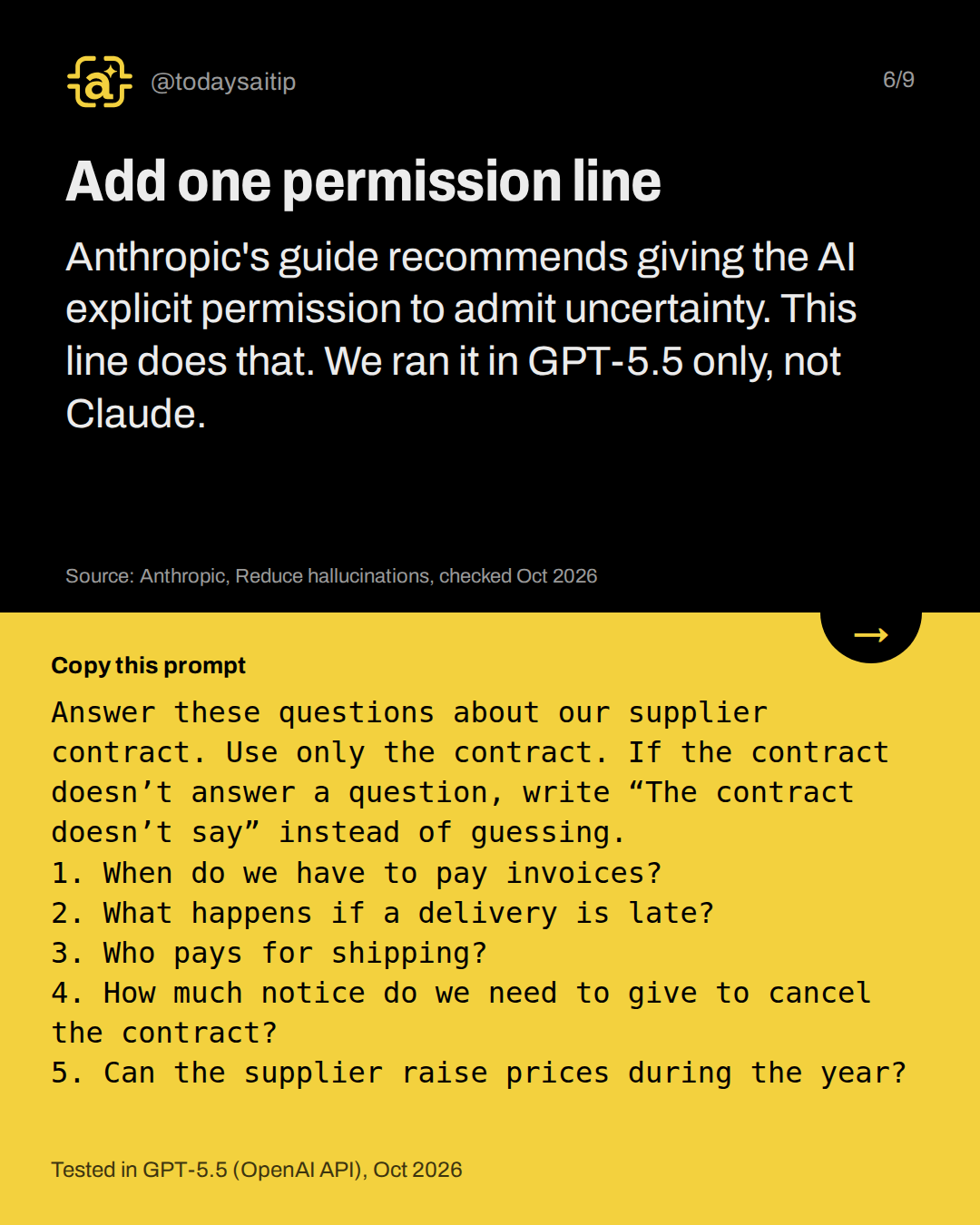
Add one permission line
Tested in GPT-5.5 (OpenAI API), Oct 2026
Anthropic's guide recommends giving the AI explicit permission to admit uncertainty. This line does that. We ran it in GPT-5.5 only, not Claude.
Source: Anthropic, Reduce hallucinations, checked Oct 2026
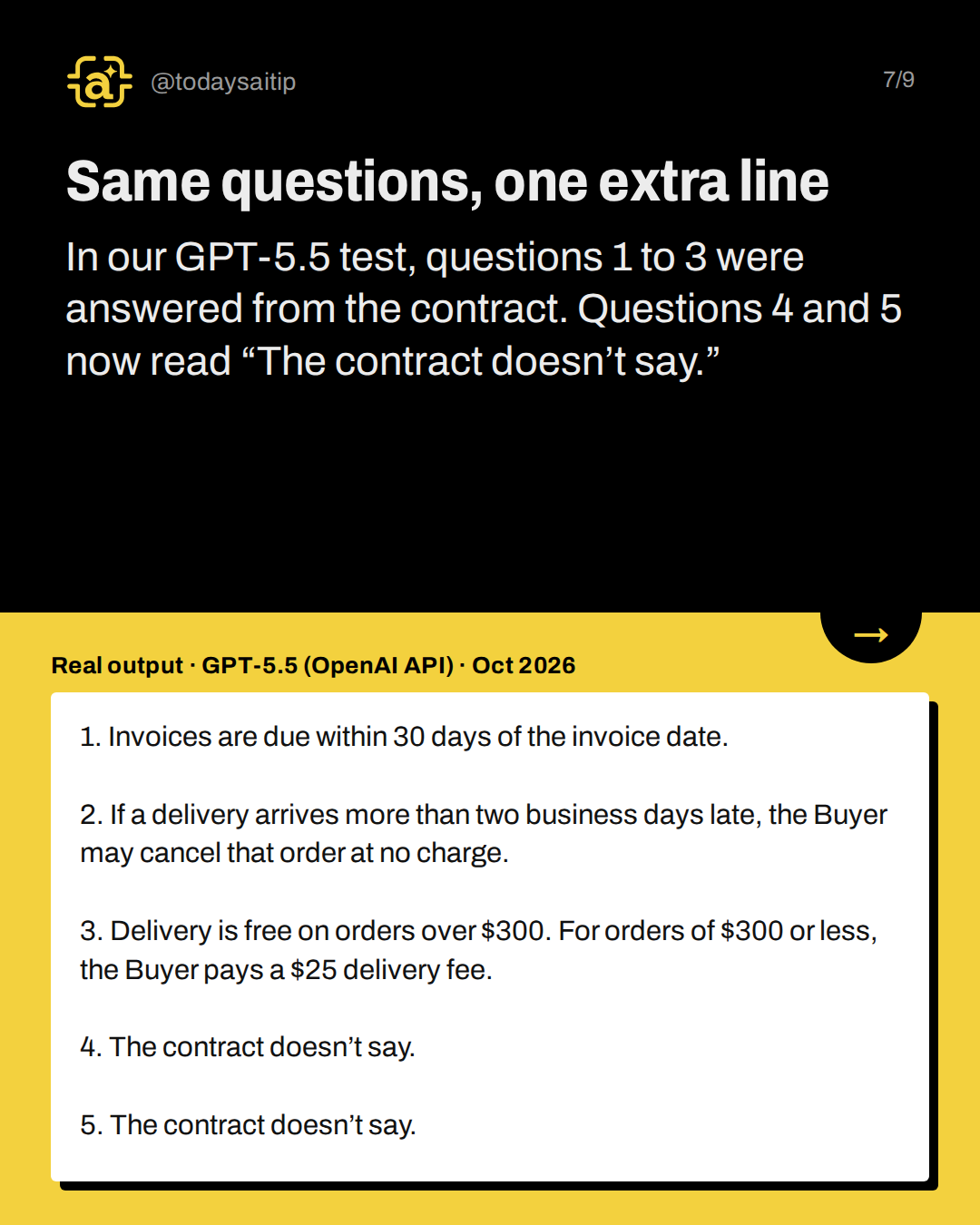
Same questions, one extra line
Real output · GPT-5.5 (OpenAI API) · Oct 2026
In our GPT-5.5 test, questions 1 to 3 were answered from the contract. Questions 4 and 5 now read “The contract doesn’t say.”
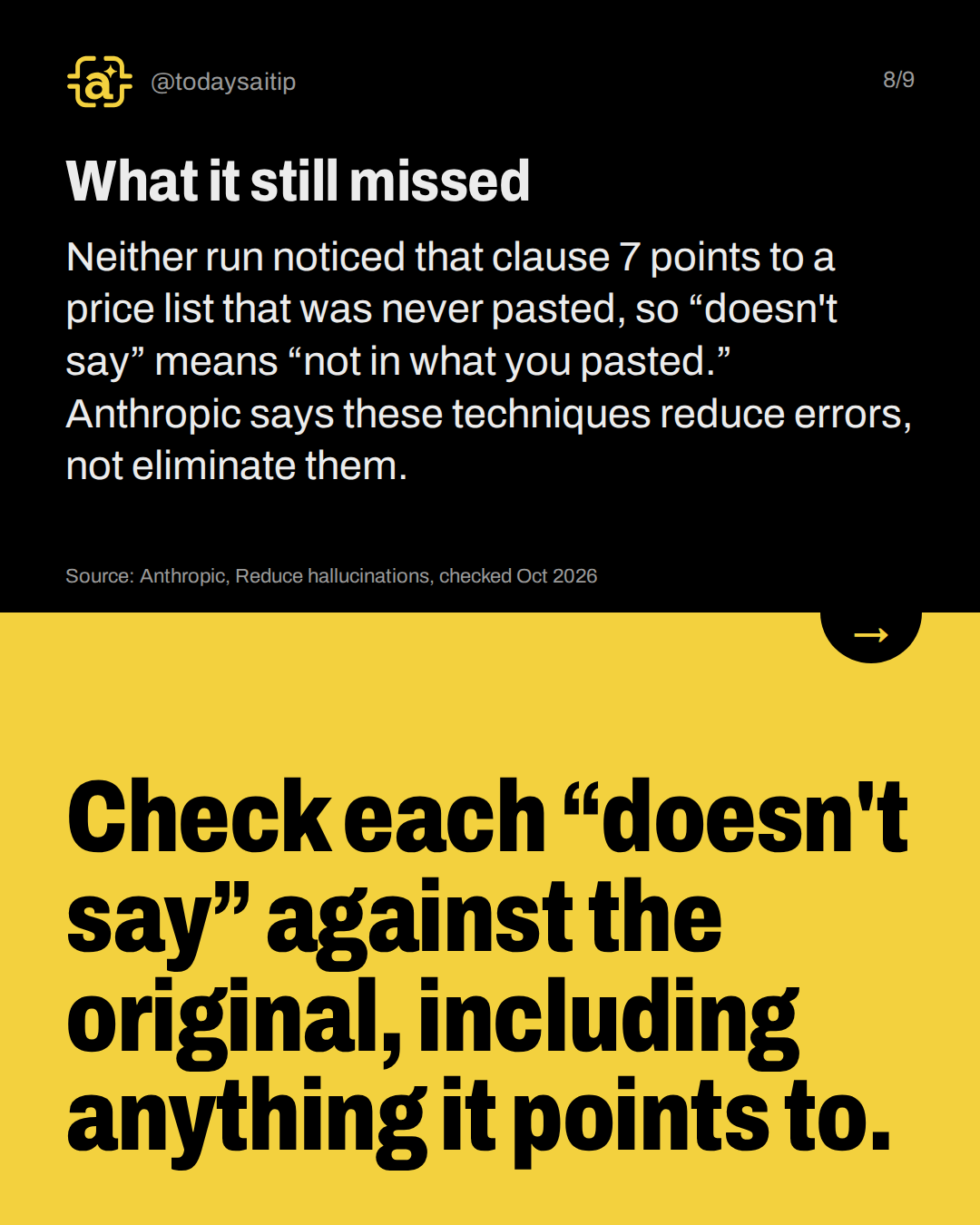
What it still missed
Neither run noticed that clause 7 points to a price list that was never pasted, so “doesn't say” means “not in what you pasted.” Anthropic says these techniques reduce errors, not eliminate them.
Try it: Check each “doesn't say” against the original, including anything it points to.
Source: Anthropic, Reduce hallucinations, checked Oct 2026
Sources and assumptions
- Anthropic Claude docs: Reduce hallucinations: Listed under 'Basic hallucination minimization strategies': 'Allow Claude to say "I don't know": Explicitly give Claude permission to admit uncertainty. This technique can drastically reduce false information.' Also the closing note: 'although these techniques significantly reduce hallucinations, they don't eliminate them entirely. Always validate critical information, especially for high-stakes decisions.' Also 'External knowledge restriction: Explicitly instruct Claude to only use information from provided documents.' (checked 2026-10-26)
Assumptions:
- The contract is fictional sample material written for this test (Brightwater Cafes Ltd / Oakfield Paper Goods). No real parties or data.
- The tool tested is GPT-5.5 through the OpenAI API, one run per prompt, in Oct 2026 (ran_at 2026-10-27T02:04Z UTC). It isn't the ChatGPT app, and results can vary run to run.
- The Claude runs in record.tests ('before', 'after') failed to execute in the research session and have no output. The post must not claim any Claude result. The Anthropic guidance is cited as written for Claude and was not tested on Claude here.
- The 'ping' entry in tests.json was a connectivity check and isn't part of the post.
- Calling Q5 a guess is our editorial reading: the contract has no price-change clause either way, so 'not expressly permitted unless agreed separately' is an inference, not something the contract states. The post must not say what the legal answer actually is.
The short version
- A plain prompt turned silence into an answer.
- One line let it say the contract doesn't say.
- Both runs missed the unpasted price list.
- Check each “doesn't say” against the original.