 Today's AI Tip
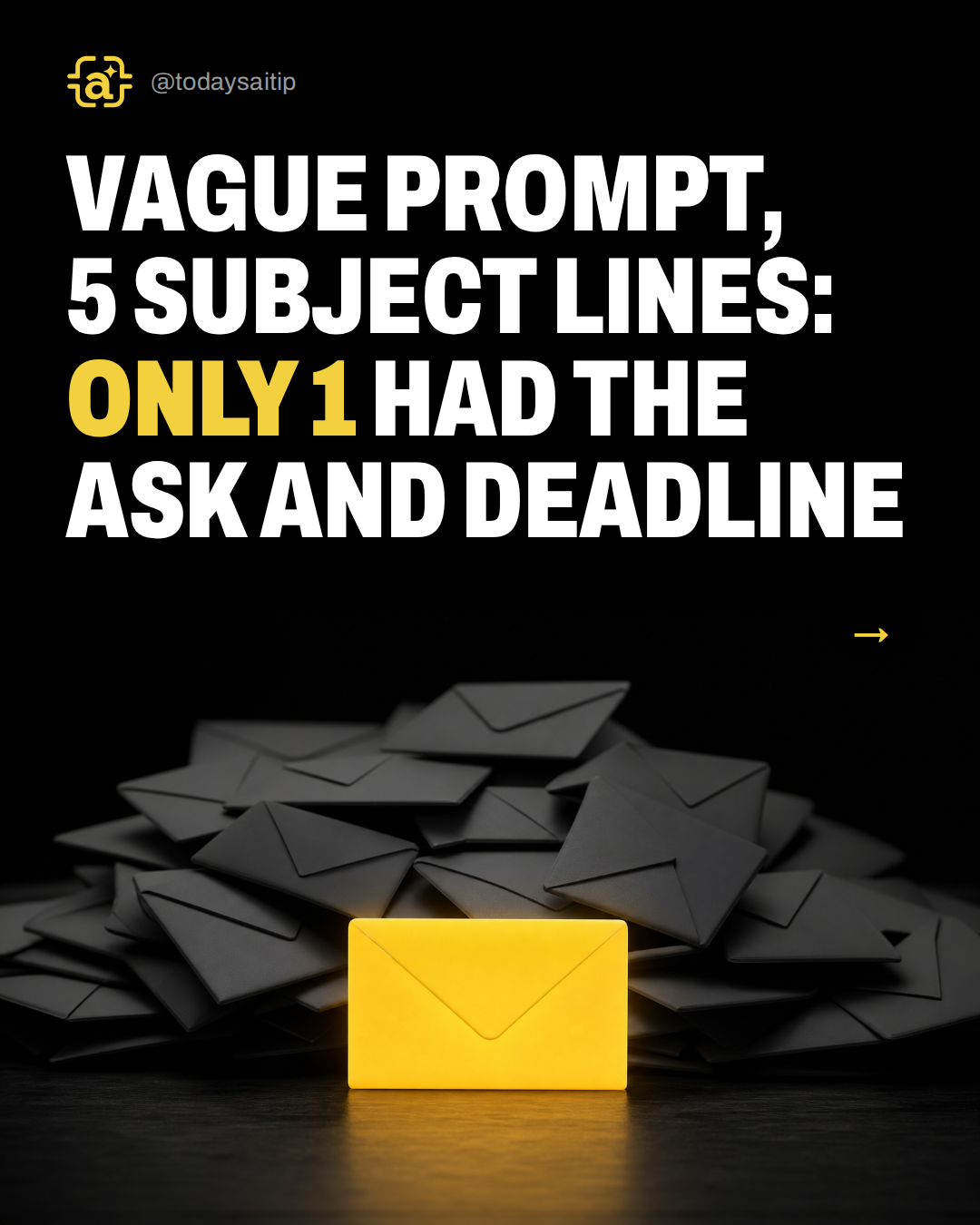
Vague prompt, 5 subject lines: only 1 had the ask and deadline
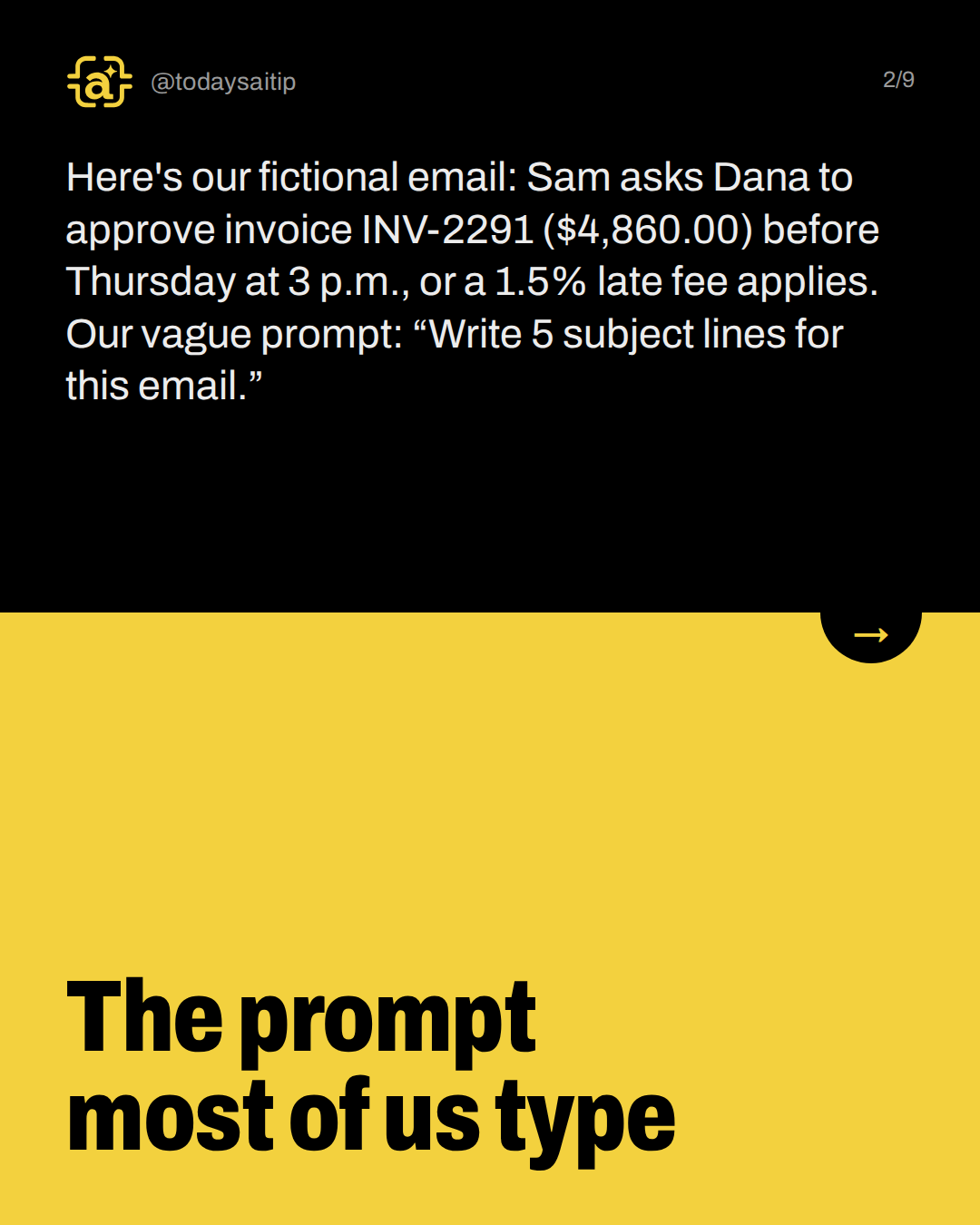
The prompt most of us type
Here's our fictional email: Sam asks Dana to approve invoice INV-2291 ($4,860.00) before Thursday at 3 p.m., or a 1.5% late fee applies. Our vague prompt: “Write 5 subject lines for this email.”
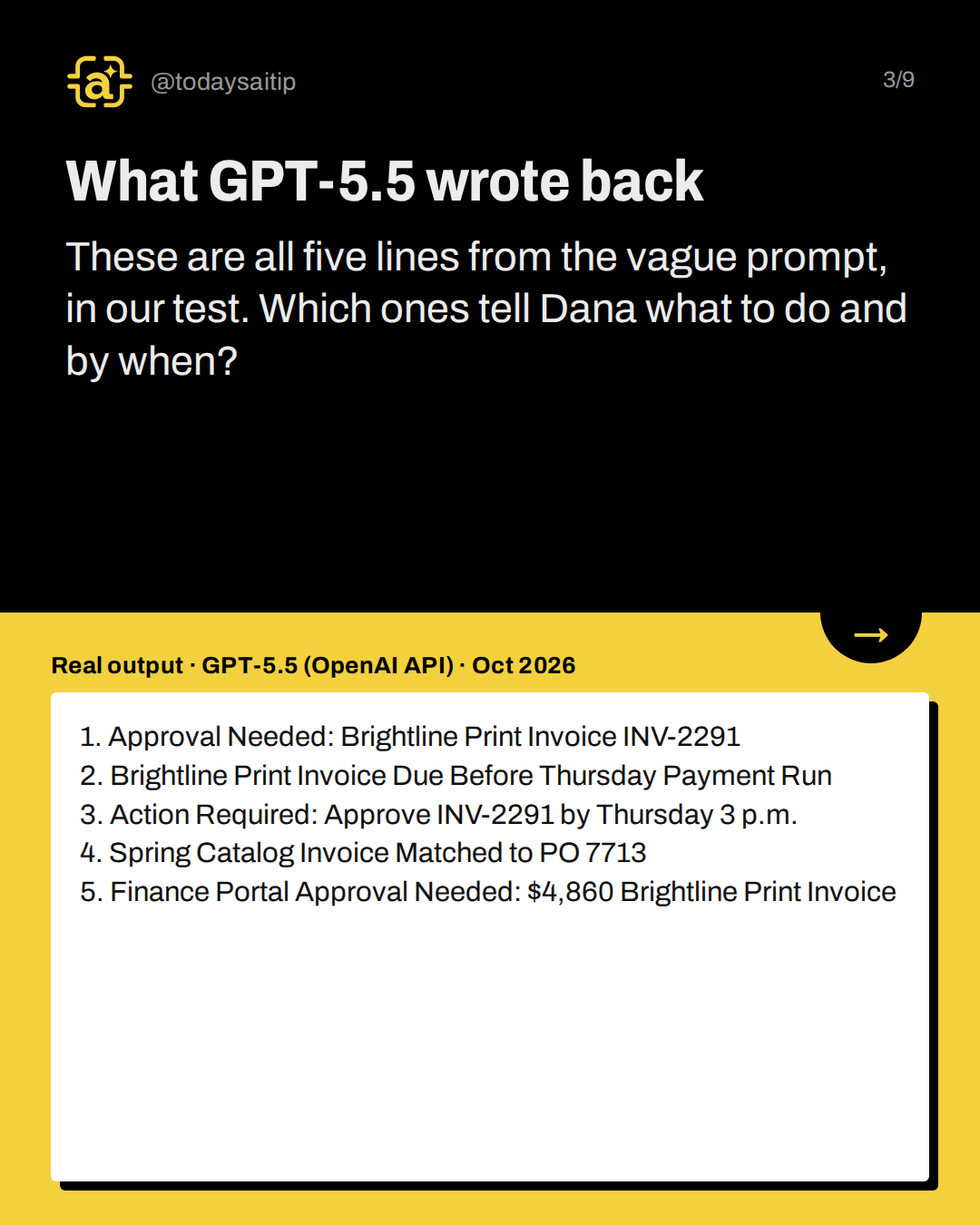
What GPT-5.5 wrote back
Real output · GPT-5.5 (OpenAI API) · Oct 2026
These are all five lines from the vague prompt, in our test. Which ones tell Dana what to do and by when?
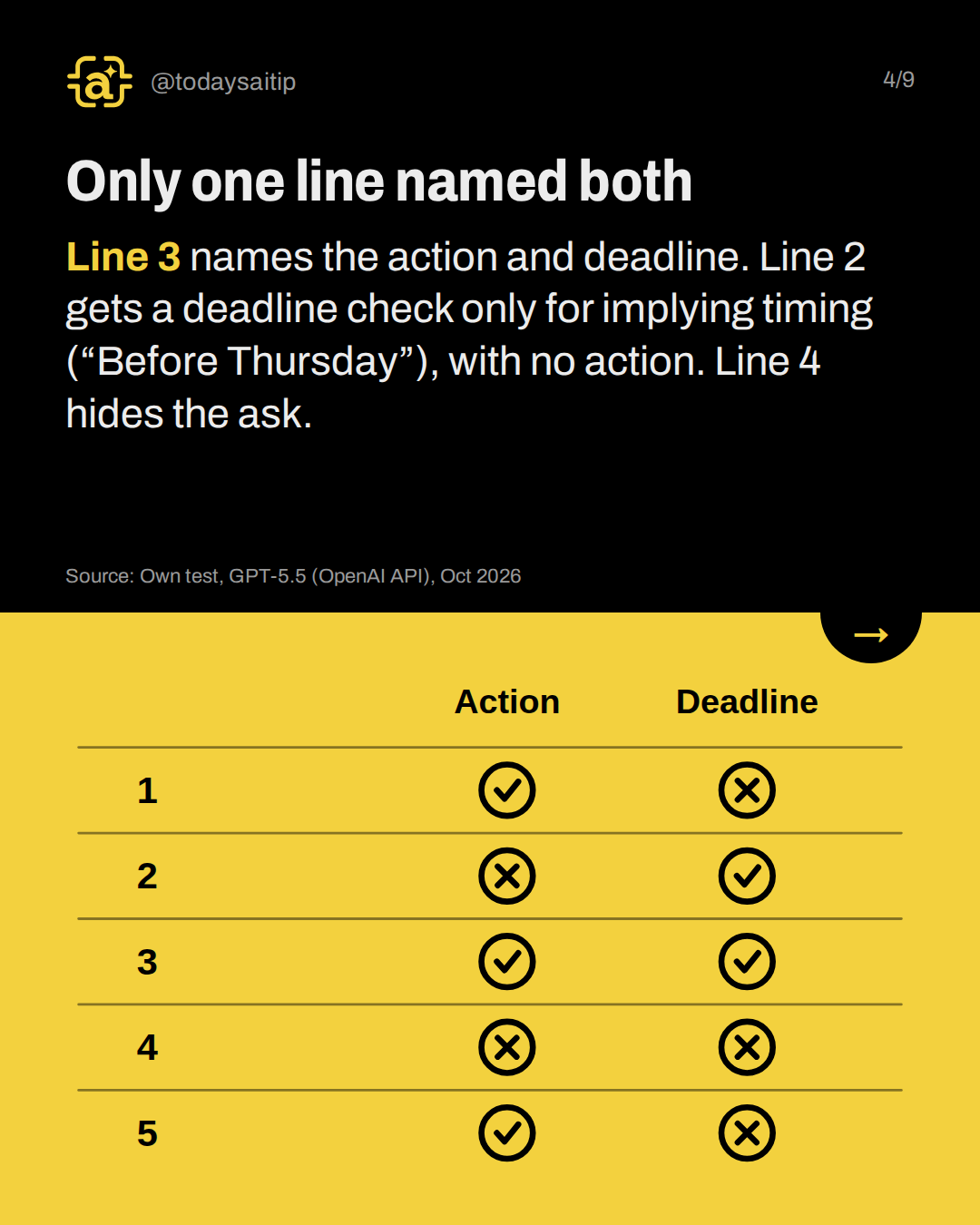
Only one line named both
Line 3 names the action and deadline. Line 2 gets a deadline check only for implying timing (“Before Thursday”), with no action. Line 4 hides the ask.
Source: Own test, GPT-5.5 (OpenAI API), Oct 2026
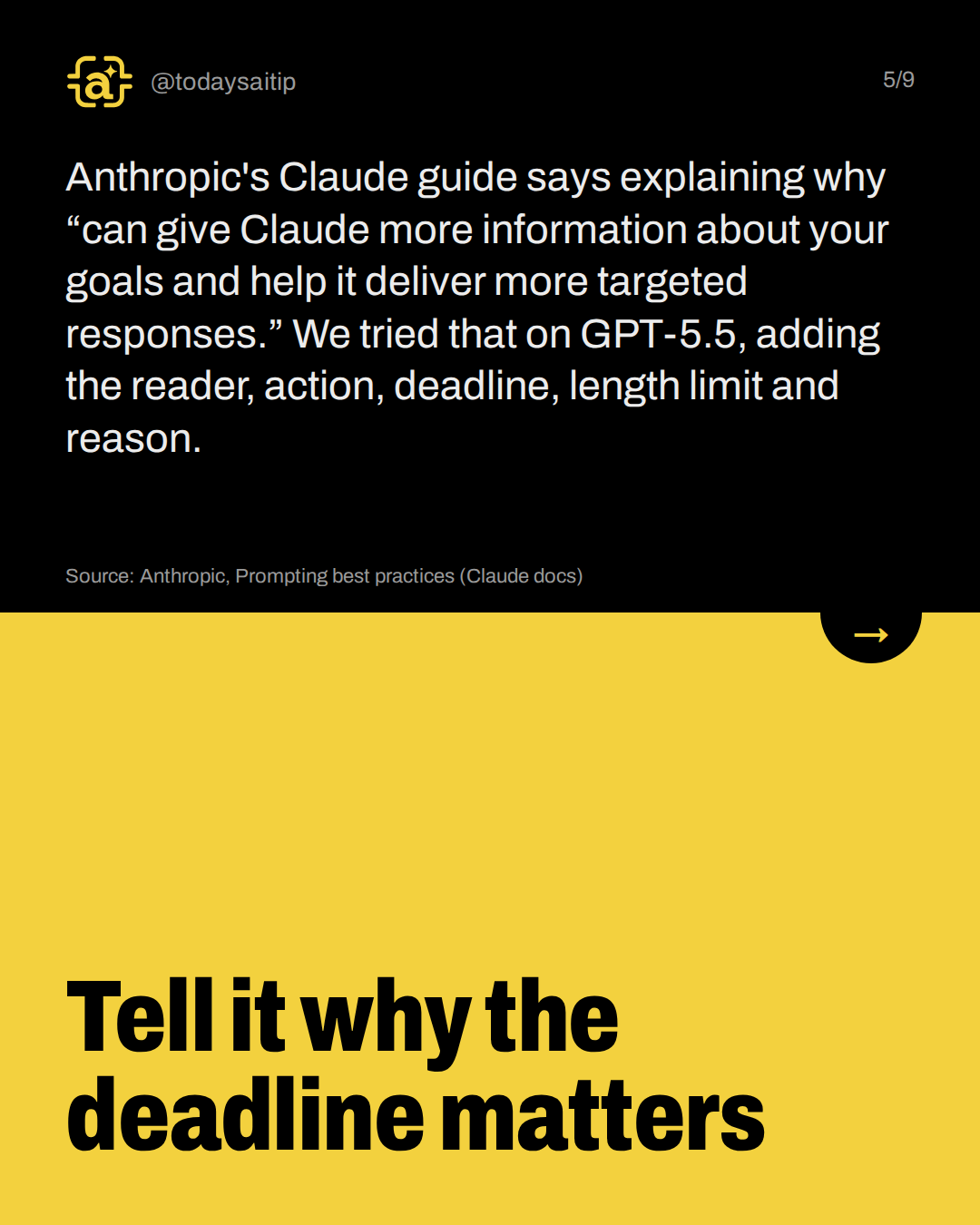
Tell it why the deadline matters
Anthropic's Claude guide says explaining why “can give Claude more information about your goals and help it deliver more targeted responses.” We tried that on GPT-5.5, adding the reader, action, deadline, length limit and reason.
Source: Anthropic, Prompting best practices (Claude docs)
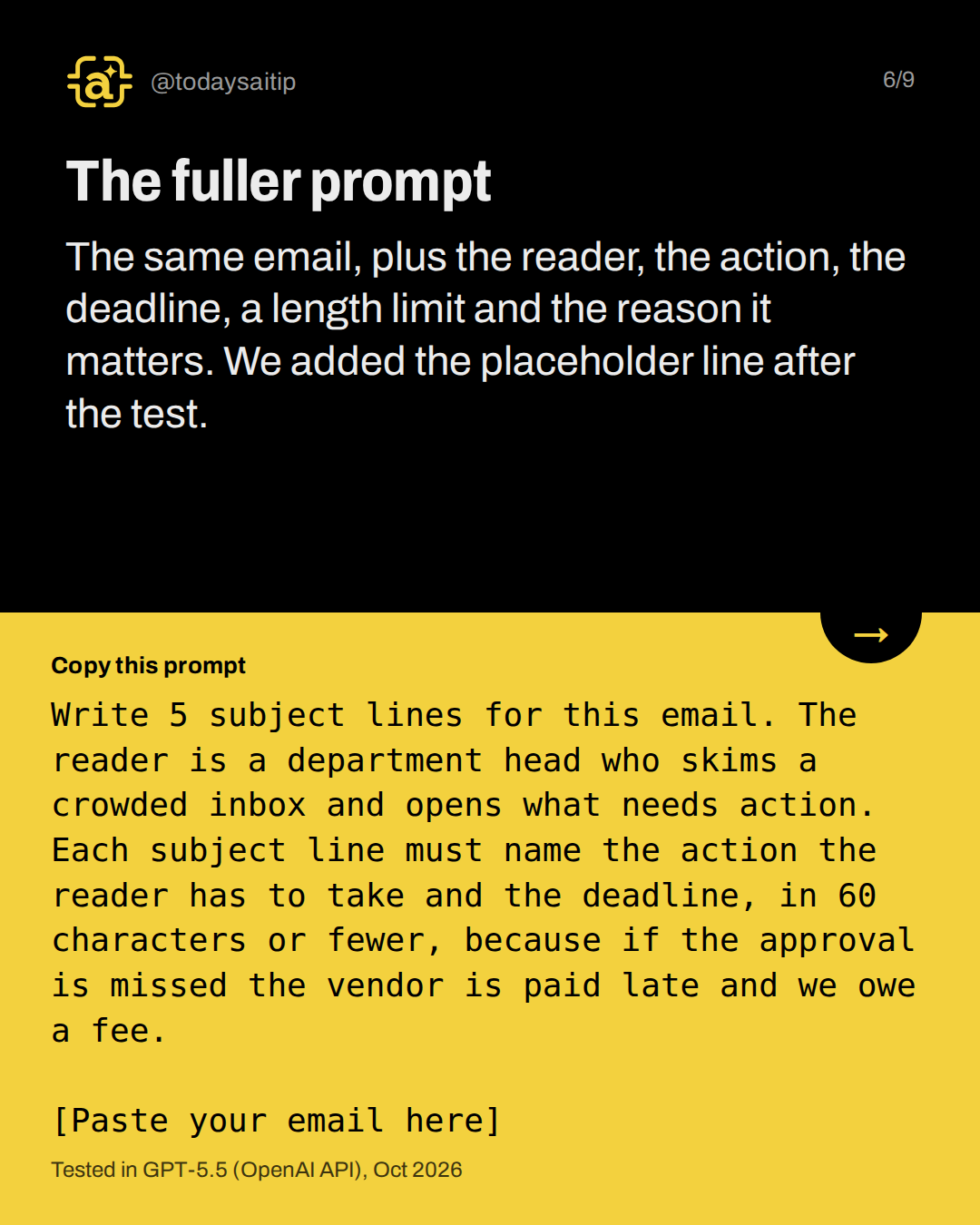
The fuller prompt
Tested in GPT-5.5 (OpenAI API), Oct 2026
The same email, plus the reader, the action, the deadline, a length limit and the reason it matters. We added the placeholder line after the test.
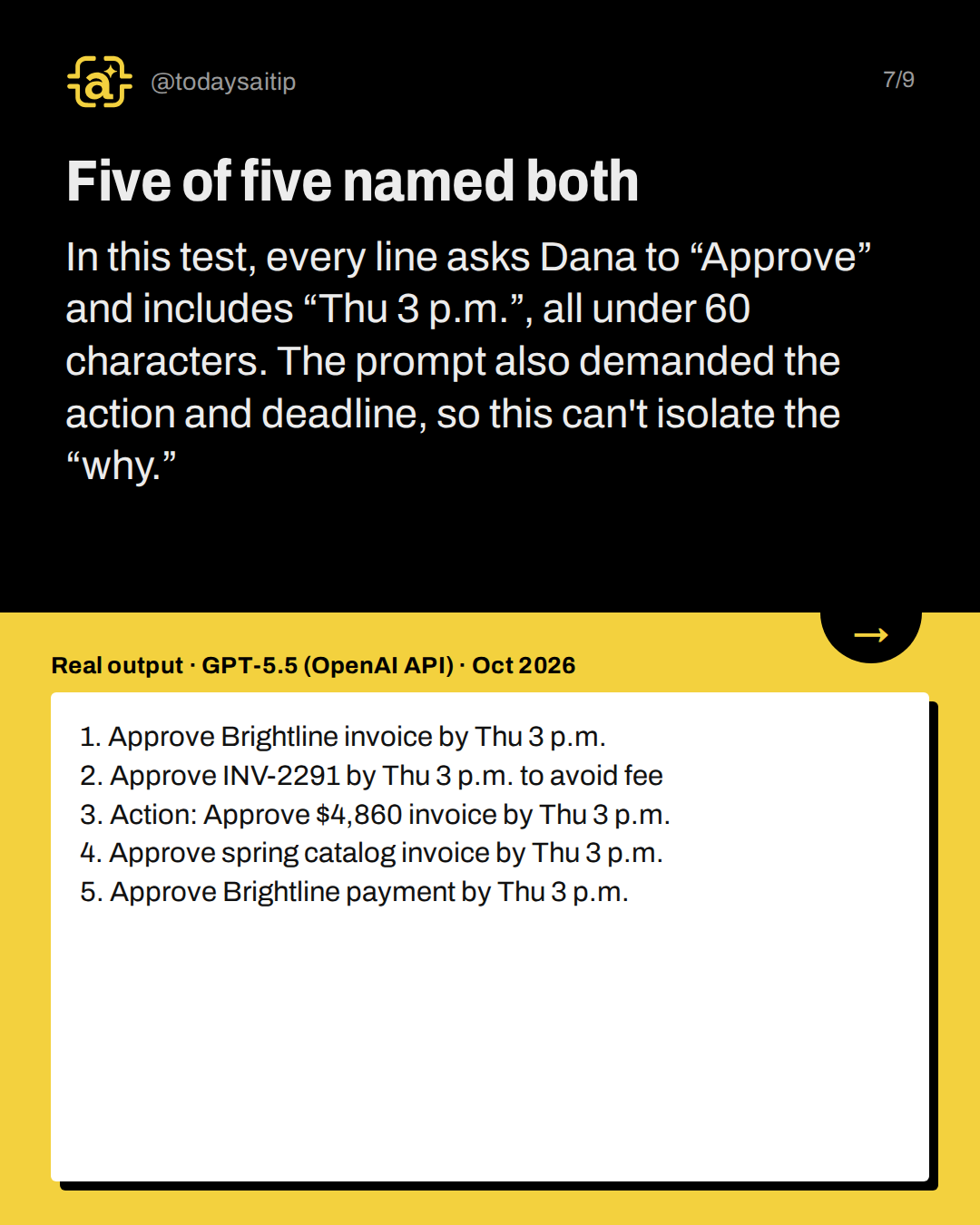
Five of five named both
Real output · GPT-5.5 (OpenAI API) · Oct 2026
In this test, every line asks Dana to “Approve” and includes “Thu 3 p.m.”, all under 60 characters. The prompt also demanded the action and deadline, so this can't isolate the “why.”
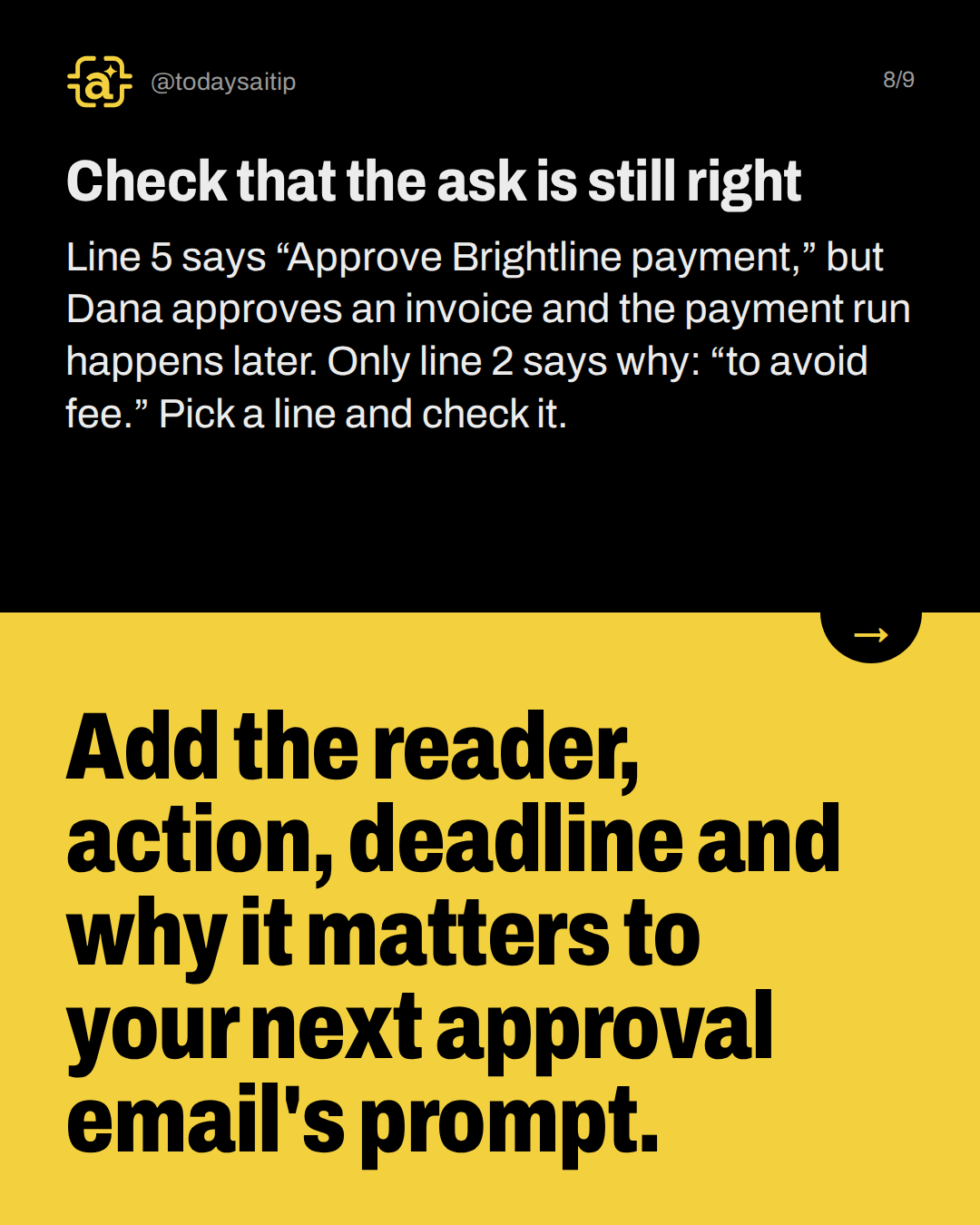
Check that the ask is still right
Line 5 says “Approve Brightline payment,” but Dana approves an invoice and the payment run happens later. Only line 2 says why: “to avoid fee.” Pick a line and check it.
Try it: Add the reader, action, deadline and why it matters to your next approval email's prompt.
Sources and assumptions
- Anthropic, Prompting best practices (Claude docs), section 'Add context to improve performance': Verbatim: 'Providing context or motivation behind your instructions, such as explaining to Claude why such behavior is important, can give Claude more information about your goals and help it deliver more targeted responses.' (checked 2026-10-28)
- Anthropic, Prompting best practices (Claude docs), section 'Be clear and direct': Verbatim: 'Claude responds well to clear, explicit instructions. Being specific about the output you want can help enhance results.' and 'Think of Claude as a brilliant but new employee who lacks context on your norms and workflows.' (checked 2026-10-28)
- Own test: engine/ai-test.js, GPT-5.5 (OpenAI API), runs 'before' and 'after': The real subject-line outputs quoted on slides 3, 4, 6 and 7 come from record.tests ids 'before' and 'after' (label GPT-5.5 (OpenAI API), ran 2026-10-29T02:01Z UTC = 2026-10-28 evening local) (checked 2026-10-28)
Assumptions:
- The email is fictional (Brightline Print, Dana, Sam Ortiz, INV-2291, PO 7713, $4,860.00, a 1.5% late fee). No real data.
- The test ran only on GPT-5.5 through the OpenAI API, not the ChatGPT app and not Claude. The planned Claude runs failed to start in the research environment, so tests.json holds two failed Claude entries with output null. The draft must use only the two GPT-5.5 entries and must not say the prompt was tested in Claude.
- The Anthropic guide is written for Claude models. The slides present it as Anthropic's general prompting advice, and the GPT-5.5 test is the evidence that it helped here. No claim that OpenAI's documentation says the same.
- Each prompt was run once. AI outputs vary from run to run, so the slides should say 'in this test'.
- 'All under 60 characters' for the after set was counted by hand. The longest line, 'Approve INV-2291 by Thu 3 p.m. to avoid fee', is about 44 characters.
The short version
- In our test, a vague prompt gave 1 of 5 lines with both ask and deadline.
- Name the reader, the action and the deadline.
- Add why the deadline matters.
- Check that the line names the right action.