 Today's AI Tip
Don't just describe the format you want. Paste last week's instead.

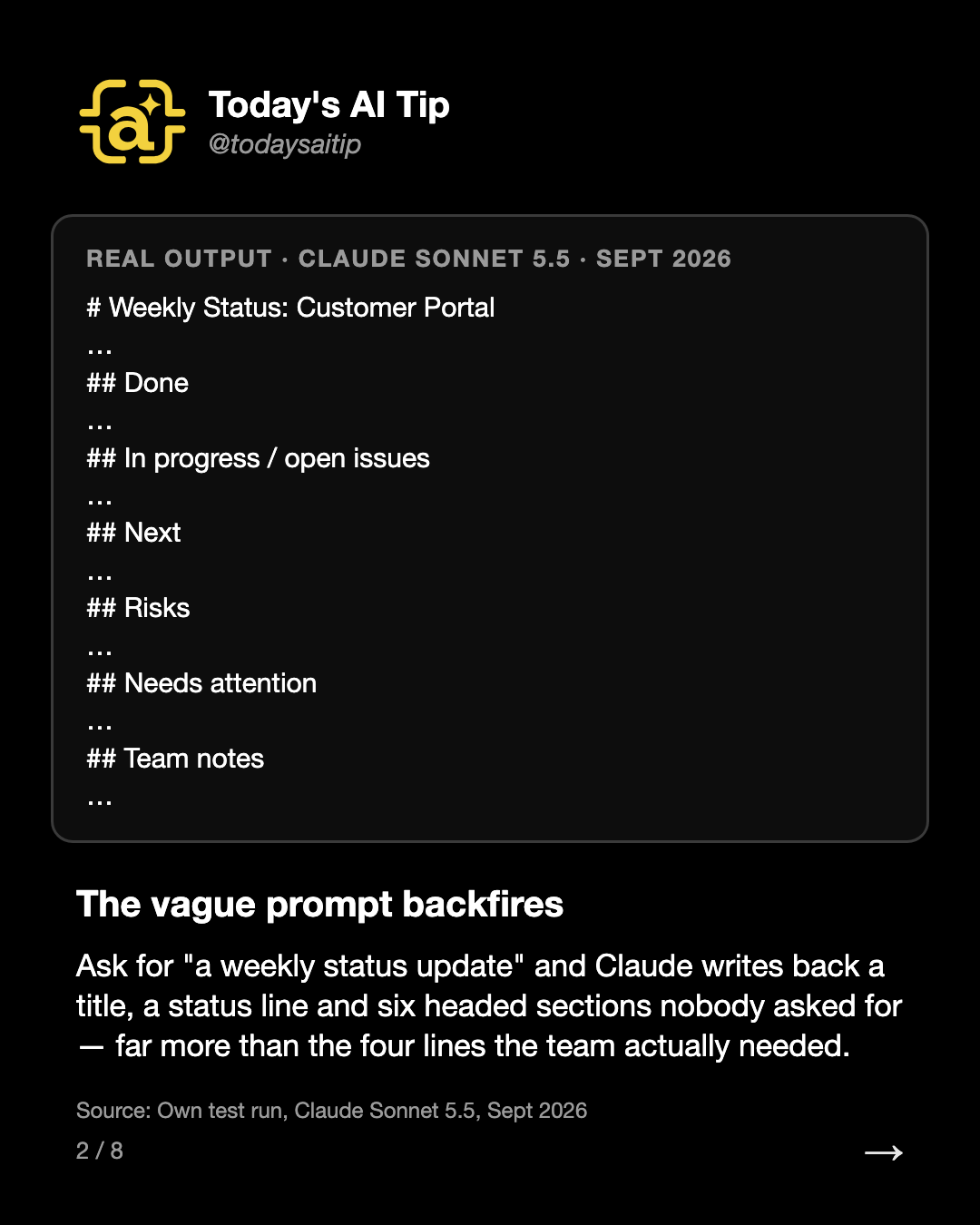
The vague prompt backfires
Real output · Claude Sonnet 5.5 · Sept 2026
Ask for "a weekly status update" and Claude writes back a title, a status line and six headed sections nobody asked for — far more than the four lines the team actually needed.
Source: Own test run, Claude Sonnet 5.5, Sept 2026
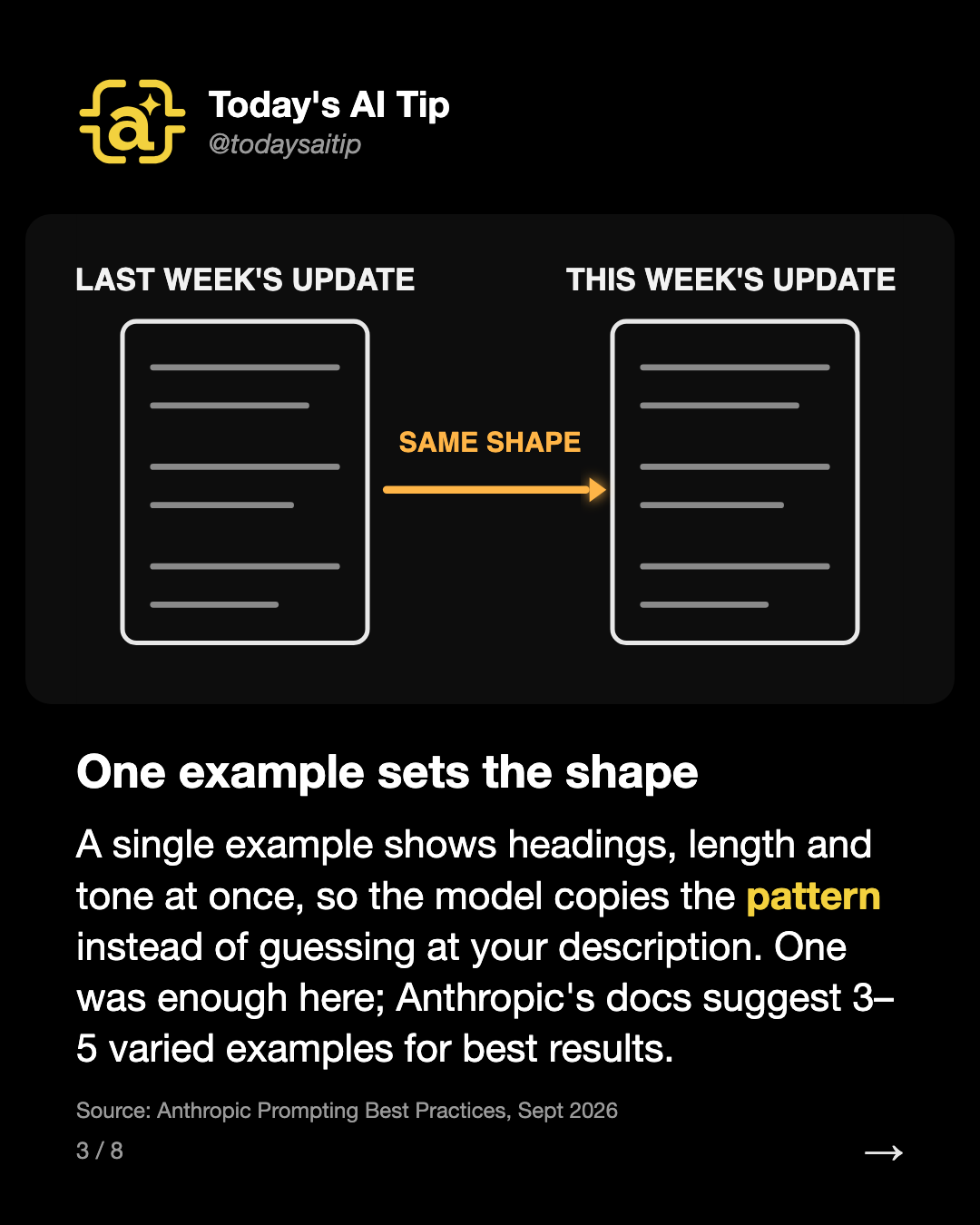
One example sets the shape
A single example shows headings, length and tone at once, so the model copies the pattern instead of guessing at your description. One was enough here; Anthropic's docs suggest 3–5 varied examples for best results.
Source: Anthropic Prompting Best Practices, Sept 2026
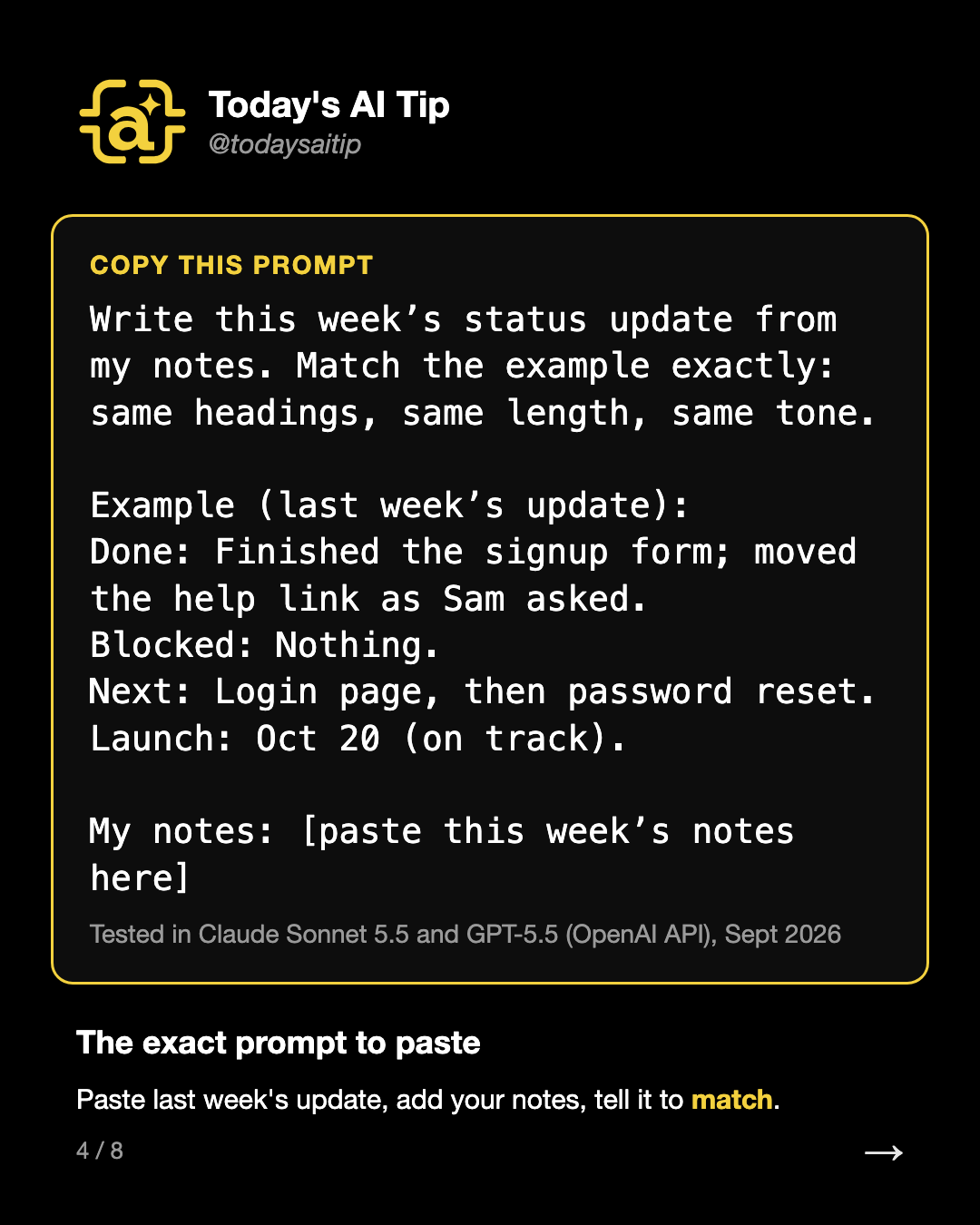
The exact prompt to paste
Tested in Claude Sonnet 5.5 and GPT-5.5 (OpenAI API), Sept 2026
Paste last week's update, add your notes, tell it to match.
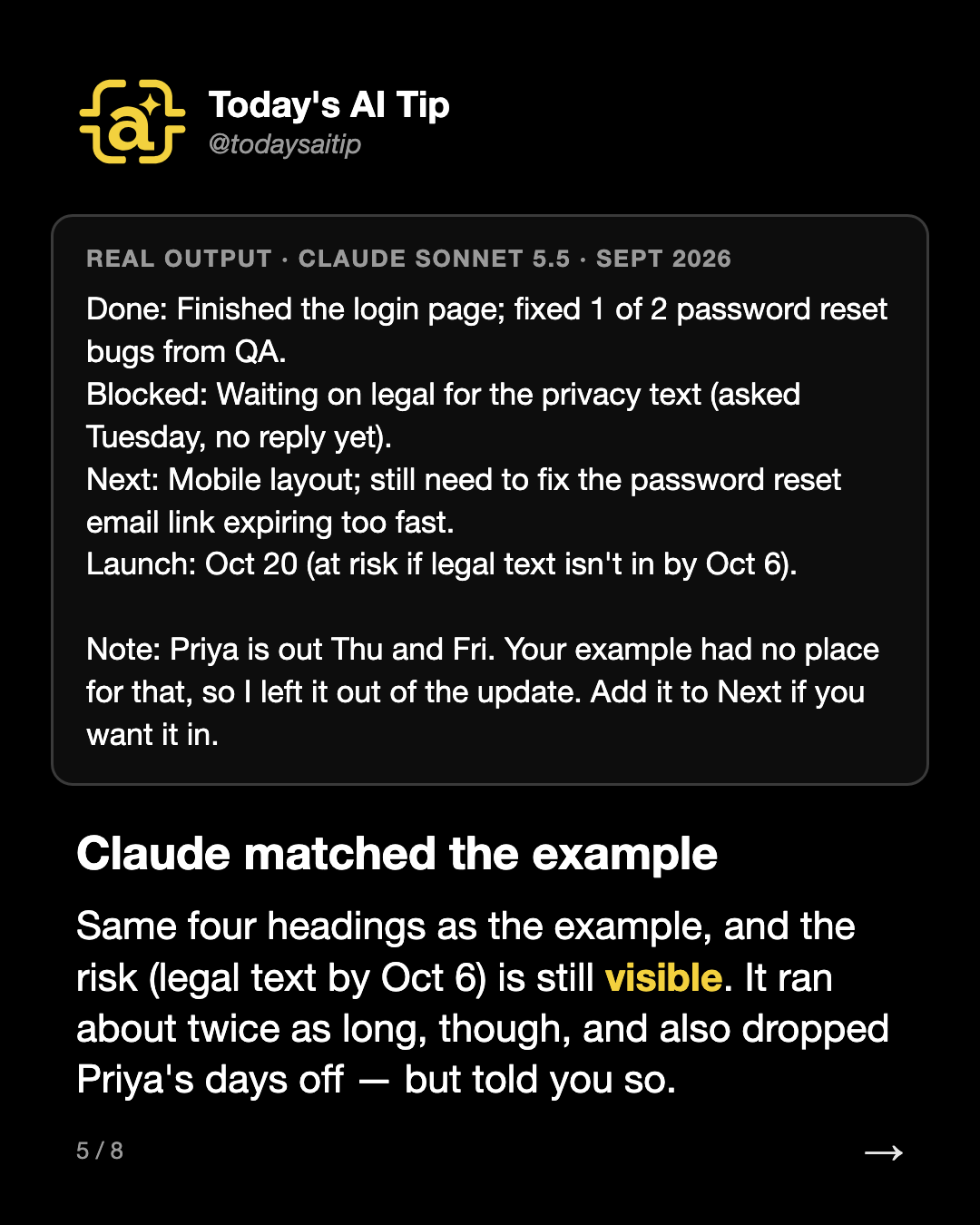
Claude matched the example
Real output · Claude Sonnet 5.5 · Sept 2026
Same four headings as the example, and the risk (legal text by Oct 6) is still visible. It ran about twice as long, though, and also dropped Priya's days off — but told you so.
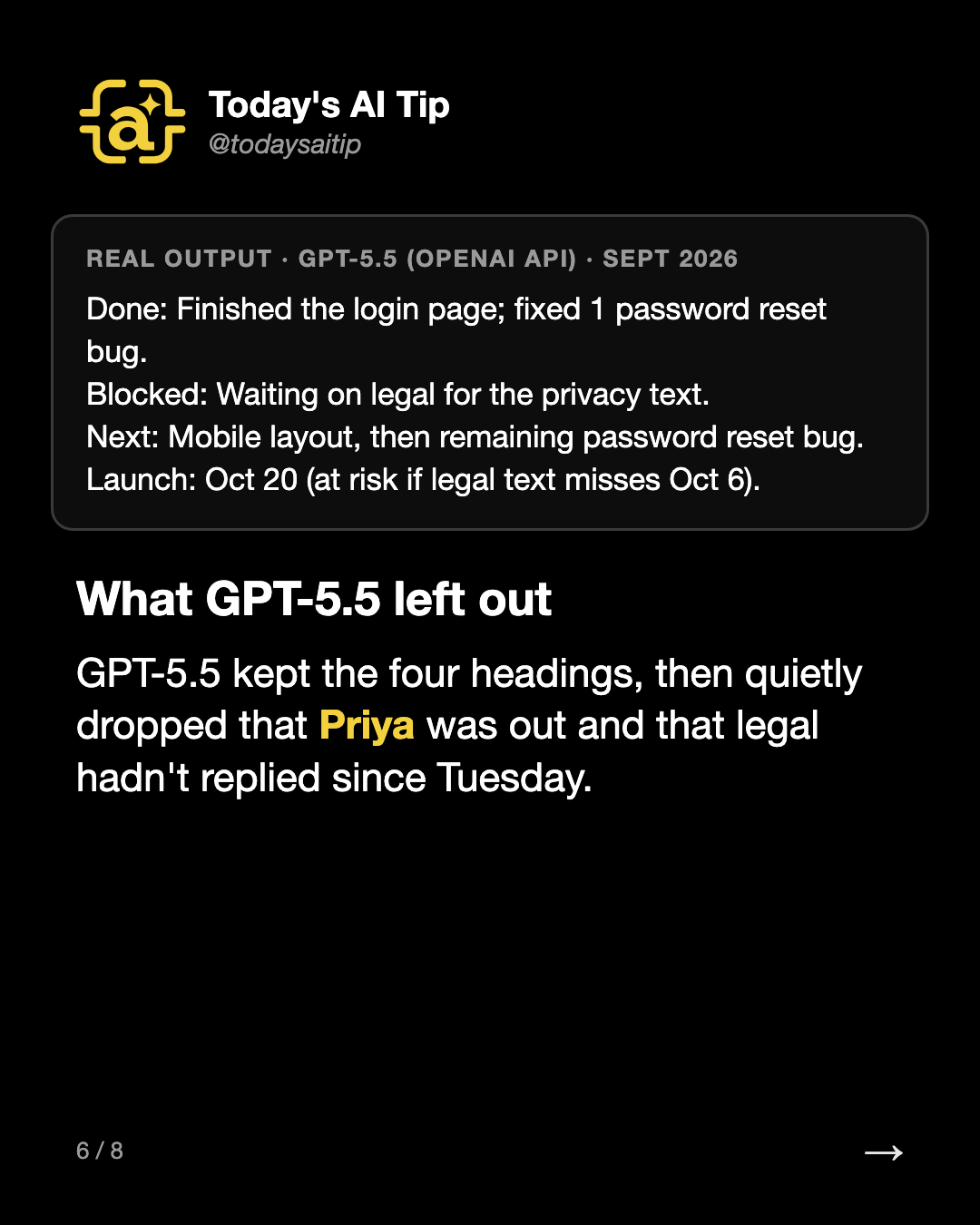
What GPT-5.5 left out
Real output · GPT-5.5 (OpenAI API) · Sept 2026
GPT-5.5 kept the four headings, then quietly dropped that Priya was out and that legal hadn't replied since Tuesday.
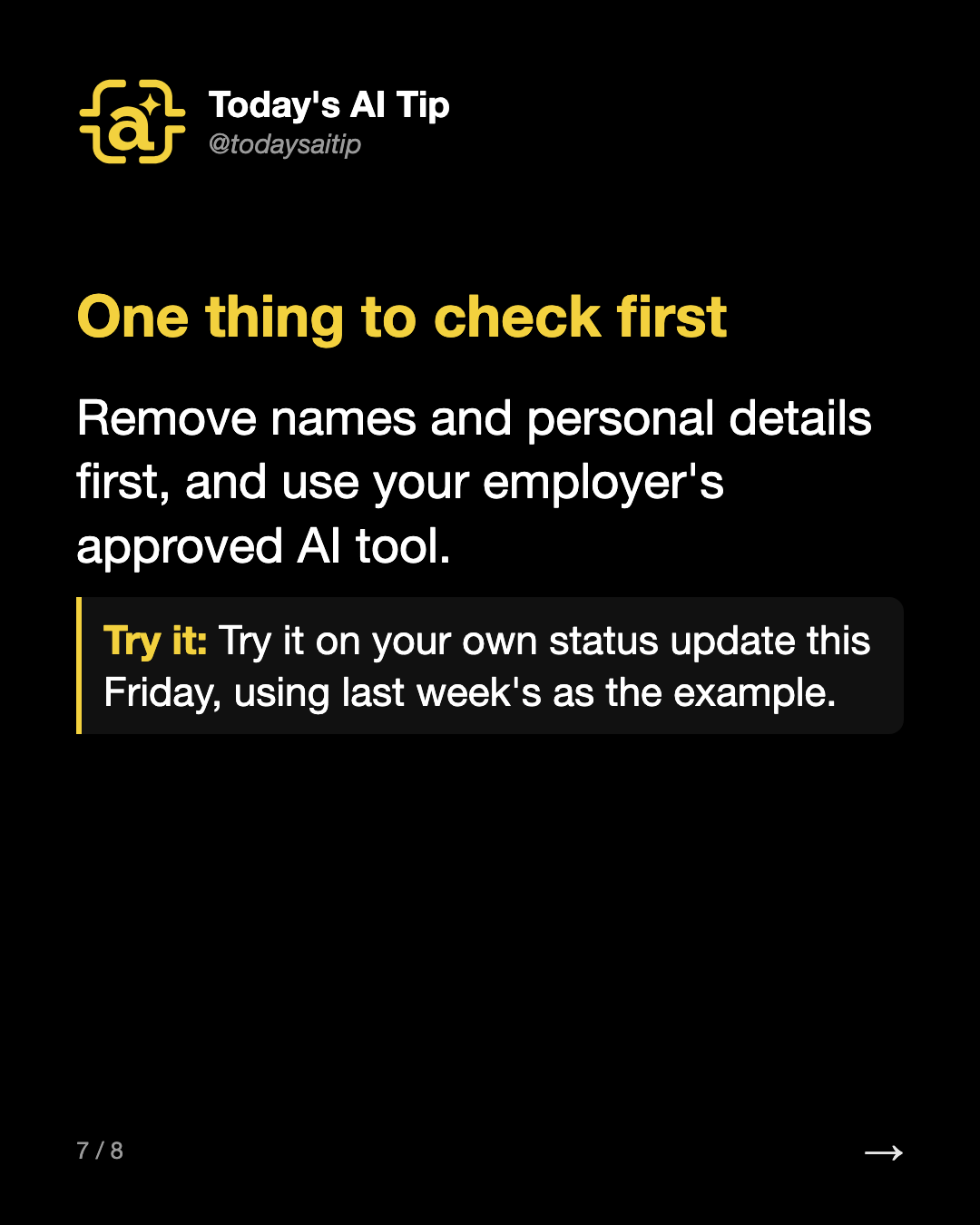
One thing to check first
Remove names and personal details first, and use your employer's approved AI tool.
Try it: Try it on your own status update this Friday, using last week's as the example.
Sources and assumptions
- Anthropic, Prompting best practices (Claude docs), section 'Use examples effectively': 'Examples are one of the most reliable ways to steer Claude's output format, tone, and structure. A few well-crafted examples (known as few-shot or multishot prompting) improve accuracy and consistency.' It also says 'Include 3–5 examples for best results' and that examples should vary enough that Claude 'doesn't pick up unintended patterns'. (checked 2026-09-29)
- OpenAI API docs, Prompt engineering guide (few-shot learning): 'The model implicitly "picks up" the pattern from those examples and applies it to a prompt.' It also recommends showing 'a diverse range of possible inputs with the desired outputs.' (checked 2026-09-29)
- Own test runs, engine/ai-test.js (record.tests: before, after, after-gpt): All three outputs quoted on slides 2, 5 and 6. They were run on 2026-09-29 in Claude Sonnet 5.5 (claude -p) and GPT-5.5 (OpenAI API) with fictional notes. (checked 2026-09-29)
Assumptions:
- The notes and last week's update are fictional: a made-up customer-portal project and a made-up teammate called Priya.
- Each prompt was run once per tool on 2026-09-29. Outputs vary from run to run, so a reader may see different wording, and on a different run Claude might drop a fact or GPT might keep one.
- The GPT-5.5 run went through the OpenAI API, not the ChatGPT app, and is labeled that way.
- Character count 749 is the length of the 'before' output as recorded; the team format example is 4 lines.
Save this template
- Paste last week's update as the example
- Say: match headings, length, and tone
- Check every note against the output
- Watch for facts that don't fit the format