 Today's AI Tip
One delay email, three readers, one prompt. Here's what it got wrong.

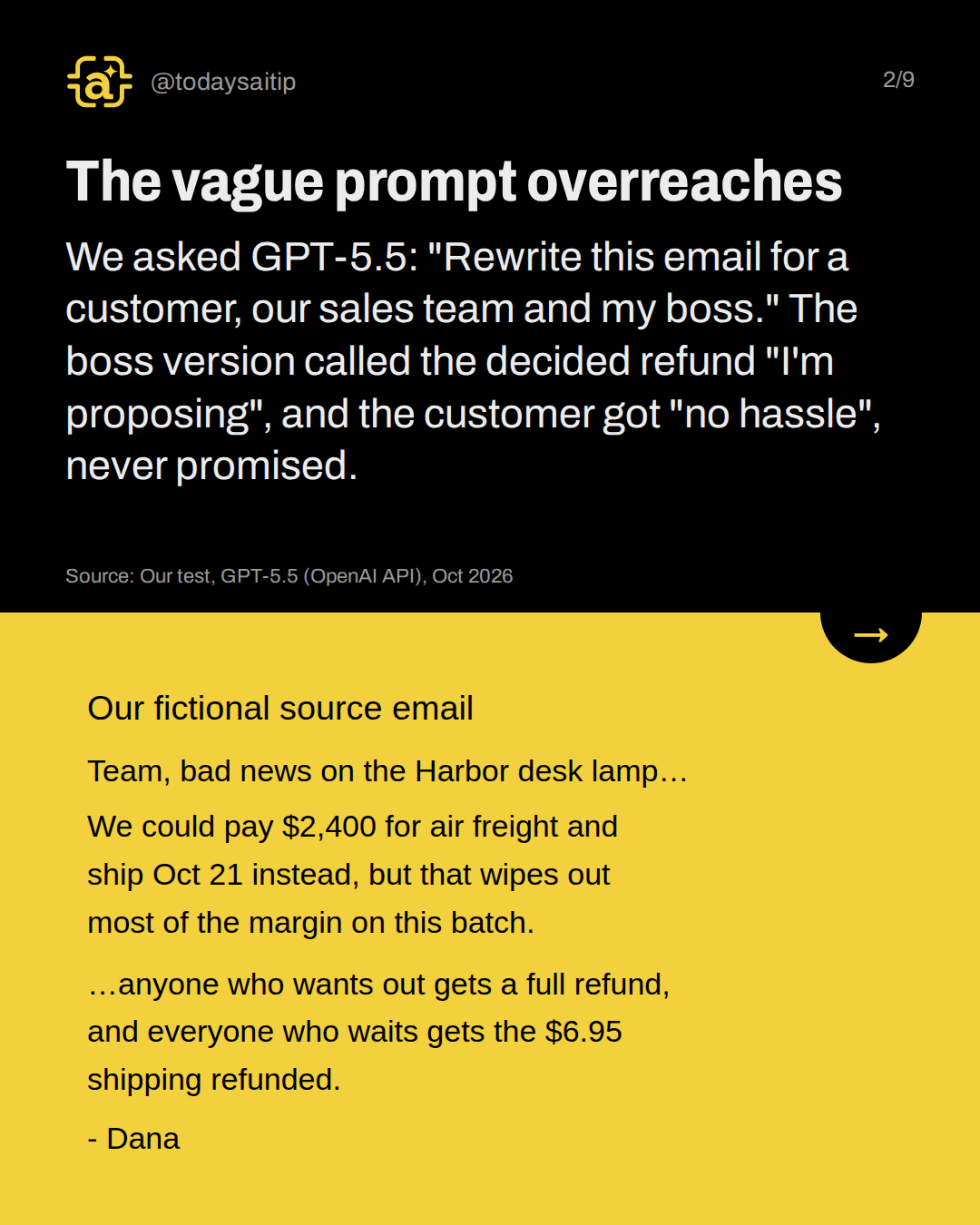
The vague prompt overreaches
We asked GPT-5.5: "Rewrite this email for a customer, our sales team and my boss." The boss version called the decided refund "I'm proposing", and the customer got "no hassle", never promised.
Source: Our test, GPT-5.5 (OpenAI API), Oct 2026
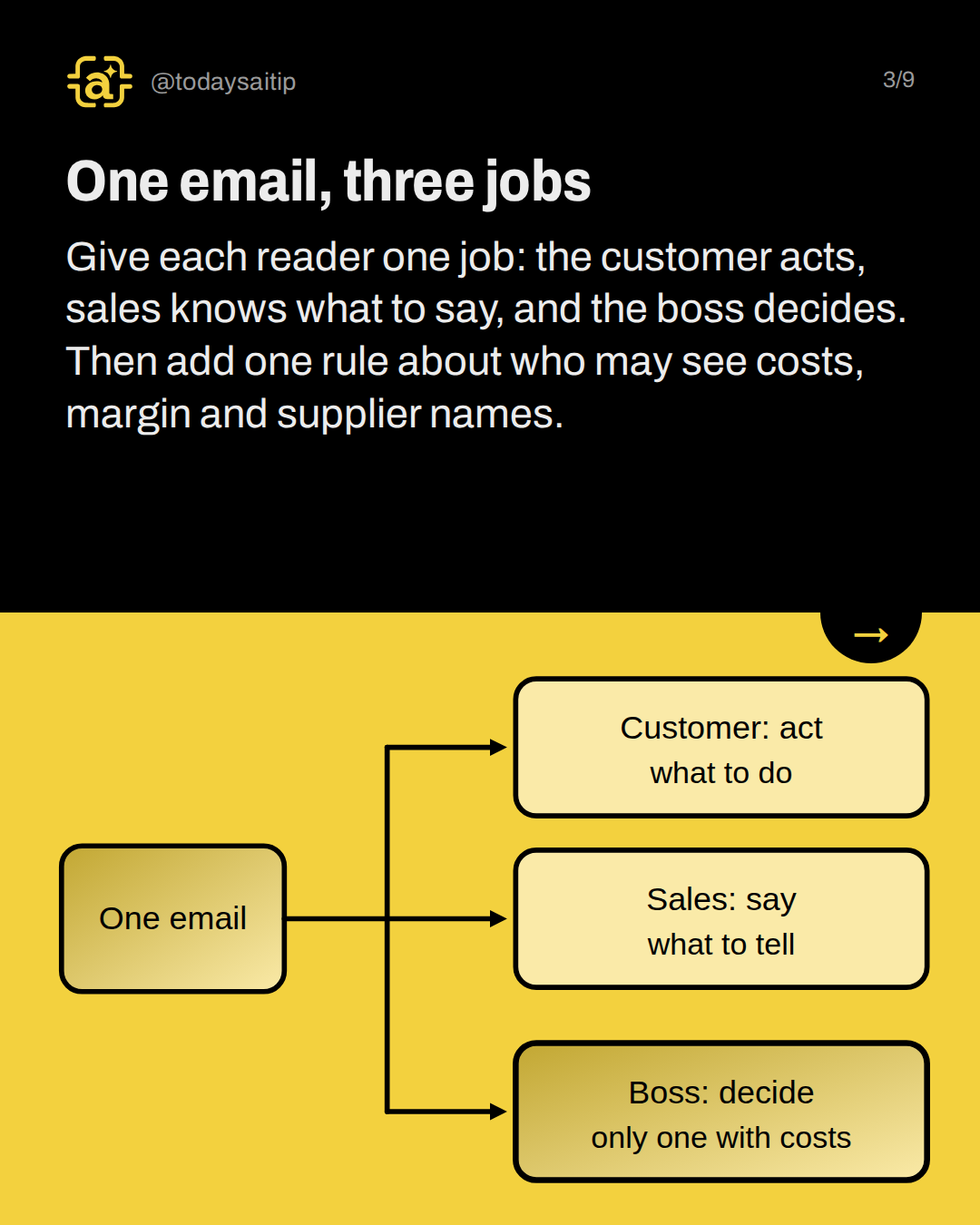
One email, three jobs
Give each reader one job: the customer acts, sales knows what to say, and the boss decides. Then add one rule about who may see costs, margin and supplier names.
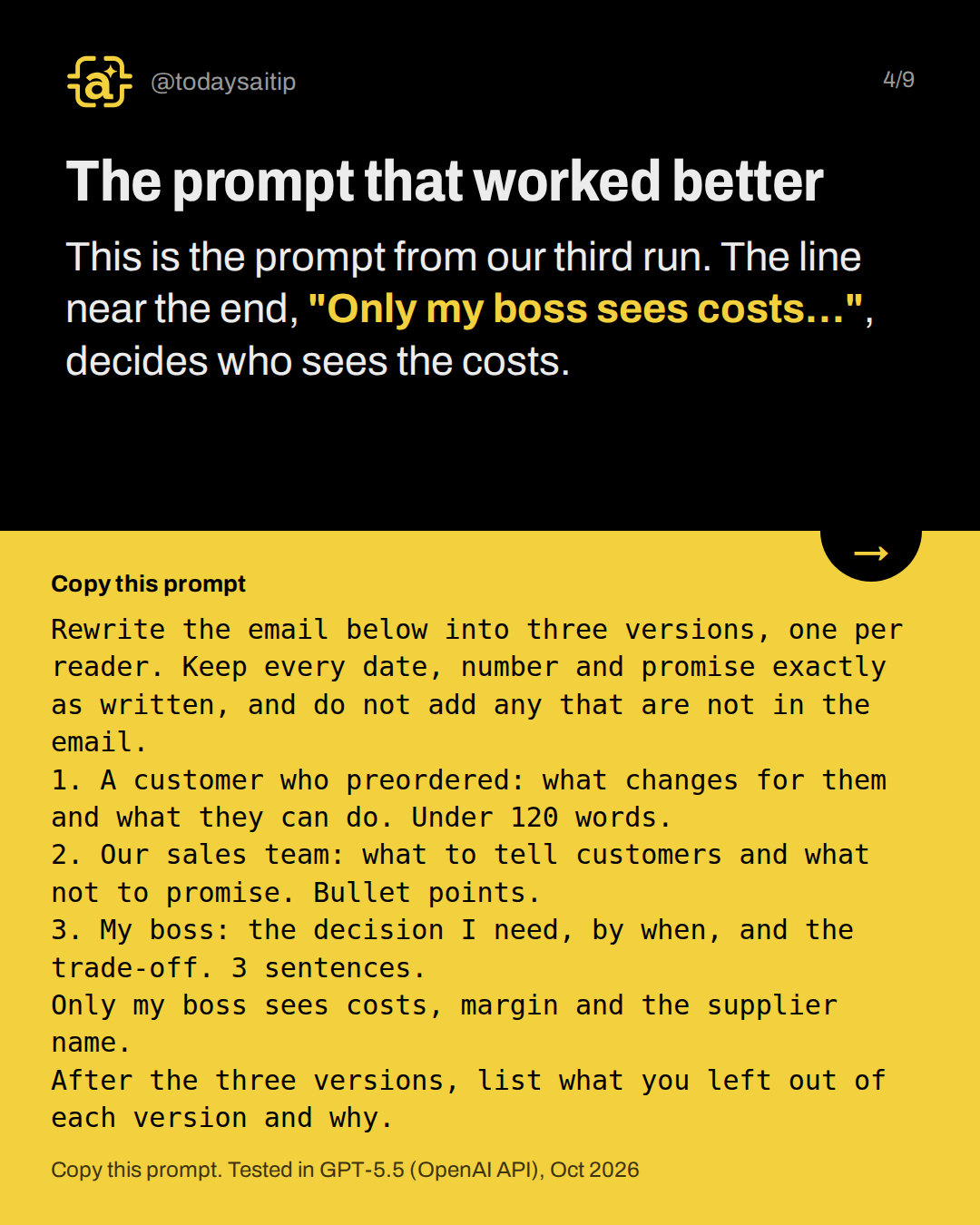
The prompt that worked better
Copy this prompt. Tested in GPT-5.5 (OpenAI API), Oct 2026
This is the prompt from our third run. The line near the end, "Only my boss sees costs…", decides who sees the costs.
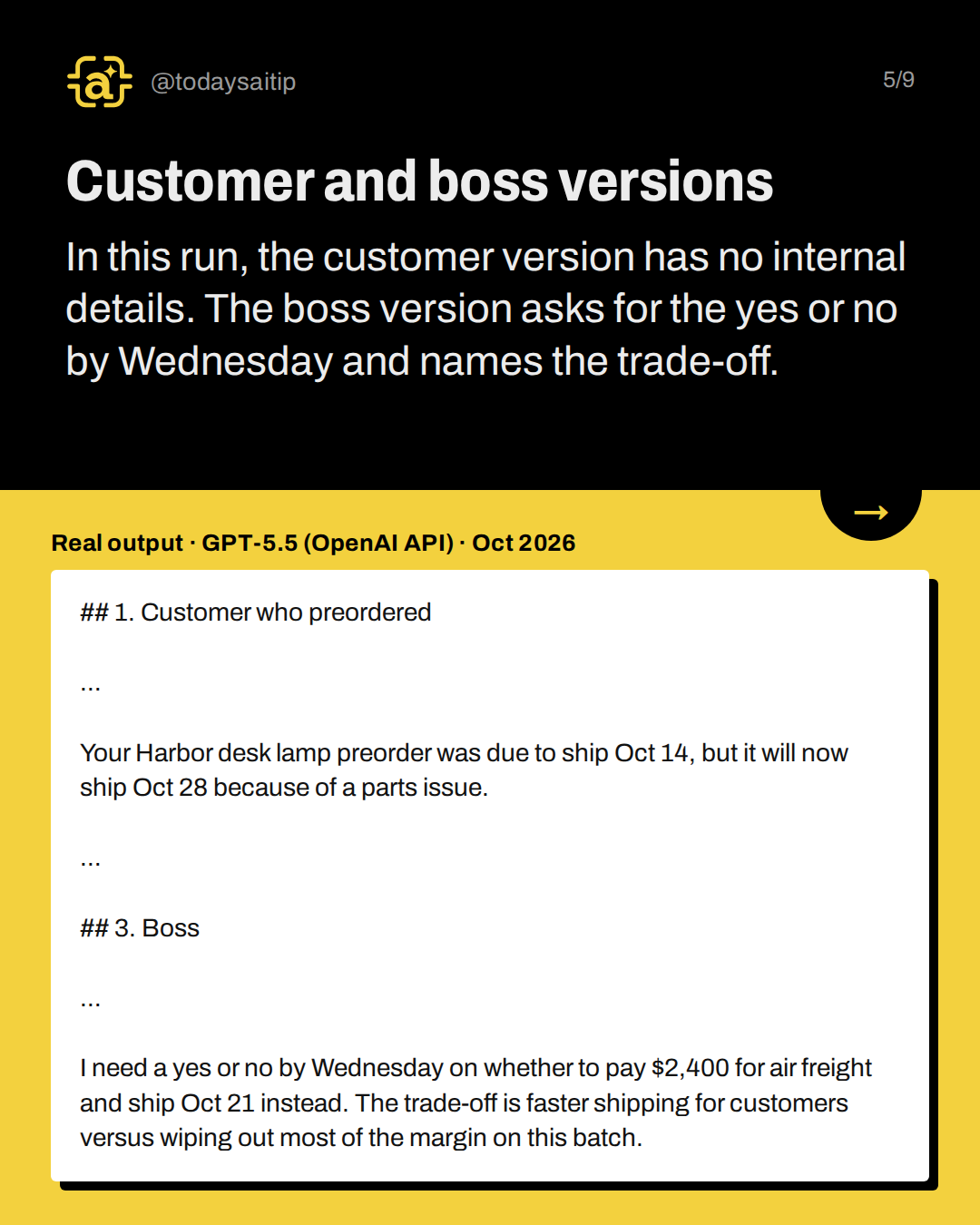
Customer and boss versions
Real output · GPT-5.5 (OpenAI API) · Oct 2026
In this run, the customer version has no internal details. The boss version asks for the yes or no by Wednesday and names the trade-off.
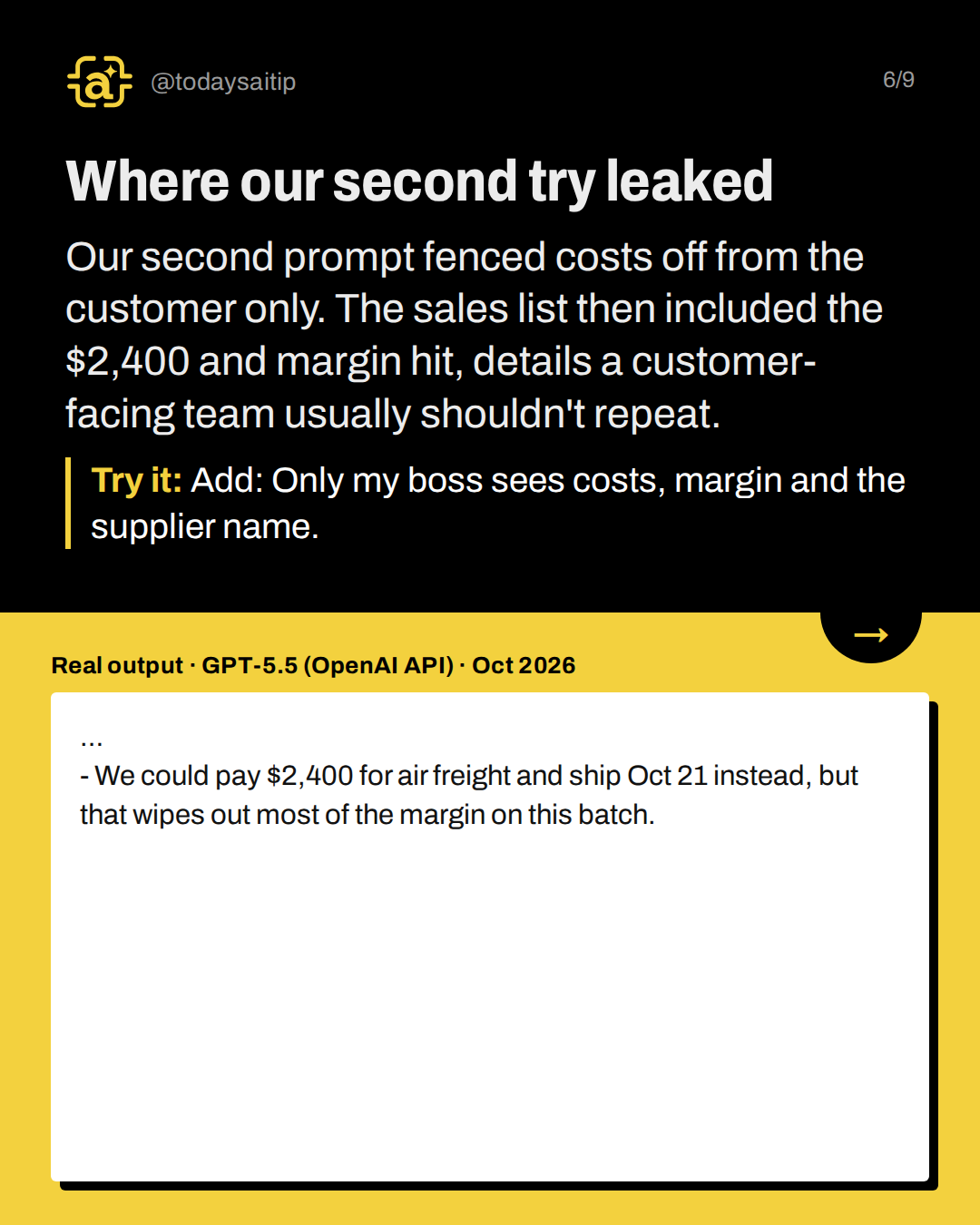
Where our second try leaked
Real output · GPT-5.5 (OpenAI API) · Oct 2026
Our second prompt fenced costs off from the customer only. The sales list then included the $2,400 and margin hit, details a customer-facing team usually shouldn't repeat.
Try it: Add: Only my boss sees costs, margin and the supplier name.
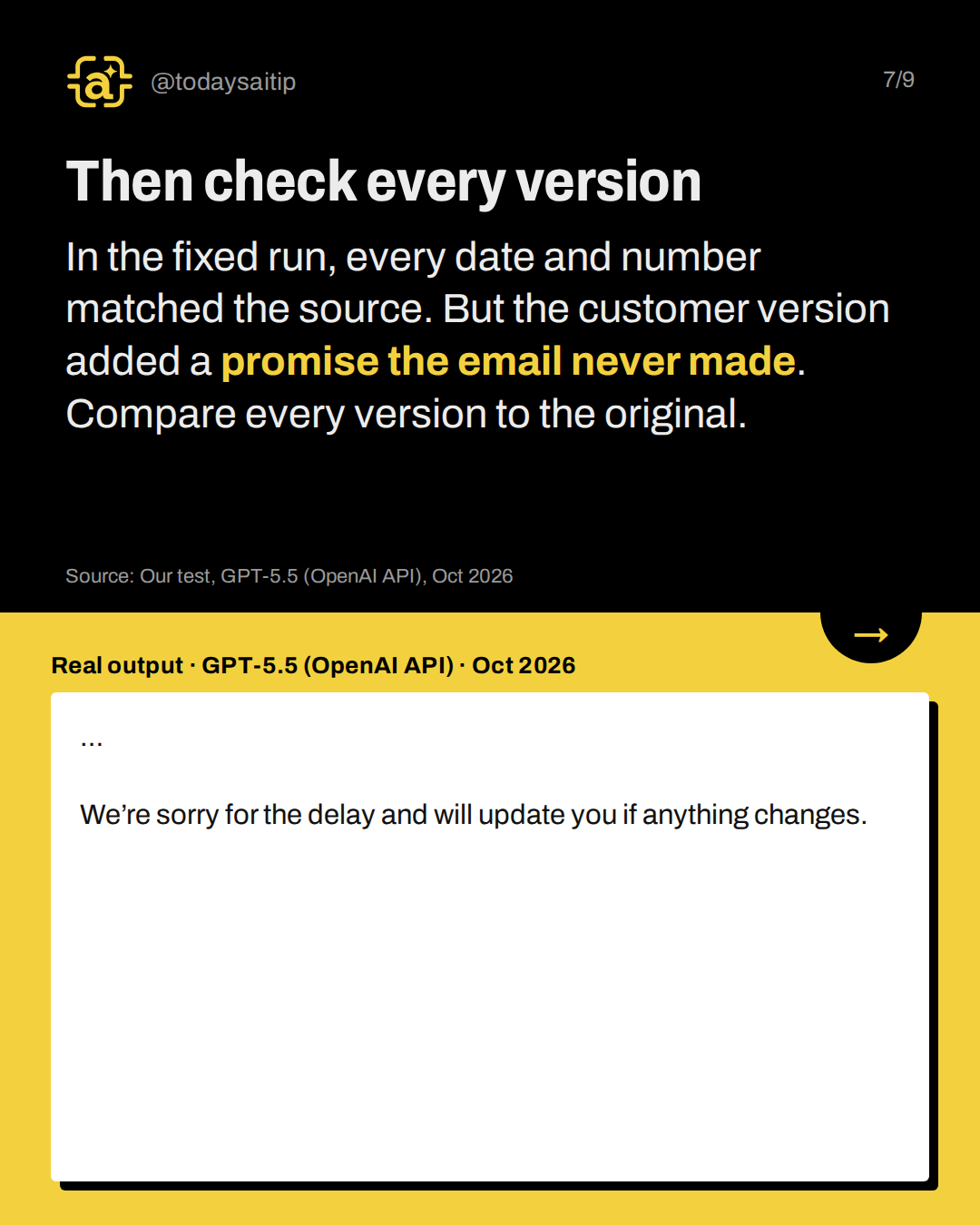
Then check every version
Real output · GPT-5.5 (OpenAI API) · Oct 2026
In the fixed run, every date and number matched the source. But the customer version added a promise the email never made. Compare every version to the original.
Source: Our test, GPT-5.5 (OpenAI API), Oct 2026
Give jobs, set visibility, verify
Give each reader one job and one line on who sees costs and names. Then check every date and number against your original. Remove names and personal details first, and check your employer's approved tools.
Try it: Try it on your next delay or price-change email.
Sources and assumptions
- Anthropic, Prompting best practices (Claude Platform Docs): General principle behind giving each reader a job: 'Providing context or motivation behind your instructions, such as explaining to Claude why such behavior is important, can help Claude better understand your goals and deliver more targeted responses.' Also: 'Think of Claude as a brilliant but new employee who lacks context on your norms and workflows. The more precisely you explain what you want, the better the result.' and 'Be specific about the desired output format and constraints.' This is Anthropic's guidance for Claude. The post's test ran in GPT-5.5, so the slides must not claim this doc proves GPT-5.5 behavior. (checked 2026-10-10)
- engine/ai-test.js runs, GPT-5.5 (OpenAI API), tests 'before', 'after', 'fixed' in record.tests: The source for every output quote and finding on the slides is record.tests (run 2026-10-10 local / 2026-10-11 UTC). The two Claude runs in the same file failed with a tool error and returned no output, so no Claude result may be claimed. (checked 2026-10-10)
Assumptions:
- The sample email, the Harbor desk lamp, Kestrel Parts, Dana and all numbers are fictional and invented for this test.
- All three outputs come from GPT-5.5 through the OpenAI API (label it 'GPT-5.5 (OpenAI API), Oct 2026', not 'ChatGPT app'). One run each, and results can vary between runs.
- The Claude runs (ids 'before' and 'after' with tool 'claude') failed with a command error during research and produced no output. The post must not say the prompt was tested in Claude.
- 'Leak' means the sales bullet list contained the $2,400 air-freight cost and the margin impact, which the email writer had not marked for sales. The source email itself did not say sales must not see them. This is a judgment about what a customer-facing team should get, and the slides should present it that way.
The short version
- Give each reader one job.
- Say who alone may see costs.
- Check every date and number.
- Delete any promise that wasn't there.