 Today's AI Tip
Stop asking AI to 'make this better.' Try this instead.

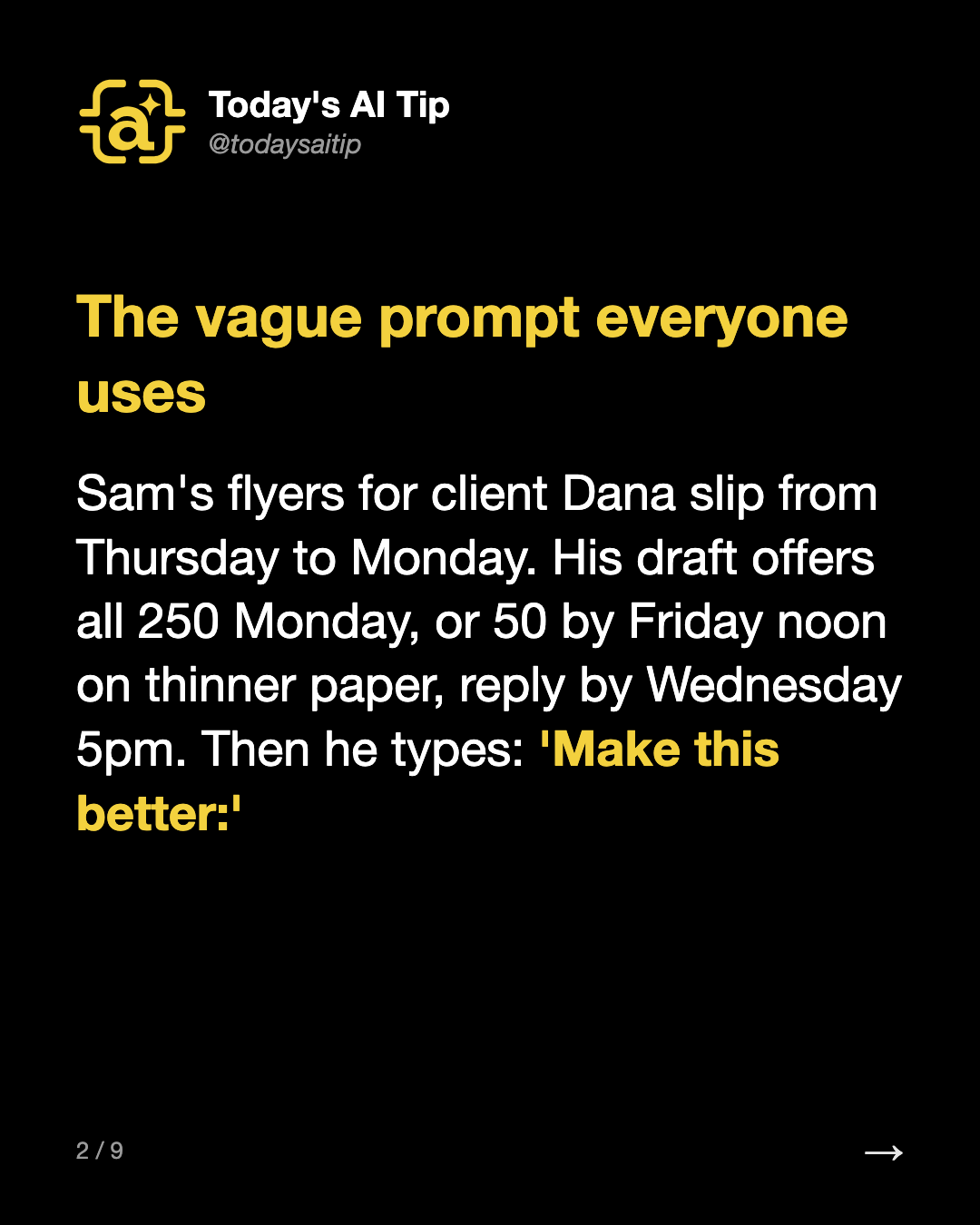
The vague prompt everyone uses
Sam's flyers for client Dana slip from Thursday to Monday. His draft offers all 250 Monday, or 50 by Friday noon on thinner paper, reply by Wednesday 5pm. Then he types: 'Make this better:'
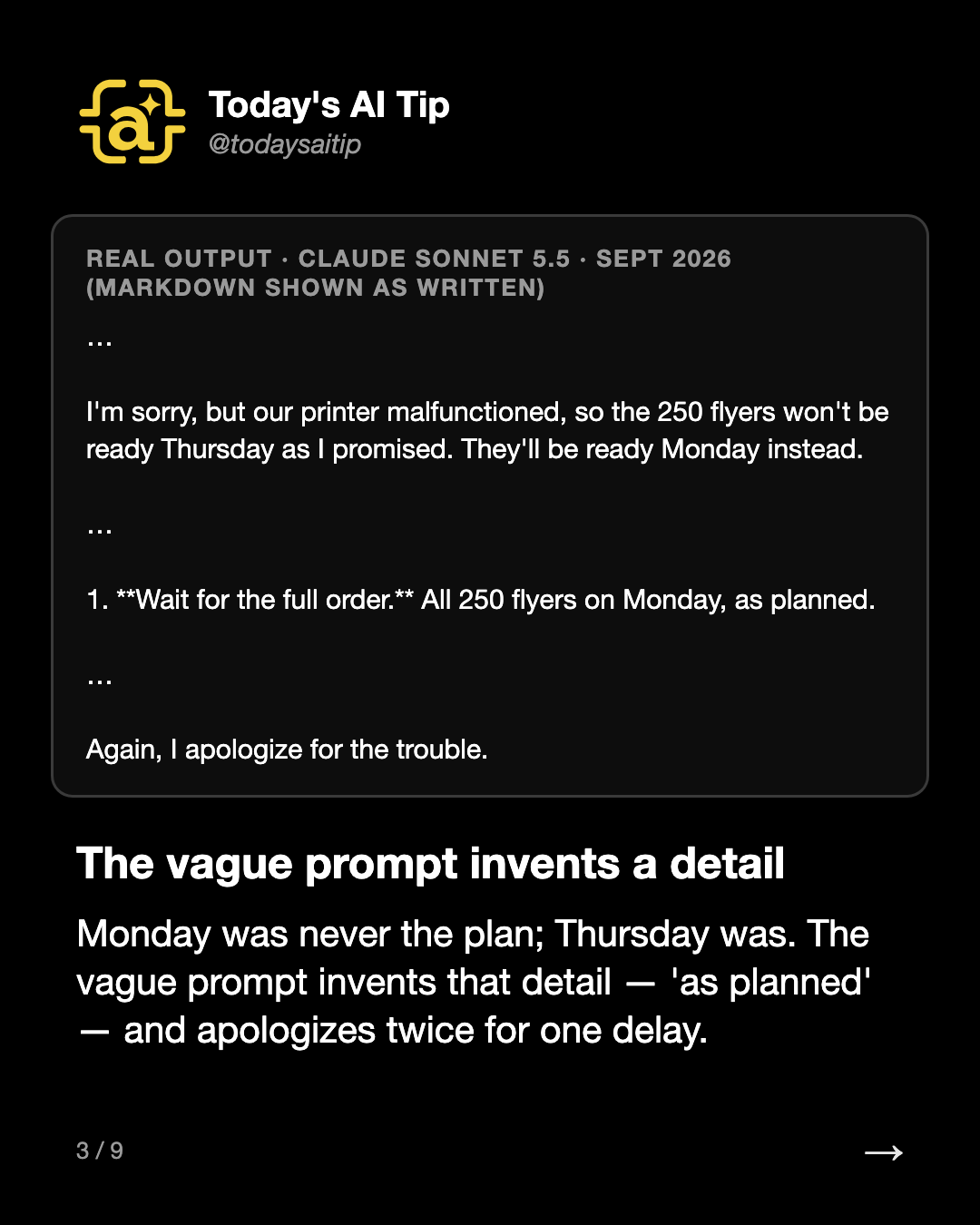
The vague prompt invents a detail
Real output · Claude Sonnet 5.5 · Sept 2026 (markdown shown as written)
Monday was never the plan; Thursday was. The vague prompt invents that detail — 'as planned' — and apologizes twice for one delay.
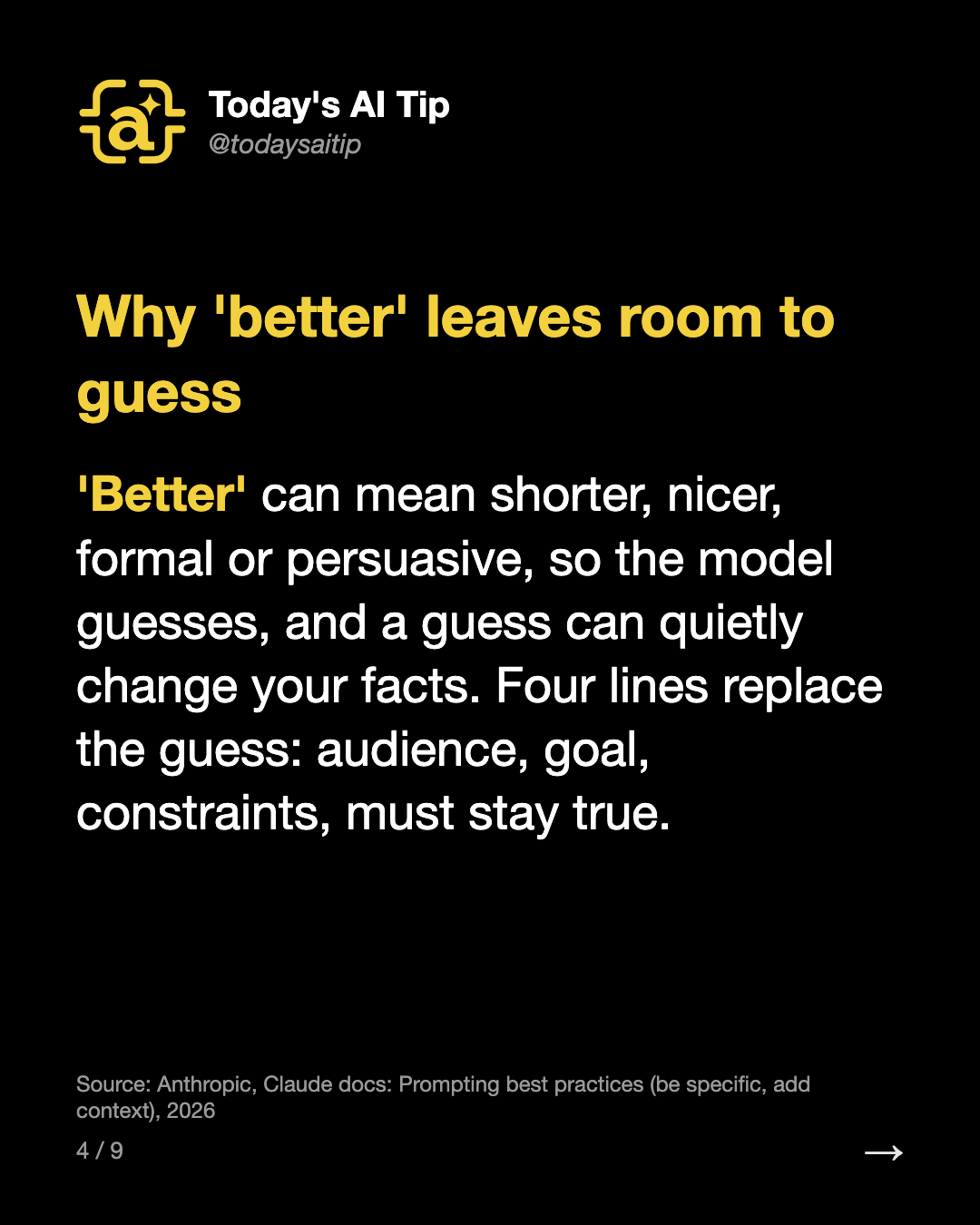
Why 'better' leaves room to guess
'Better' can mean shorter, nicer, formal or persuasive, so the model guesses, and a guess can quietly change your facts. Four lines replace the guess: audience, goal, constraints, must stay true.
Source: Anthropic, Claude docs: Prompting best practices (be specific, add context), 2026
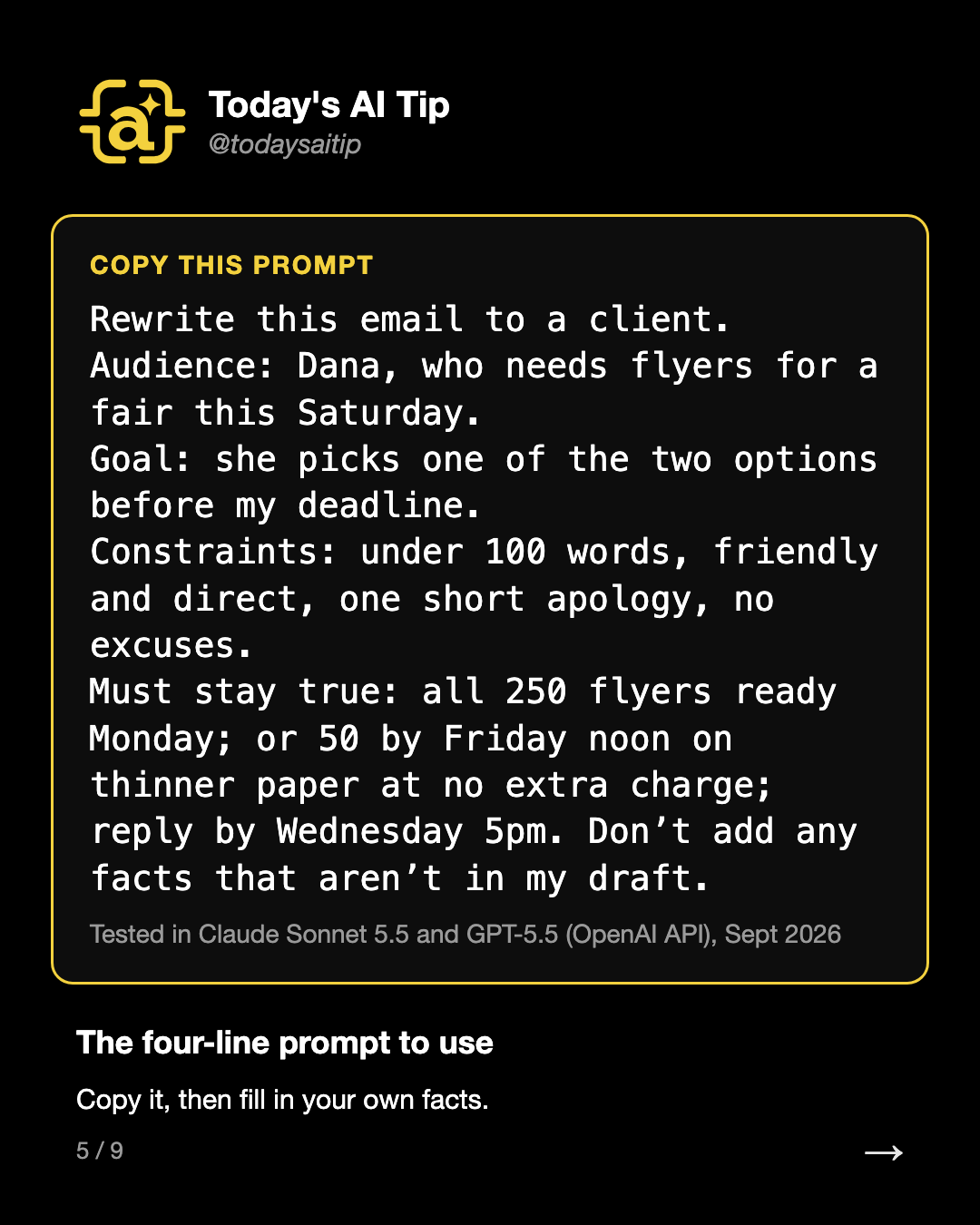
The four-line prompt to use
Tested in Claude Sonnet 5.5 and GPT-5.5 (OpenAI API), Sept 2026
Copy it, then fill in your own facts.
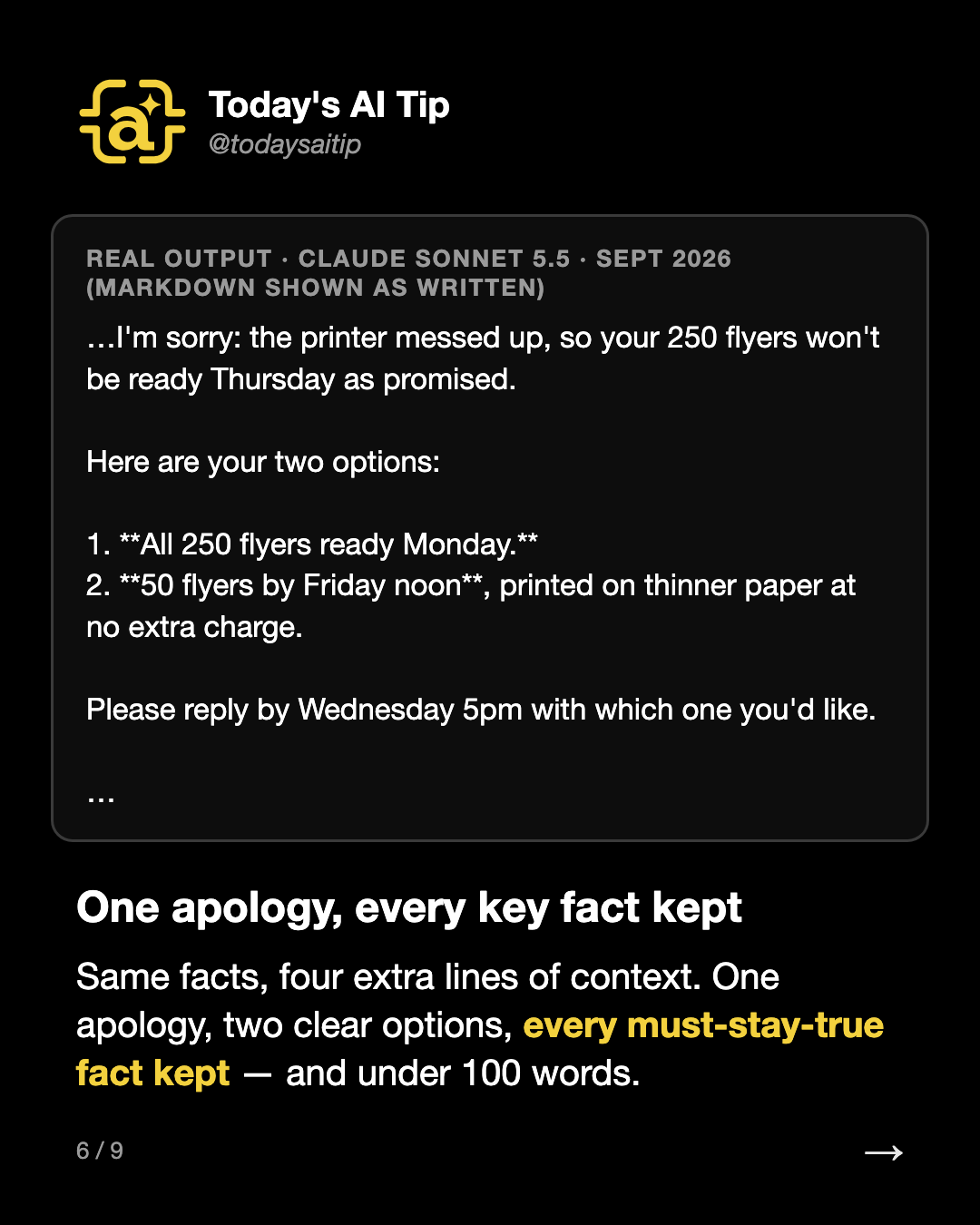
One apology, every key fact kept
Real output · Claude Sonnet 5.5 · Sept 2026 (markdown shown as written)
Same facts, four extra lines of context. One apology, two clear options, every must-stay-true fact kept — and under 100 words.
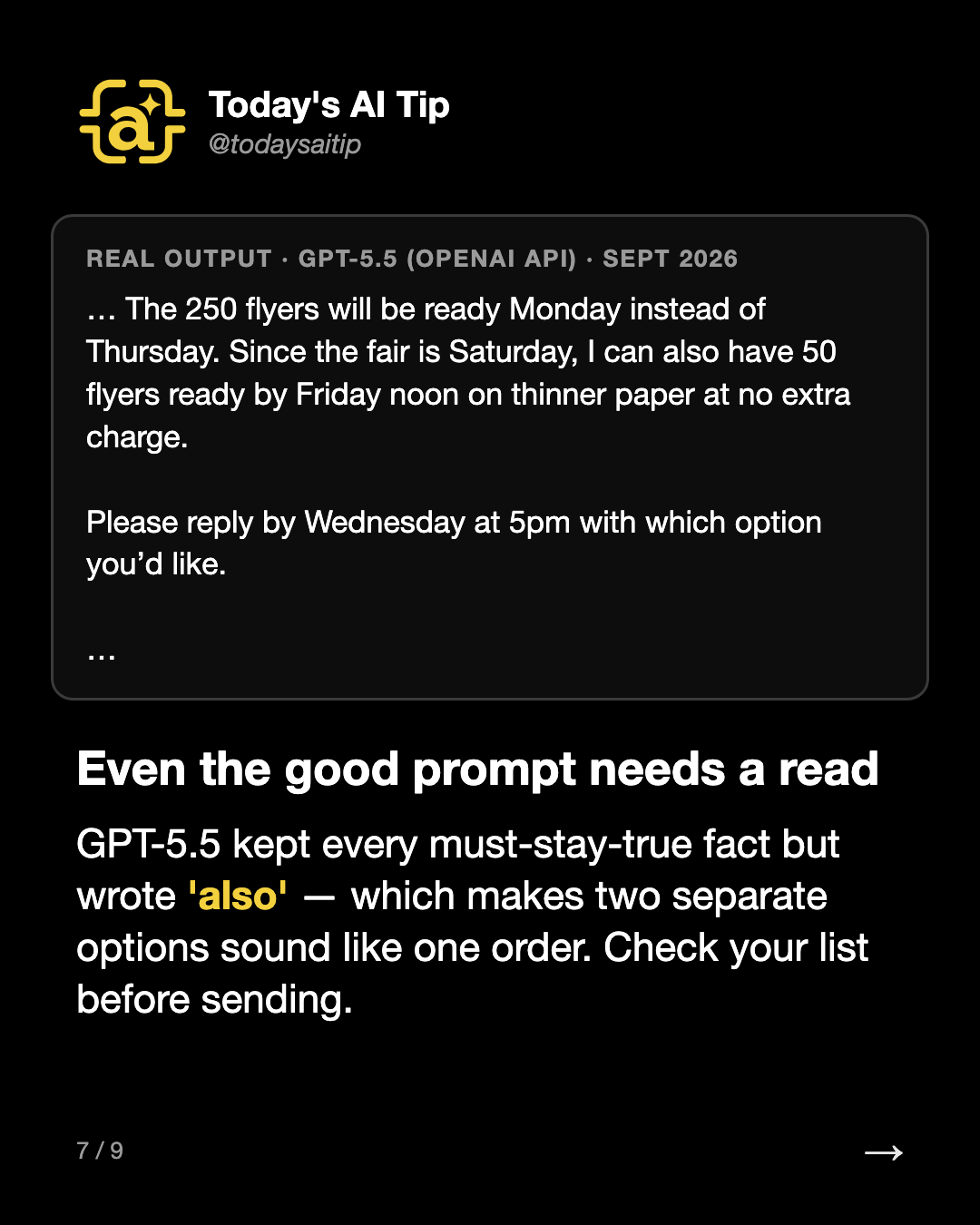
Even the good prompt needs a read
Real output · GPT-5.5 (OpenAI API) · Sept 2026
GPT-5.5 kept every must-stay-true fact but wrote 'also' — which makes two separate options sound like one order. Check your list before sending.
![Your next email, in four lines. Rewrite this email to [who]. Audience: __. Goal: __. Constraints: __. Must stay true: __. Add: 'Don't add any facts that aren't in my draft.' Paste your next rough email under it.](https://media.carouselcdn.com/ai-tools/2026-09-30-a/08.png)
Your next email, in four lines
Rewrite this email to [who]. Audience: __. Goal: __. Constraints: __. Must stay true: __. Add: 'Don't add any facts that aren't in my draft.' Paste your next rough email under it.
Try it: Remove names, account numbers and other details first; check your employer's approved tools.
Sources and assumptions
- Anthropic, Claude docs: Prompting best practices ('Be clear and direct', 'Add context to improve performance'): Official guidance: 'Think of Claude as a brilliant but new employee who lacks context on your norms and workflows. The more precisely you explain what you want, the better the result.' and 'Be specific about the desired output format and constraints.' Also that giving context or the reason behind an instruction helps Claude deliver more targeted responses. (checked 2026-09-29)
- Our own test runs, engine/ai-test.js (record.tests ids before-v2, after-v2, before-gpt-v2, after-gpt-v2): Every output quoted on the slides: Claude Sonnet 5.5 via claude -p and GPT-5.5 via the OpenAI API, run 2026-09-29 (checked 2026-09-29)
Assumptions:
- The sample email (Sam the printer, client Dana, 250 flyers, a fair on Saturday) is fictional and written for this test. It contains no real person's or client's data.
- Use only record.tests ids ending in -v2. The first two entries in tests.json (ids 'before' and 'after') used an earlier sample that said 'monday the 6th', a date that falls on no nearby Monday. That confused the models, so those entries are superseded and must not be quoted.
- One run per prompt per tool. Model outputs vary between runs: in the superseded vague run, Claude added a different unrequested detail ('with the rest on Monday'), and flagged it. The slides should say 'in my test', not 'always'.
- Claude runs used claude -p with a plain assistant system prompt and no tools. GPT-5.5 runs used the OpenAI Chat Completions API, not the ChatGPT app. Label them 'Claude Sonnet 5.5' and 'GPT-5.5 (OpenAI API)'.
- Word counts are approximate and were counted by hand: the after-v2 email body is about 53 words, and the model says 'about 60'. Slides should say 'under 100 words', not an exact count.
- The technique works in any chat assistant because it is plain text. The post claims testing only in the two tools that were run.
The short version
- Skip 'make this better' — be specific.
- Name the audience, goal and constraints.
- List the facts that must stay true.
- Tick off each fact before you send.