 Today's AI Tip
Asking AI to say no for you? Give it your real reason.

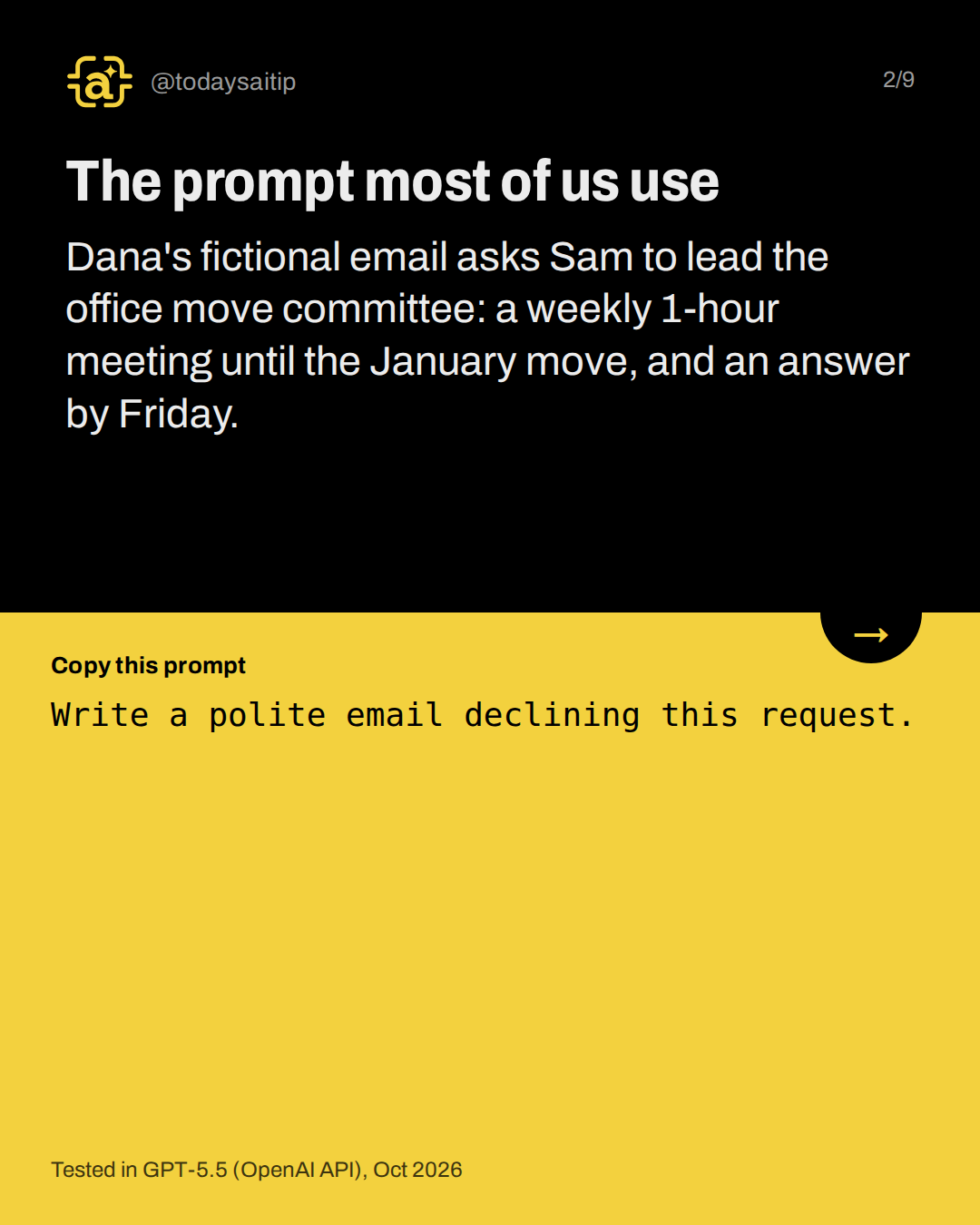
The prompt most of us use
Tested in GPT-5.5 (OpenAI API), Oct 2026
Dana's fictional email asks Sam to lead the office move committee: a weekly 1-hour meeting until the January move, and an answer by Friday.
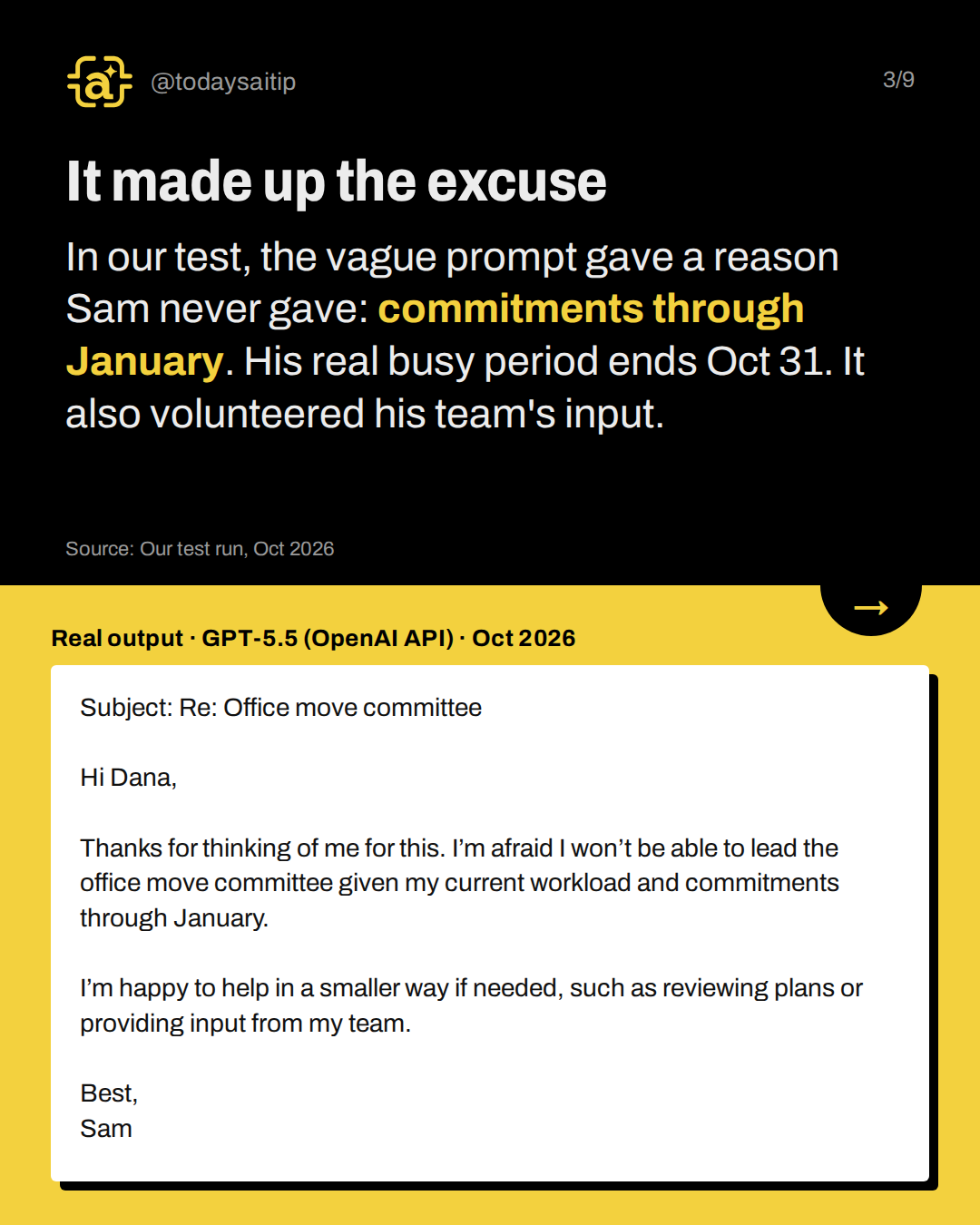
It made up the excuse
Real output · GPT-5.5 (OpenAI API) · Oct 2026
In our test, the vague prompt gave a reason Sam never gave: commitments through January. His real busy period ends Oct 31. It also volunteered his team's input.
Source: Our test run, Oct 2026
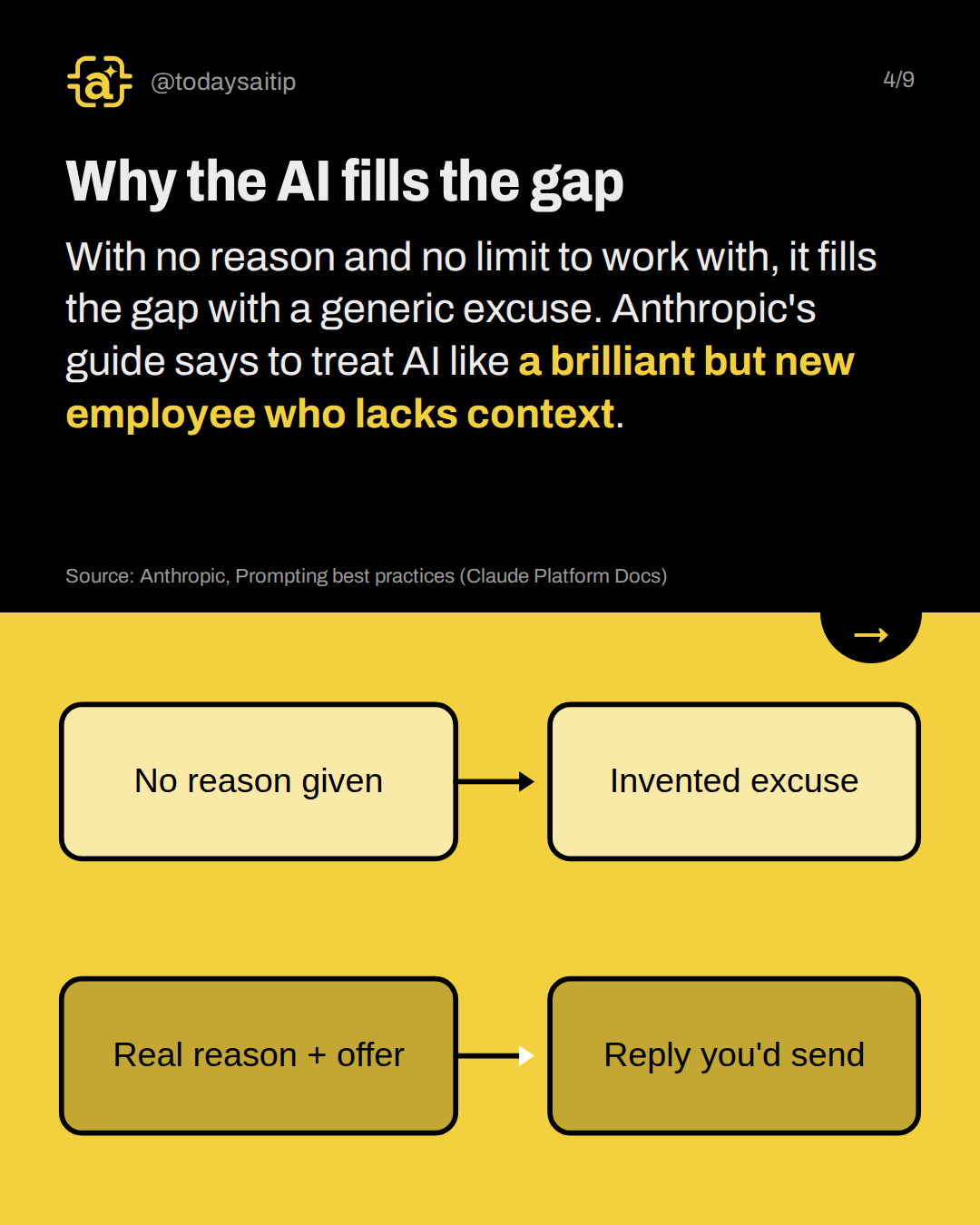
Why the AI fills the gap
With no reason and no limit to work with, it fills the gap with a generic excuse. Anthropic's guide says to treat AI like a brilliant but new employee who lacks context.
Source: Anthropic, Prompting best practices (Claude Platform Docs)
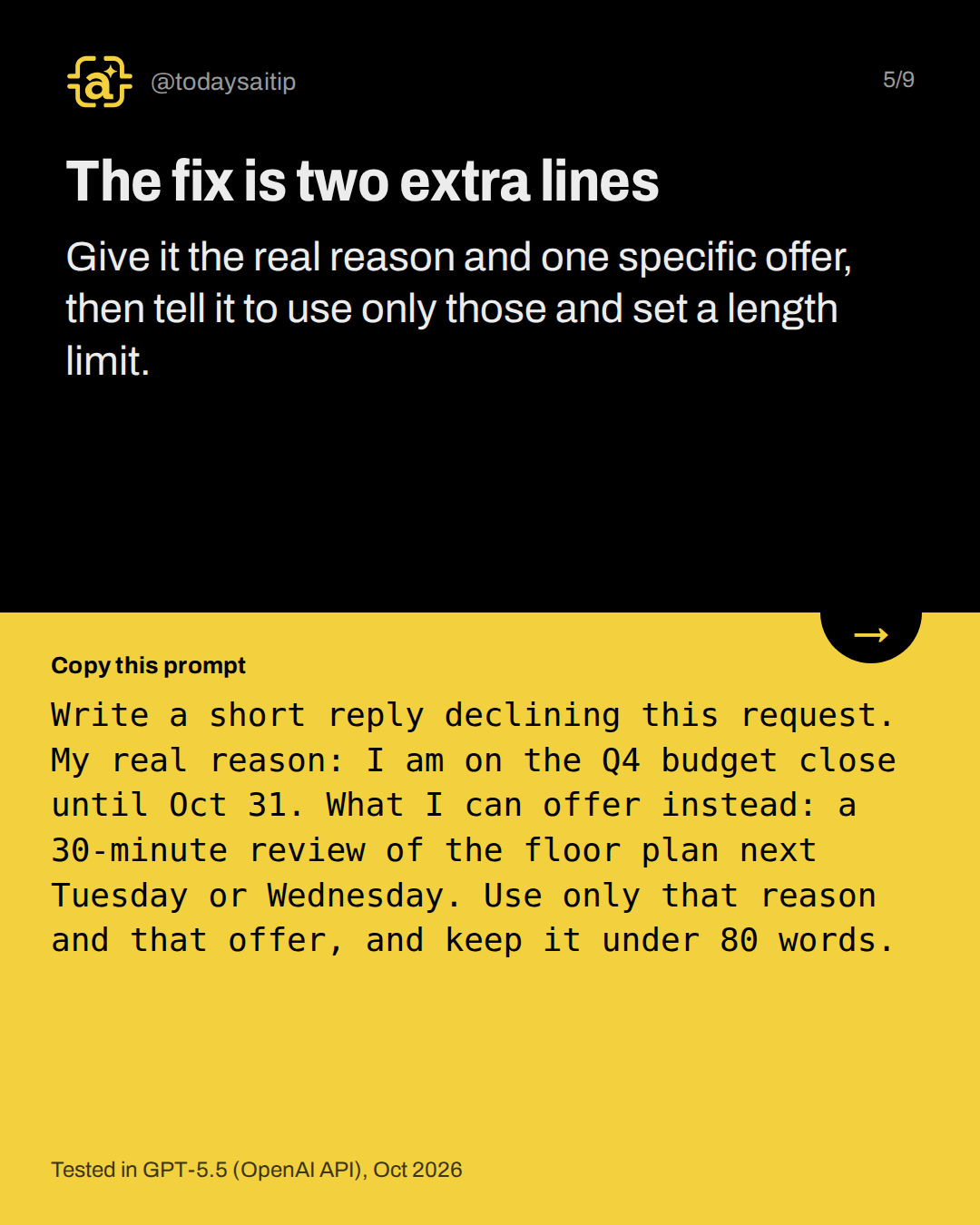
The fix is two extra lines
Tested in GPT-5.5 (OpenAI API), Oct 2026
Give it the real reason and one specific offer, then tell it to use only those and set a length limit.
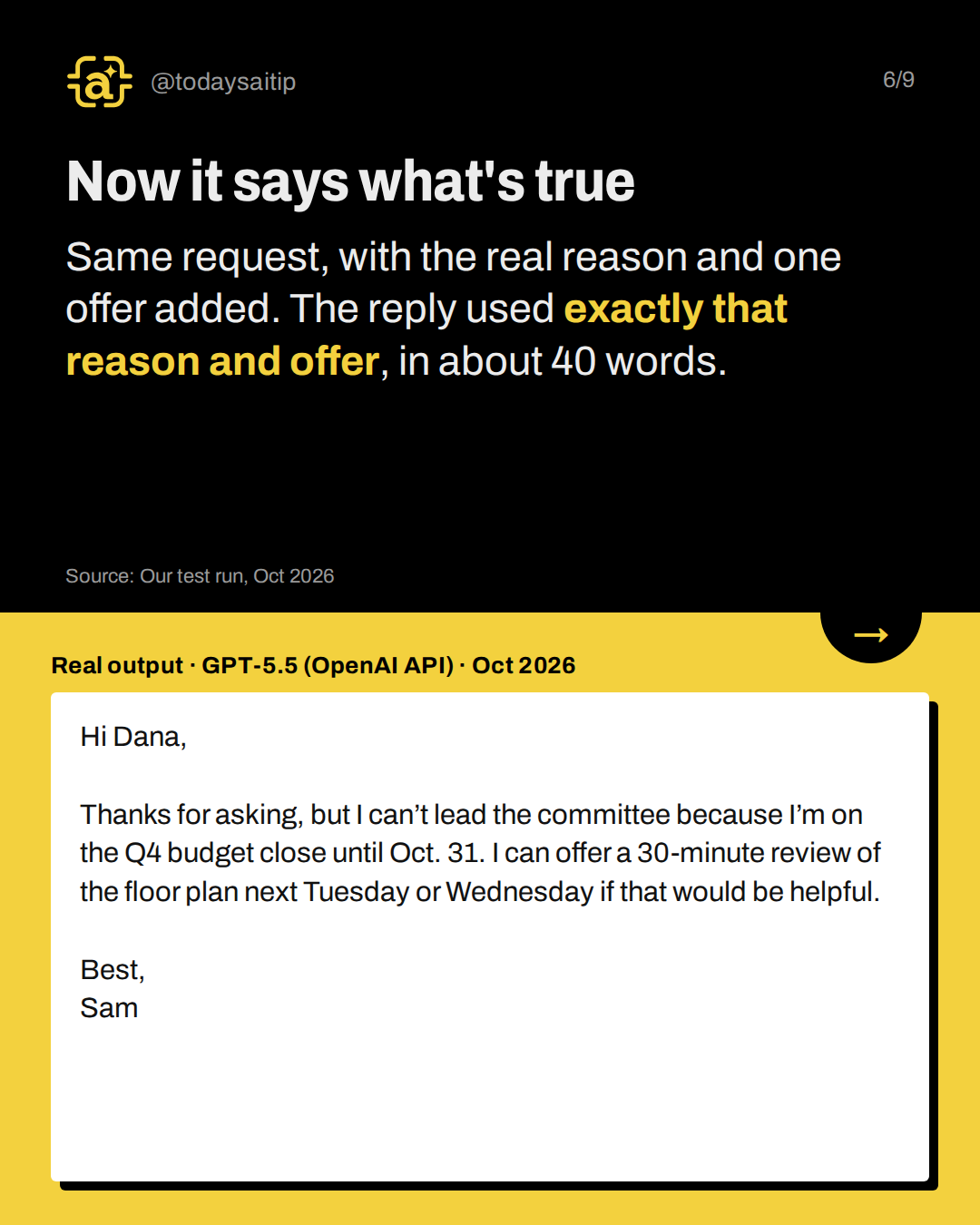
Now it says what's true
Real output · GPT-5.5 (OpenAI API) · Oct 2026
Same request, with the real reason and one offer added. The reply used exactly that reason and offer, in about 40 words.
Source: Our test run, Oct 2026
Still read it before sending
Both vague runs invented a different reason. The fixed reply is also short and a bit blunt, and the AI can only be as honest as the reason you give it.
Two lines to add every time
Add these to any "decline this" prompt: "My real reason: …" and "What I can offer instead: …". Or tell it to offer nothing else.
Try it: Try it on the next request you need to turn down.
Sources and assumptions
- Anthropic, Prompting best practices (Claude Platform Docs), 'Be clear and direct' section: 'Think of Claude as a brilliant but new employee who lacks context on your norms and workflows. The more precisely you explain what you want, the better the result.' and 'Providing context or motivation behind your instructions ... can help Claude better understand your goals and deliver more targeted responses.' (reached via the redirect from /prompt-engineering/be-clear-and-direct) (checked 2026-10-10)
- Our own test runs, engine/ai-test.js, GPT-5.5 via the OpenAI API (record.tests: before-gpt, before-gpt-2, after-gpt): The before and after outputs quoted on the slides. Both vague runs invented a reason; the specific prompt kept only the given reason and offer. (checked 2026-10-10)
Assumptions:
- The request email (Dana, Sam, office move committee) is fictional sample material written for this test.
- Sam's real situation (Q4 budget close until Oct 31; can give a 30-minute floor-plan review next Tuesday or Wednesday) is the fictional ground truth that the outputs are checked against.
- Tests ran only in GPT-5.5 via the OpenAI API (not the ChatGPT app). The Claude runs failed to execute in this session, so no Claude result may be claimed or shown. prompt_tools must name GPT-5.5 (OpenAI API) only.
- Each output comes from one run; a rerun will word things differently. The two vague runs gave different invented reasons, which shows that variation.
The short version
- A vague prompt gets an invented reason
- Give your real reason in the prompt
- Add one specific offer
- Tell it to use only those
- Read the reply before you send