 Today's AI Tip
Before you send the plan, ask AI for the objections
What most of us ask
We paste the plan and ask: “What do you think of this proposal?” The fictional sample replaces a Monday meeting with written updates and a Thursday call “only for items marked Need a decision.”
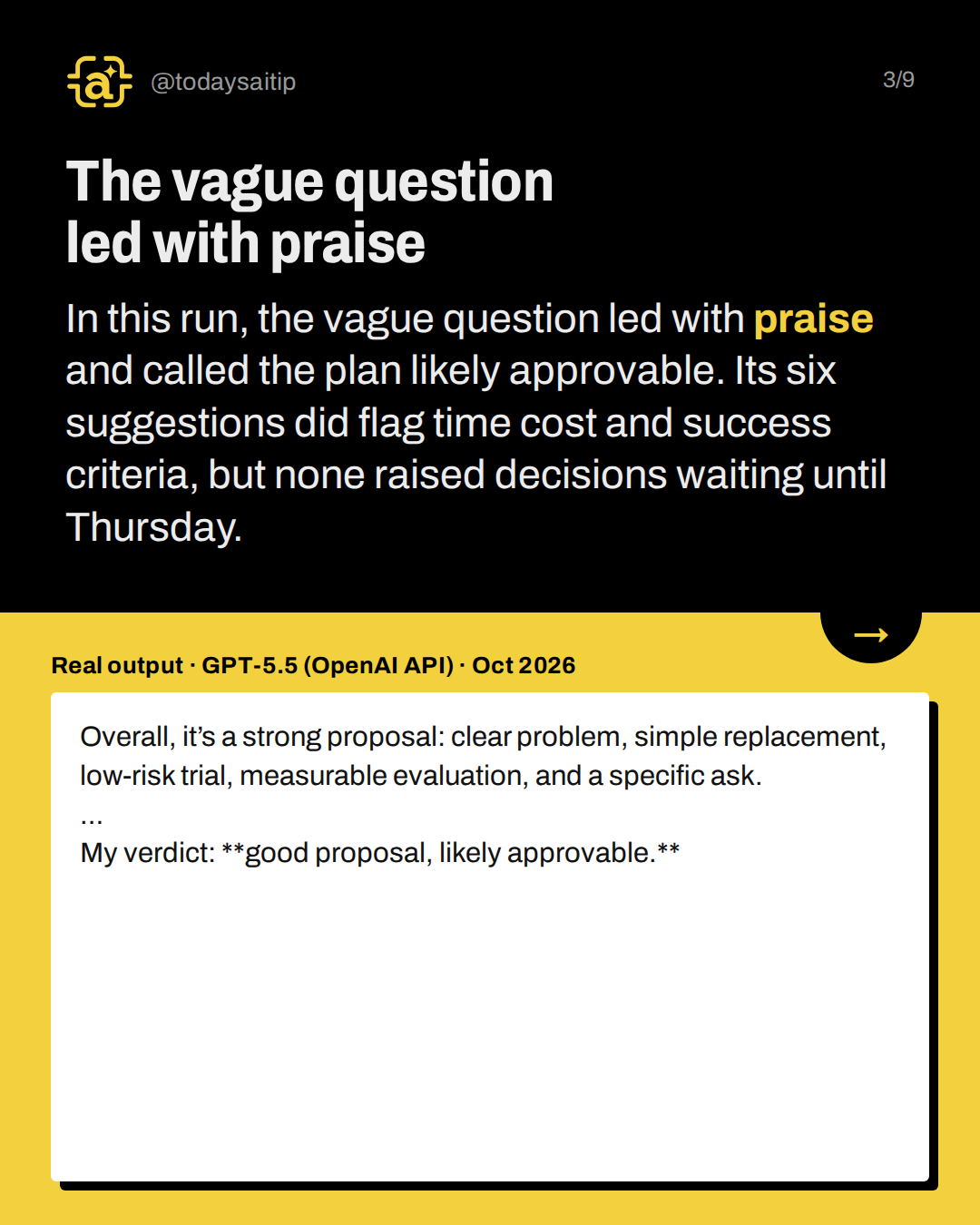
The vague question led with praise
Real output · GPT-5.5 (OpenAI API) · Oct 2026
In this run, the vague question led with praise and called the plan likely approvable. Its six suggestions did flag time cost and success criteria, but none raised decisions waiting until Thursday.
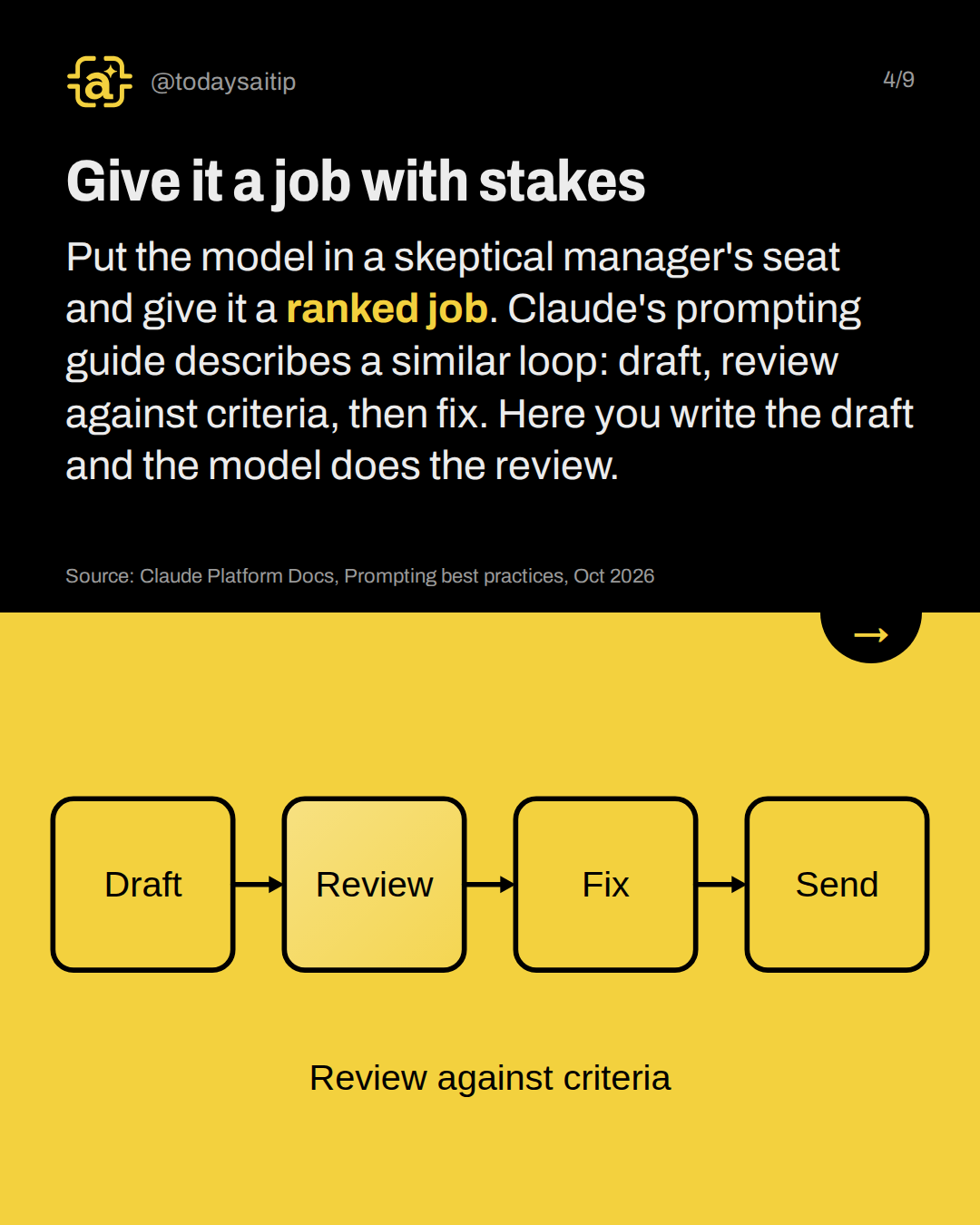
Give it a job with stakes
Put the model in a skeptical manager's seat and give it a ranked job. Claude's prompting guide describes a similar loop: draft, review against criteria, then fix. Here you write the draft and the model does the review.
Source: Claude Platform Docs, Prompting best practices, Oct 2026
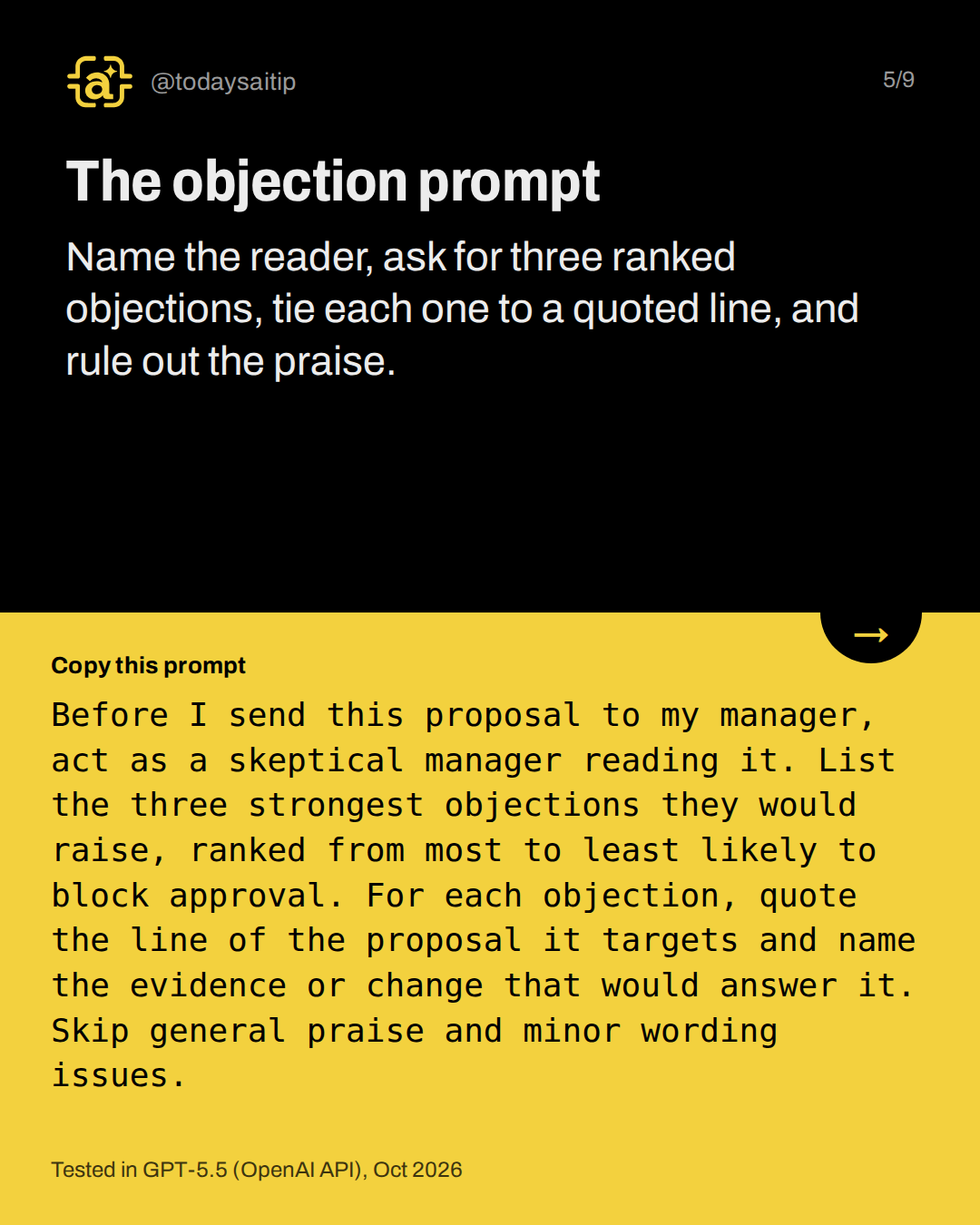
The objection prompt
Tested in GPT-5.5 (OpenAI API), Oct 2026
Name the reader, ask for three ranked objections, tie each one to a quoted line, and rule out the praise.
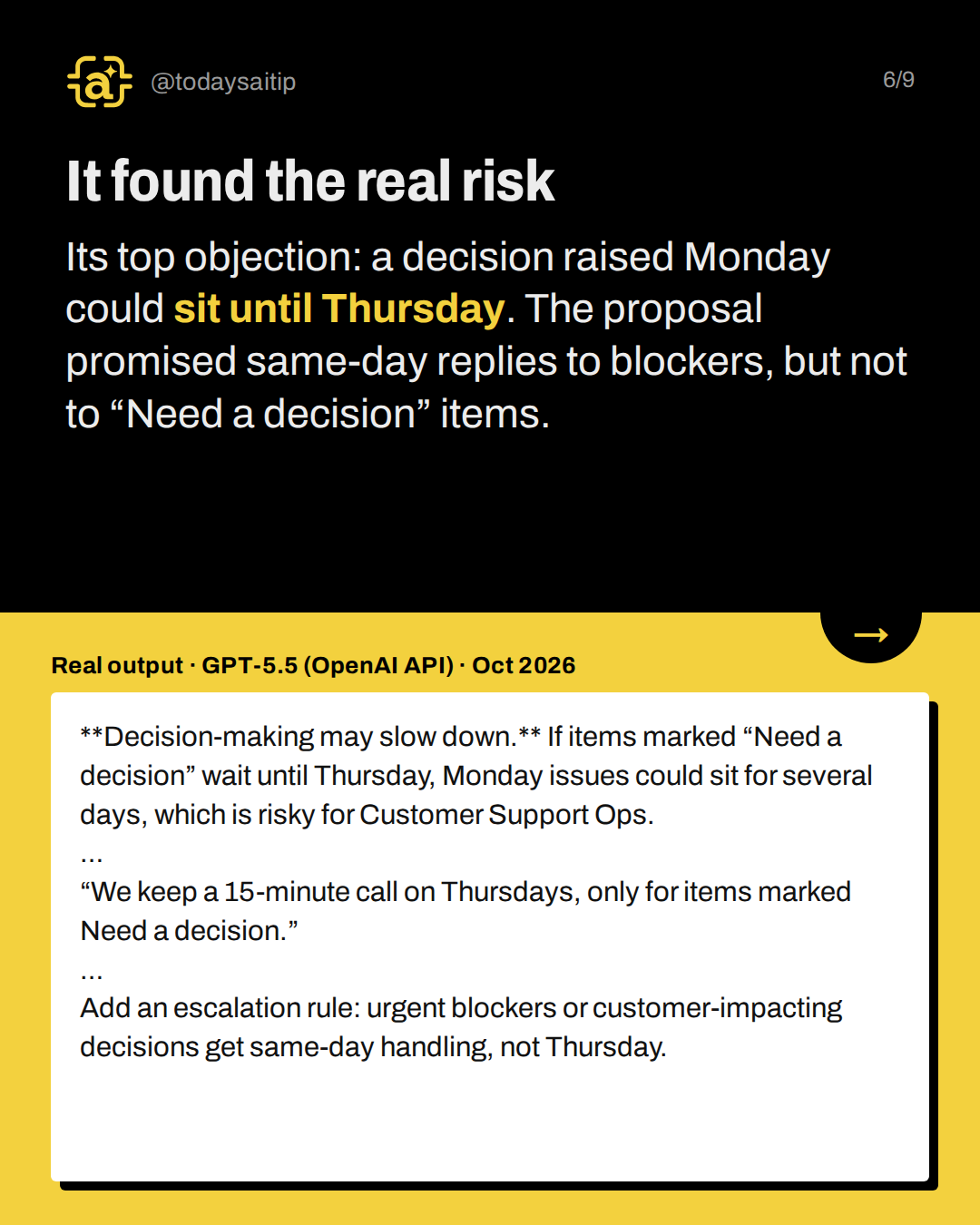
It found the real risk
Real output · GPT-5.5 (OpenAI API) · Oct 2026
Its top objection: a decision raised Monday could sit until Thursday. The proposal promised same-day replies to blockers, but not to “Need a decision” items.
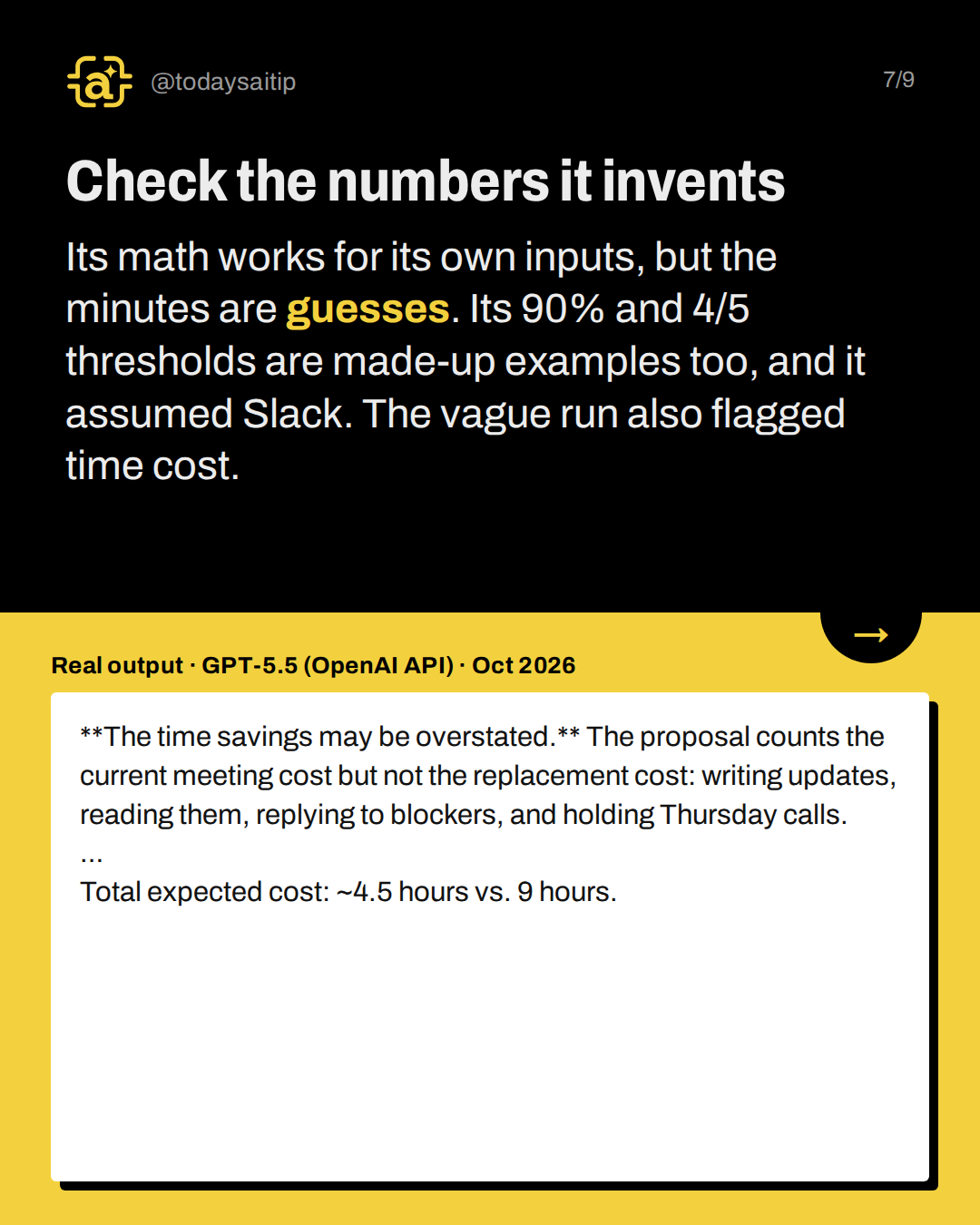
Check the numbers it invents
Real output · GPT-5.5 (OpenAI API) · Oct 2026
Its math works for its own inputs, but the minutes are guesses. Its 90% and 4/5 thresholds are made-up examples too, and it assumed Slack. The vague run also flagged time cost.
Fix it, then send it
Fix the top objection in the document itself. Before pasting a real plan, remove names and figures you can't share, and check your tool's data policy or your employer's approved tools.
Try it: Paste your next proposal with this prompt and fix only objection one.
Sources and assumptions
- Prompting best practices – Claude Platform Docs (section 'Chain complex prompts'): 'The most common chaining pattern is self-correction: generate a draft → have Claude review it against criteria → have Claude refine based on the review.' Supports describing the technique as a critique/review step against criteria. Vendor guidance written for Claude, applied here as a general principle. (checked 2026-10-03)
- Prompting best practices – Claude Platform Docs (thinking section, 'Ask Claude to self-check'): 'Append something like "Before you finish, verify your answer against [test criteria]."' Supports the idea of giving explicit review criteria rather than asking for open feedback. (checked 2026-10-03)
- GPT-5.5 model page – OpenAI API docs: GPT-5.5 is available in the OpenAI API (snapshot gpt-5.5-2026-04-23), so the 'GPT-5.5 (OpenAI API)' label on the output cards is accurate. (checked 2026-10-03)
Assumptions:
- The proposal (Sam Patel, Dana Ruiz, 9-person Customer Support Ops team) is fictional sample material written for this test.
- Both tests ran once each on GPT-5.5 via the OpenAI Chat Completions API with default settings (no reasoning-effort or temperature set, no system message), on 2026-10-04 at about 02:01 UTC (the evening of 2026-10-03 US time). Label as 'GPT-5.5 (OpenAI API), Oct 2026', not the ChatGPT app.
- The same prompts were attempted in Claude Sonnet 5.5 through engine/ai-test.js, but the claude CLI call failed in this research session, so the record has no Claude output. Slides and prompt_tools must name only GPT-5.5 (OpenAI API). Failed entries with output null are in tests.json.
- This is a single run of each prompt. Outputs vary between runs, so the post shows one example, not a guaranteed result.
- Objection 2's thresholds (90% on-time updates, 4/5 survey score) and objection 3's minute estimates are the model's illustrative examples, not facts or benchmarks.
- The Anthropic doc describes the self-correction pattern for Claude, while the test ran on GPT-5.5. The post presents it as a general review-against-criteria technique, not as an OpenAI recommendation.
The short version
- In one run, the vague question led with praise.
- Ask for ranked objections from a skeptical reader.
- Fix objection #1 in the document.
- Treat its example numbers as placeholders.