 Today's AI Tip
AI's '31 hours' stat is traced to a 1998 study without it.
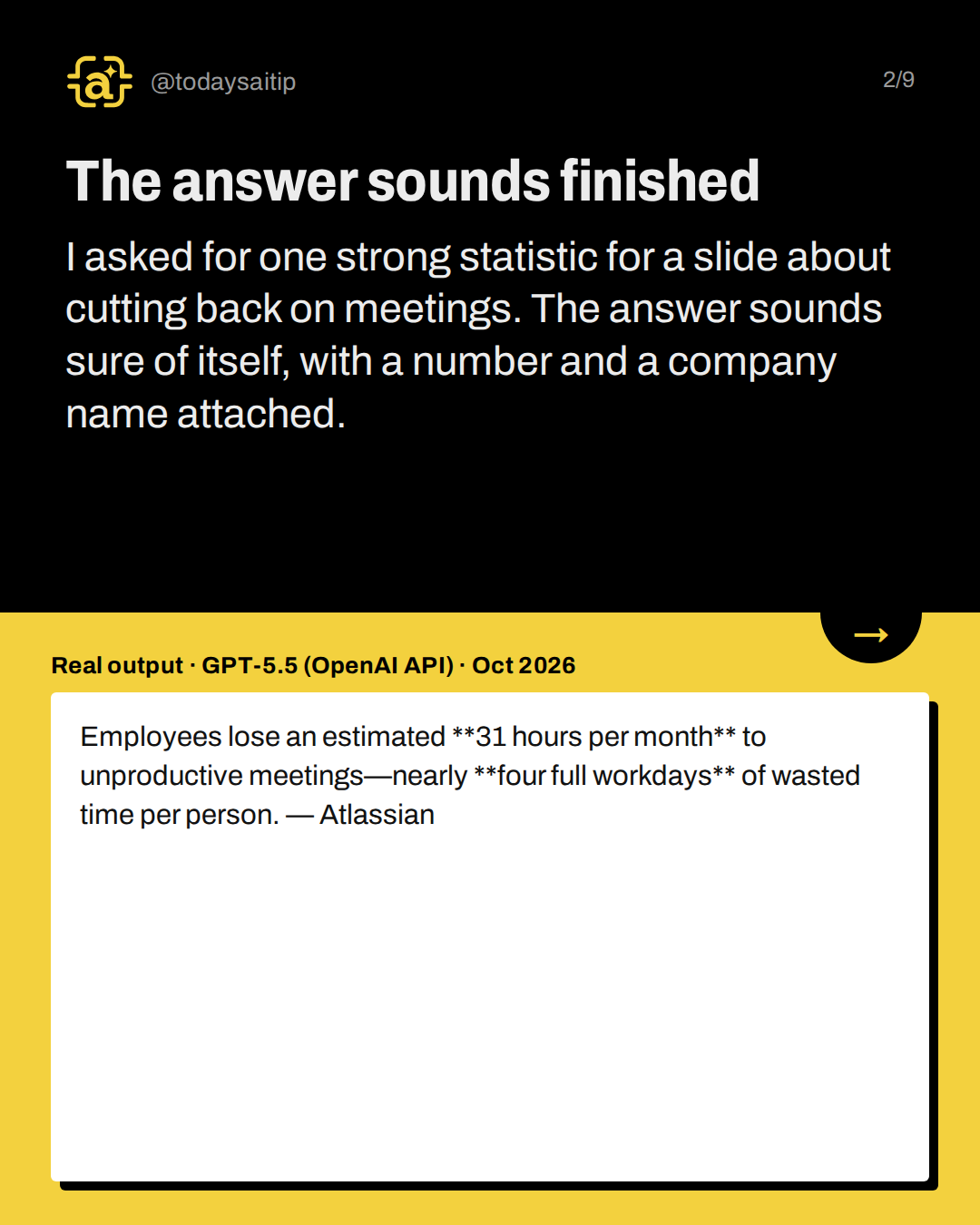
The answer sounds finished
Real output · GPT-5.5 (OpenAI API) · Oct 2026
I asked for one strong statistic for a slide about cutting back on meetings. The answer sounds sure of itself, with a number and a company name attached.
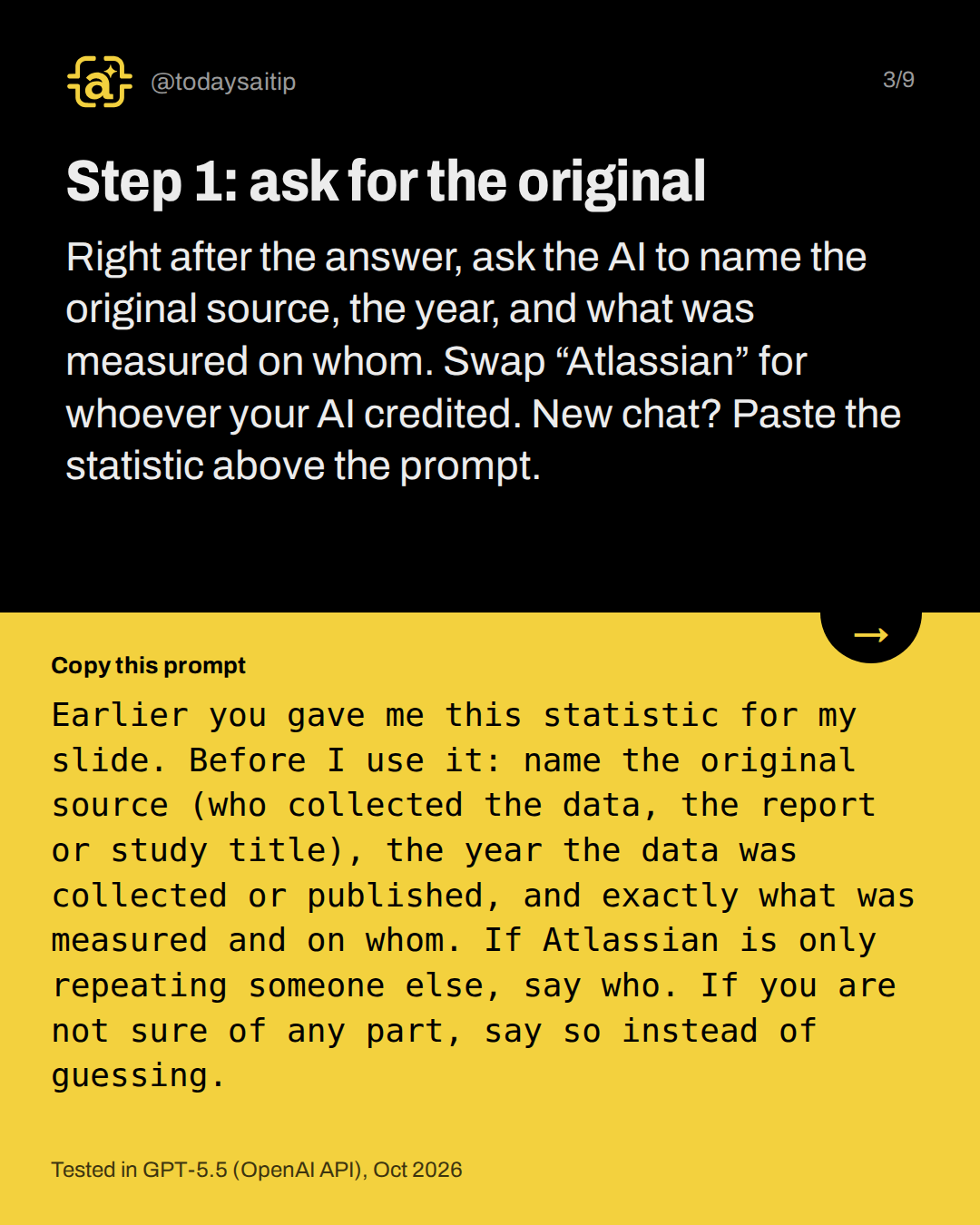
Step 1: ask for the original
Tested in GPT-5.5 (OpenAI API), Oct 2026
Right after the answer, ask the AI to name the original source, the year, and what was measured on whom. Swap “Atlassian” for whoever your AI credited. New chat? Paste the statistic above the prompt.
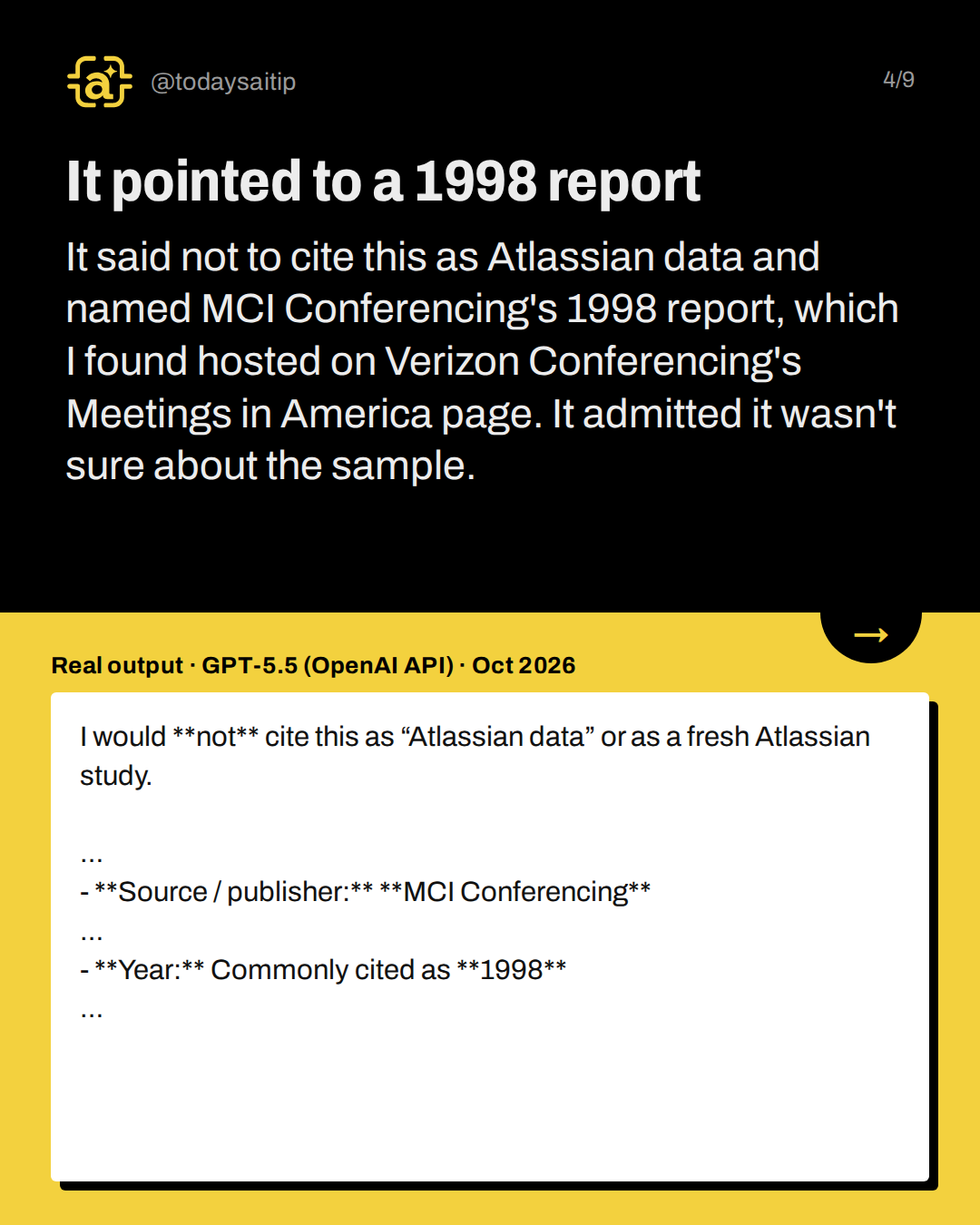
It pointed to a 1998 report
Real output · GPT-5.5 (OpenAI API) · Oct 2026
It said not to cite this as Atlassian data and named MCI Conferencing's 1998 report, which I found hosted on Verizon Conferencing's Meetings in America page. It admitted it wasn't sure about the sample.
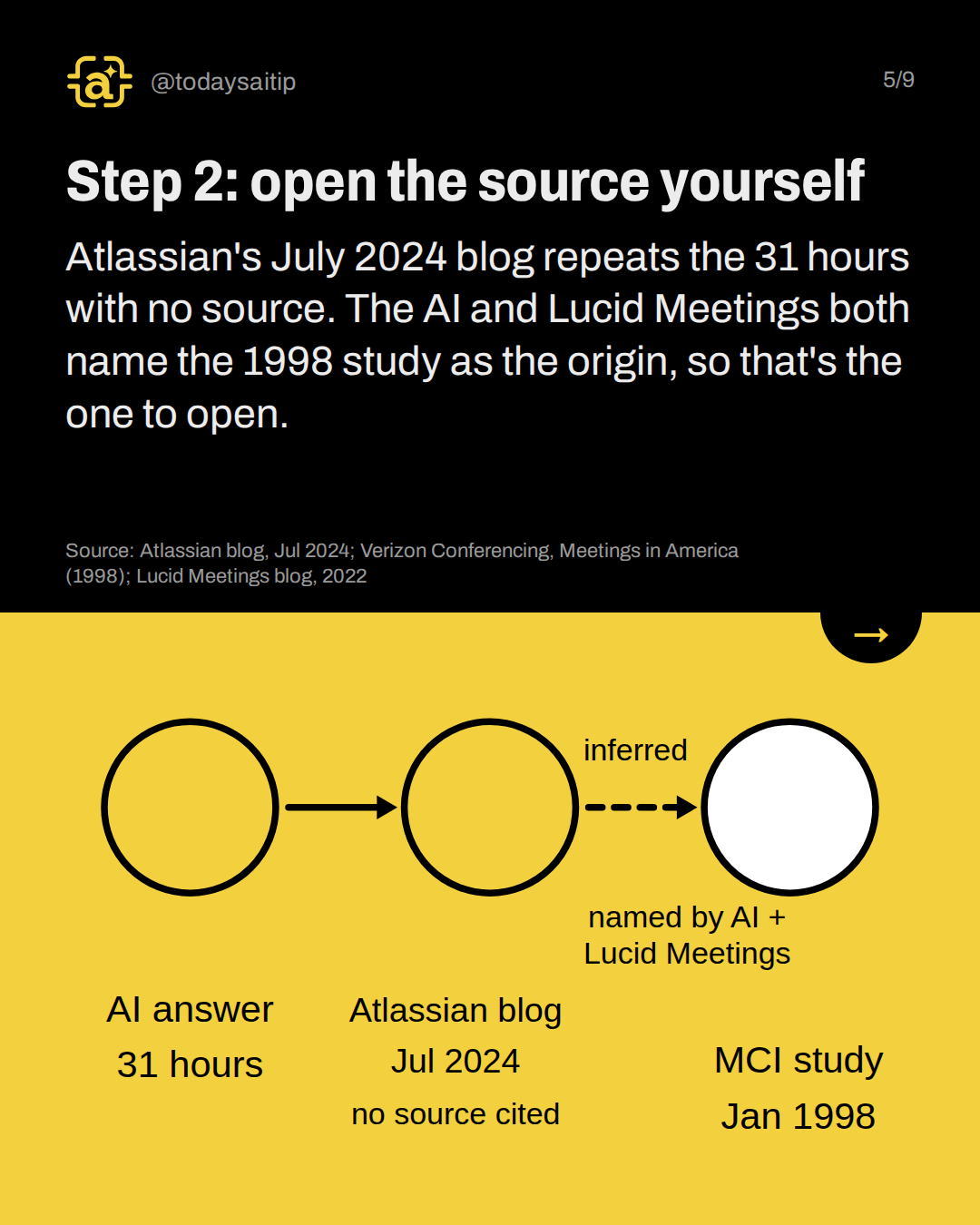
Step 2: open the source yourself
Atlassian's July 2024 blog repeats the 31 hours with no source. The AI and Lucid Meetings both name the 1998 study as the origin, so that's the one to open.
Source: Atlassian blog, Jul 2024; Verizon Conferencing, Meetings in America (1998); Lucid Meetings blog, 2022
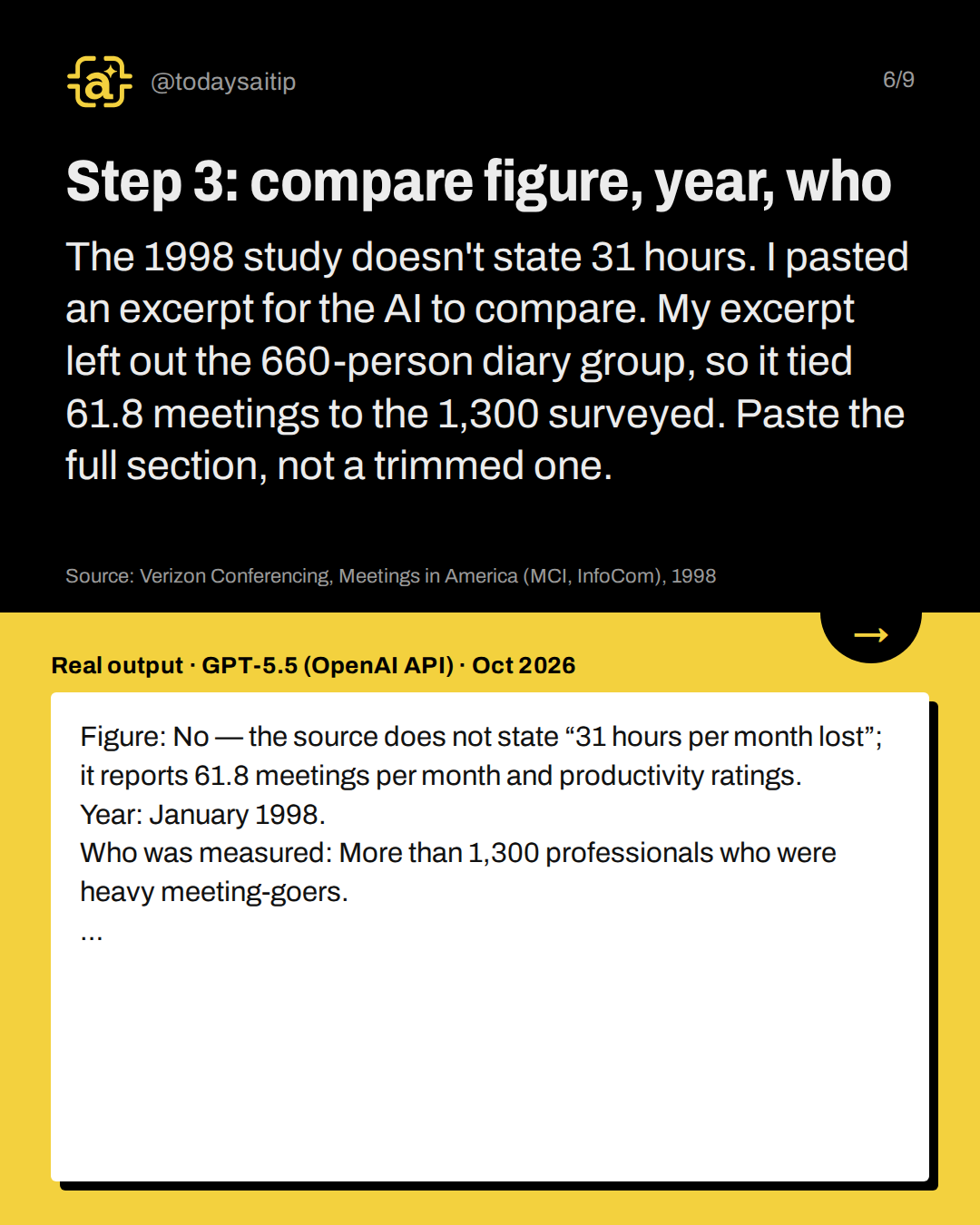
Step 3: compare figure, year, who
Real output · GPT-5.5 (OpenAI API) · Oct 2026
The 1998 study doesn't state 31 hours. I pasted an excerpt for the AI to compare. My excerpt left out the 660-person diary group, so it tied 61.8 meetings to the 1,300 surveyed. Paste the full section, not a trimmed one.
Source: Verizon Conferencing, Meetings in America (MCI, InfoCom), 1998
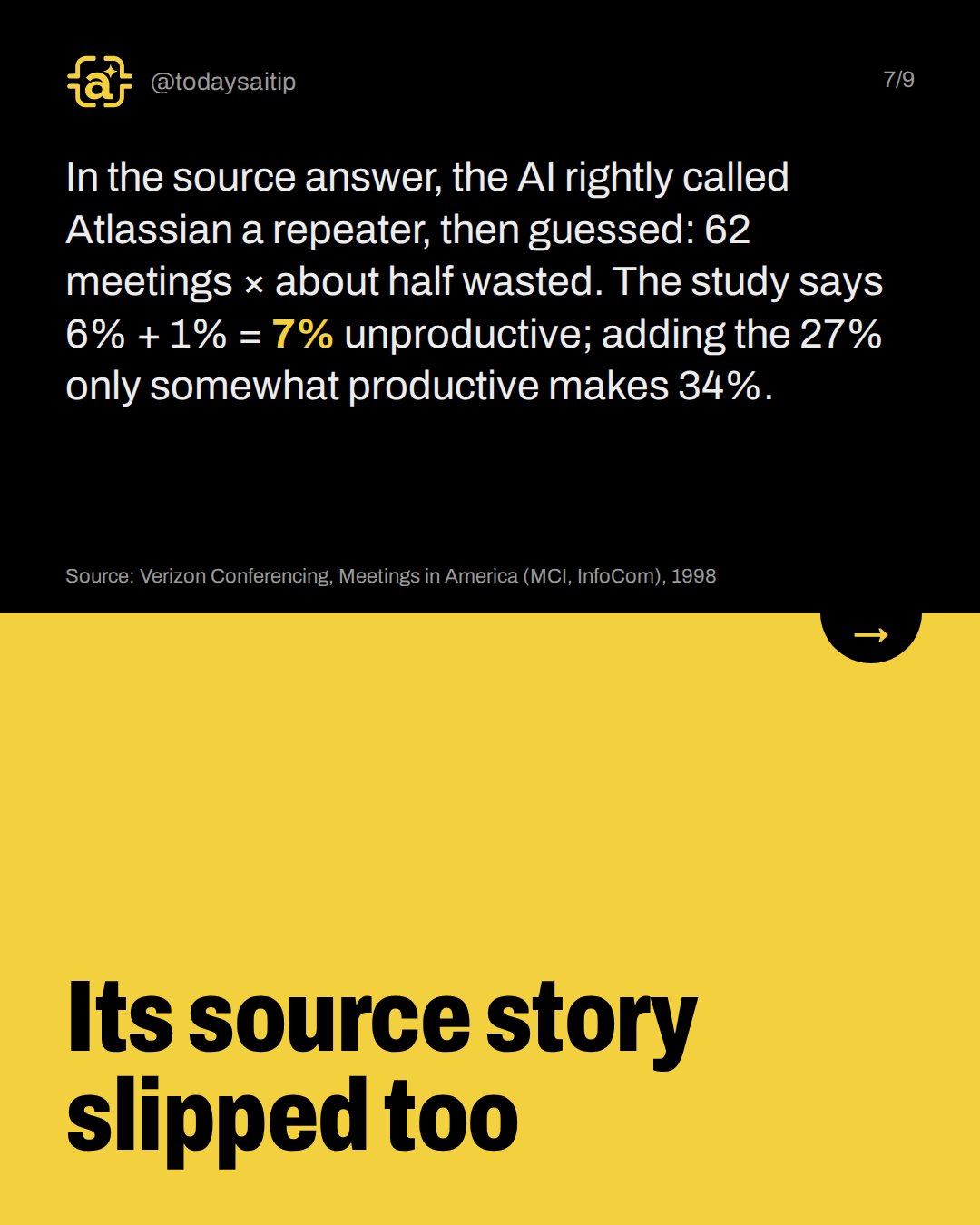
Its source story slipped too
In the source answer, the AI rightly called Atlassian a repeater, then guessed: 62 meetings × about half wasted. The study says 6% + 1% = 7% unproductive; adding the 27% only somewhat productive makes 34%.
Source: Verizon Conferencing, Meetings in America (MCI, InfoCom), 1998
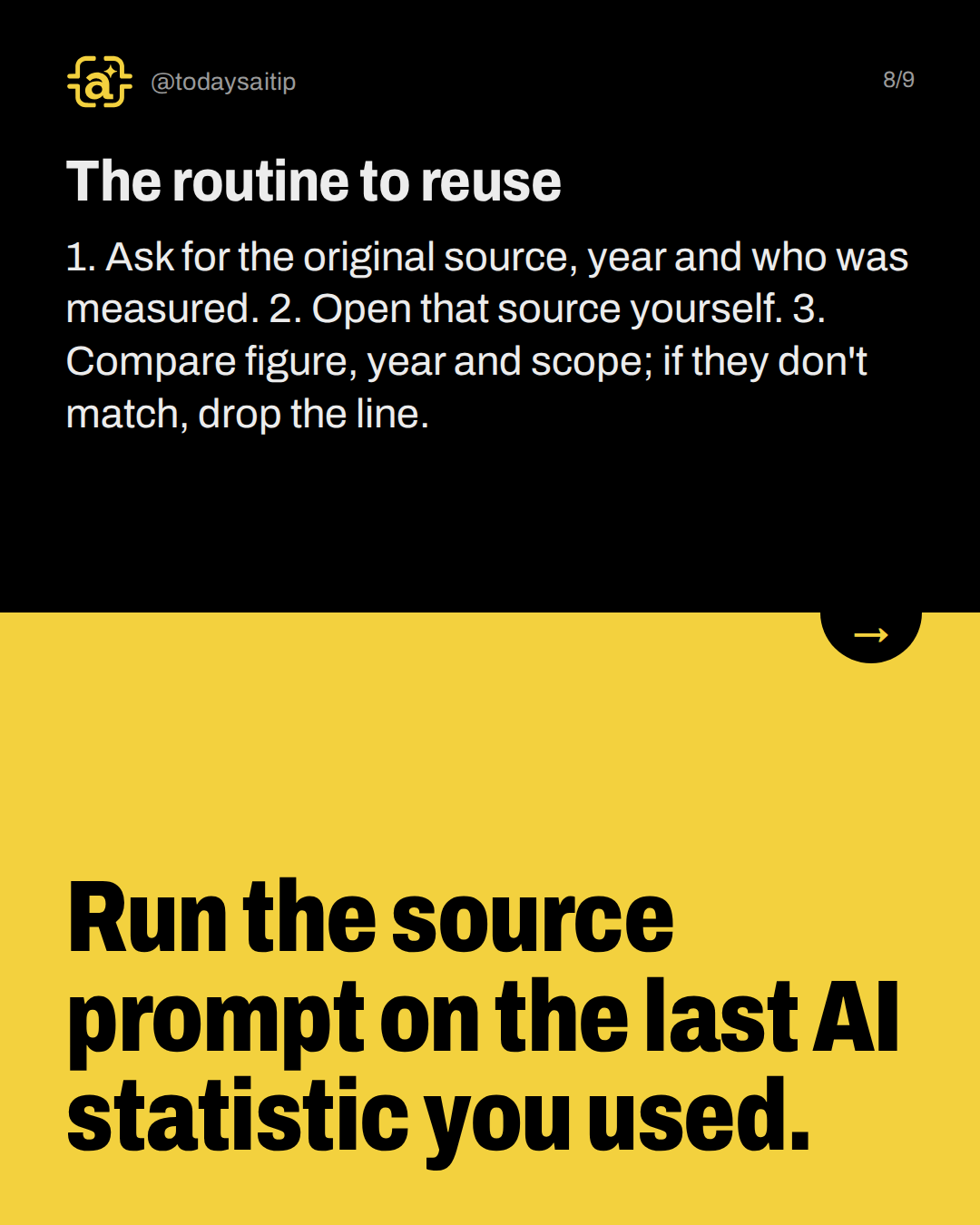
The routine to reuse
1. Ask for the original source, year and who was measured. 2. Open that source yourself. 3. Compare figure, year and scope; if they don't match, drop the line.
Try it: Run the source prompt on the last AI statistic you used.
Sources and assumptions
- Atlassian Blog (Loom): 6 Surefire Ways to Run More Effective Meetings and Save Time: Atlassian's July 29, 2024 article states 'the average employee spends 31 hours in unproductive meetings every month' and gives no source for it (checked 2026-10-03)
- Atlassian: Workplace Woes: Meetings (the former time-wasting-at-work infographic URL): The infographic URL that secondary sources cite for '31 hours' now shows different survey stats (Loom-era figures such as 72%, 78%, 80%) and no '31 hours' figure (checked 2026-10-03)
- Verizon Conferencing: Meetings in America (MCI white paper, study by InfoCom): InfoCom (a division of NFO Worldwide) ran the study in January 1998, diaries Jan 26 to Feb 6, 1998. More than 1,300 phone-survey participants focused on 'heavy meeting-goers', then 660 heavy meeting-goers in diary research. Total of 61.8 meetings per month (12.2 travel/audio/video plus an estimated 49.6 internal face-to-face). 22% extremely, 44% very and 27% somewhat productive; 6% not very and 1% not at all productive. No '31 hours' figure. (checked 2026-10-03)
- Lucid Meetings Blog, Elise Keith: 55 Million: A Fresh Look at the Number, Effectiveness, and Cost of Meetings in the U.S. (updated Sept 3, 2022): An independent analysis noting that Atlassian's graphic points to the 1998 Verizon study, that the sample was hand-picked heavy meeting-goers (so 62 meetings per month doesn't describe typical workers), and that the study found 93% of meetings at least somewhat productive, which contradicts '50% unproductive' (checked 2026-10-03)
Assumptions:
- The tests ran in GPT-5.5 via the OpenAI API (default settings, no reasoning-effort override) on 2026-10-04 UTC (evening of 2026-10-03 local). The Claude runner (claude -p) failed in this research session, so no Claude output exists and the slides must not claim Claude was tested. Label every card 'GPT-5.5 (OpenAI API), Oct 2026'.
- This is one statistic from one run, not evidence of how often AI statistics are wrong. Don't present it as typical.
- The 'ask' and 'source' prompts are separate single-turn API calls. The second one pasted the first answer in as input ('Your earlier answer: …') to stand in for a follow-up in the same chat.
- The 'compare' run was given a hand-copied excerpt of the MCI source text, not the web page itself.
- The Verizon page says 'our respondents' for the 61.8 figure without clearly separating the 1,300 phone-survey group from the 660-person diary group. Slides should say 'heavy meeting-goers surveyed in 1998' and not tie 61.8 to the 1,300.
- The '31 hours' number may come from some intermediate source we didn't find. The claim we can support is narrow: the 1998 study that both the AI and Lucid Meetings name as the origin doesn't state it, and Atlassian's 2024 article gives no source.
- All sample material is public. No personal or confidential data was used.
The short version
- Ask for the original source and year
- Open that source yourself
- Compare figure, year and who was measured
- Treat the AI's source story as a lead