 Today's AI Tip
Survey to customer email in one AI prompt? Split it into three.

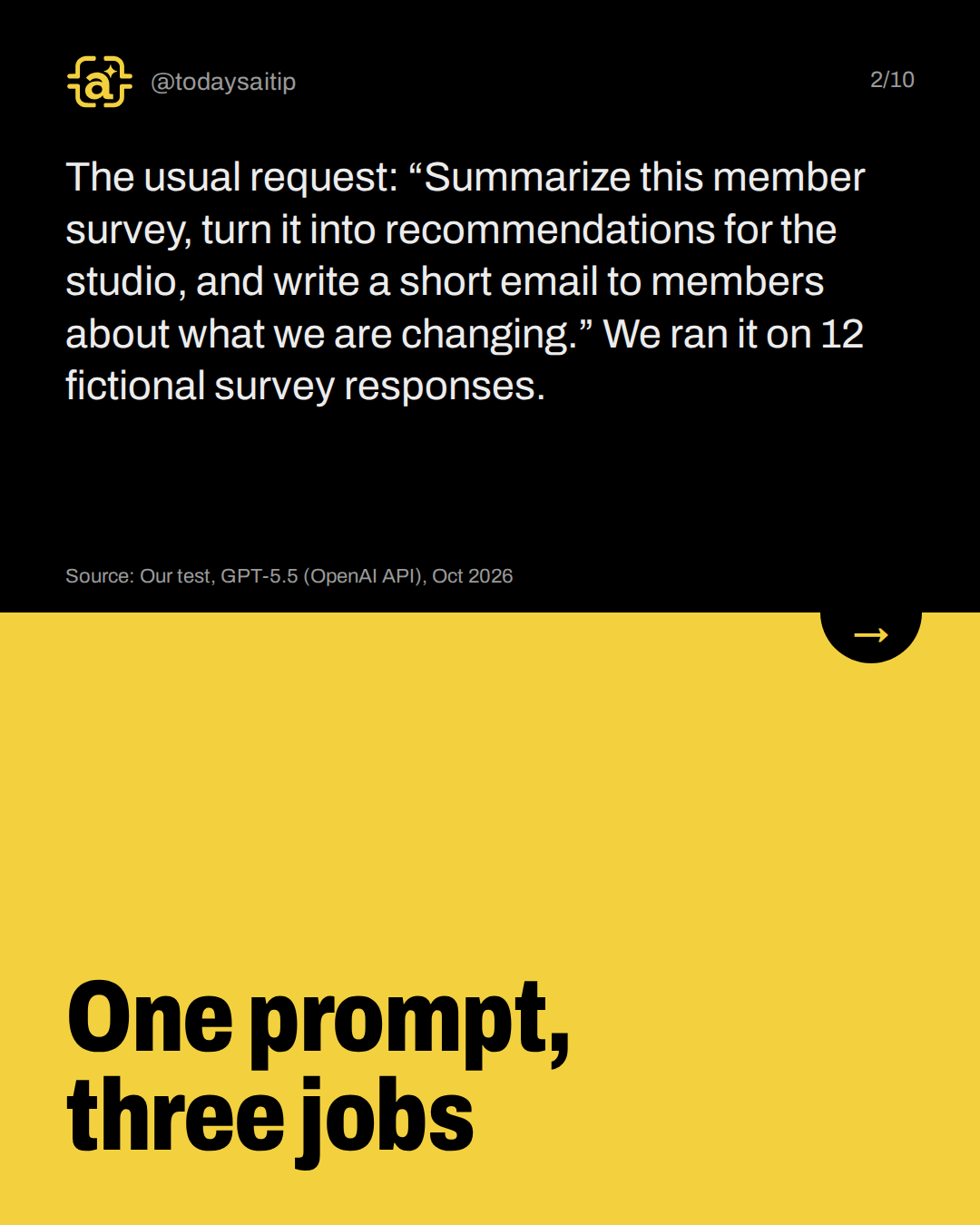
One prompt, three jobs
The usual request: “Summarize this member survey, turn it into recommendations for the studio, and write a short email to members about what we are changing.” We ran it on 12 fictional survey responses.
Source: Our test, GPT-5.5 (OpenAI API), Oct 2026
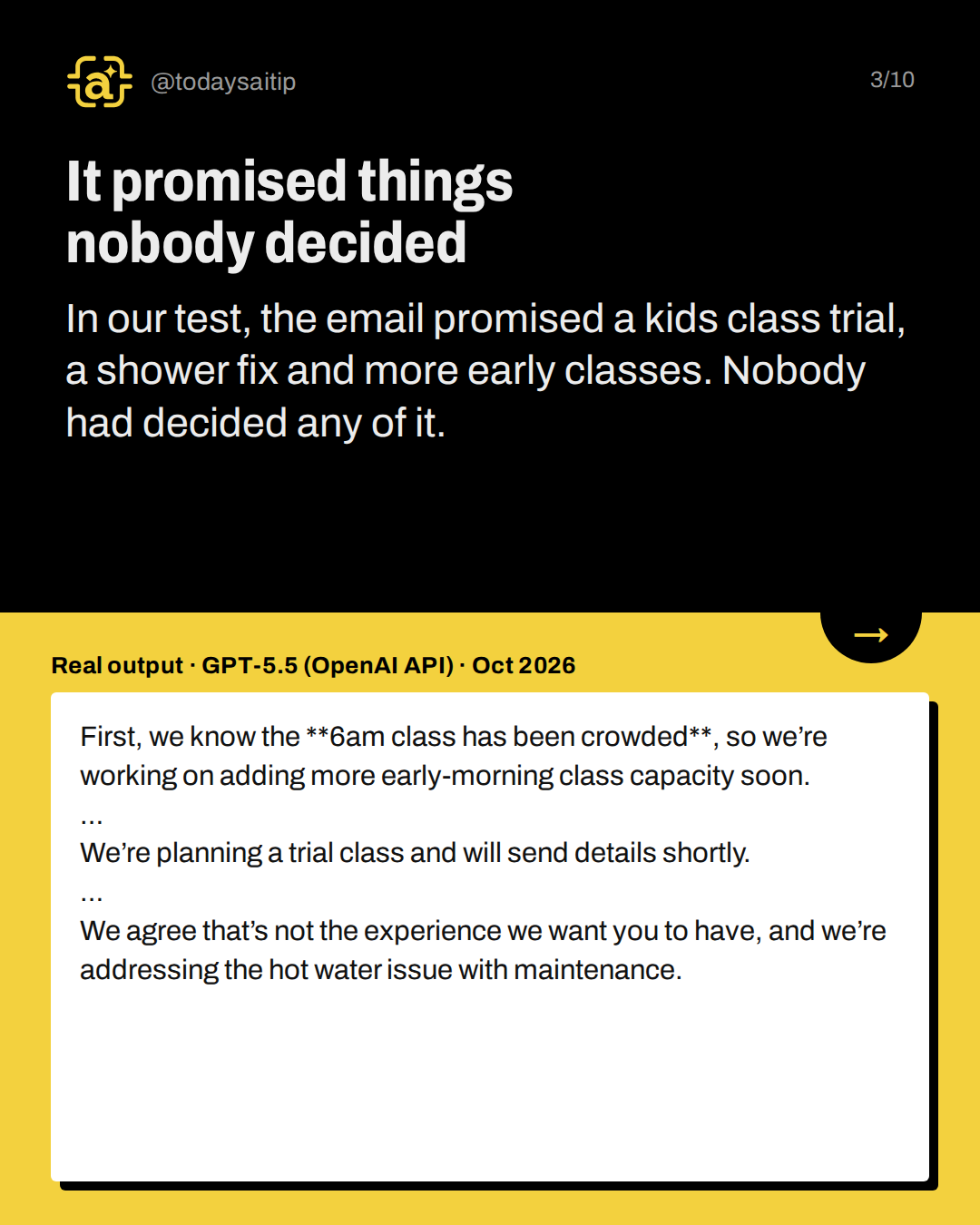
It promised things nobody decided
Real output · GPT-5.5 (OpenAI API) · Oct 2026
In our test, the email promised a kids class trial, a shower fix and more early classes. Nobody had decided any of it.
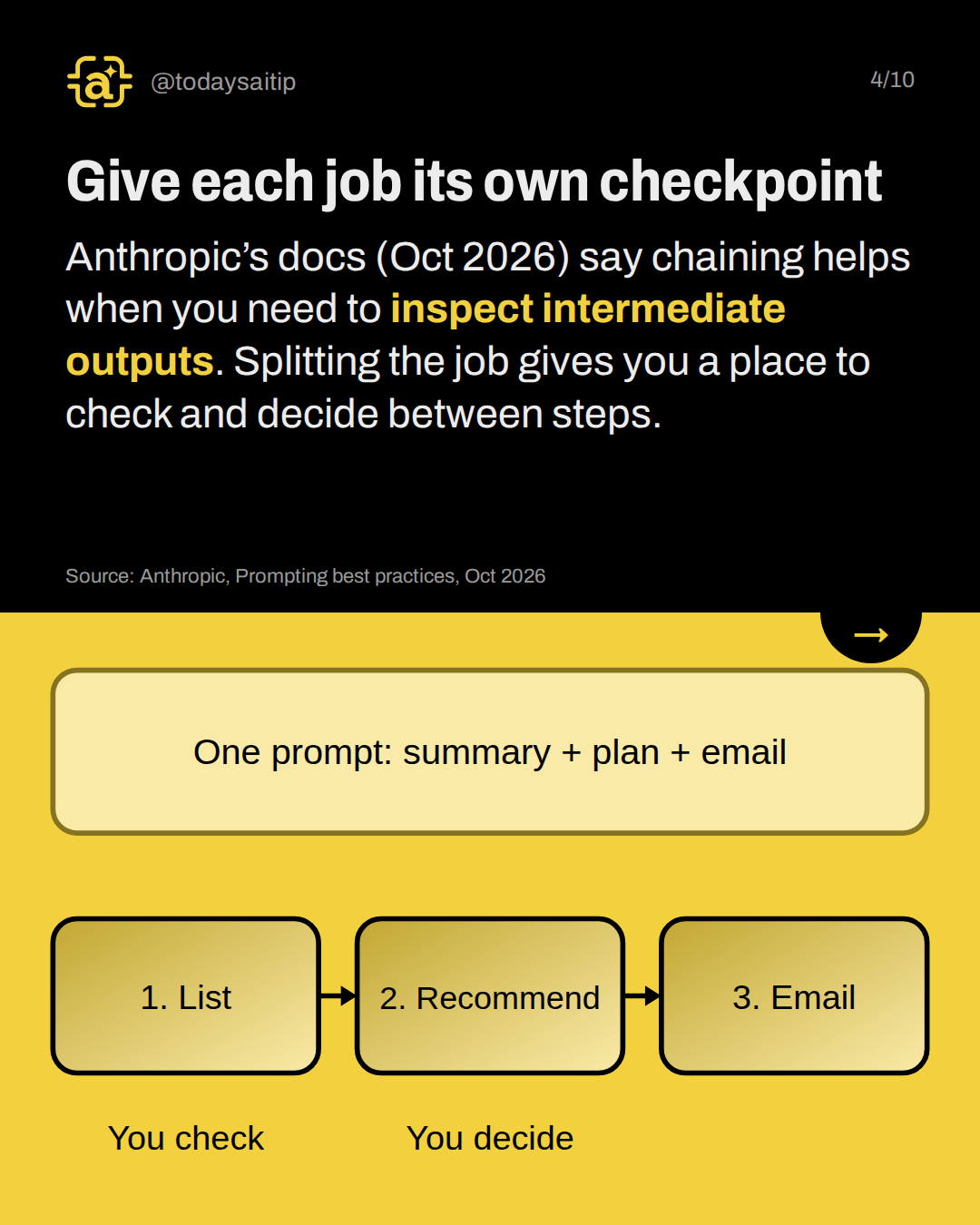
Give each job its own checkpoint
Anthropic’s docs (Oct 2026) say chaining helps when you need to inspect intermediate outputs. Splitting the job gives you a place to check and decide between steps.
Source: Anthropic, Prompting best practices, Oct 2026
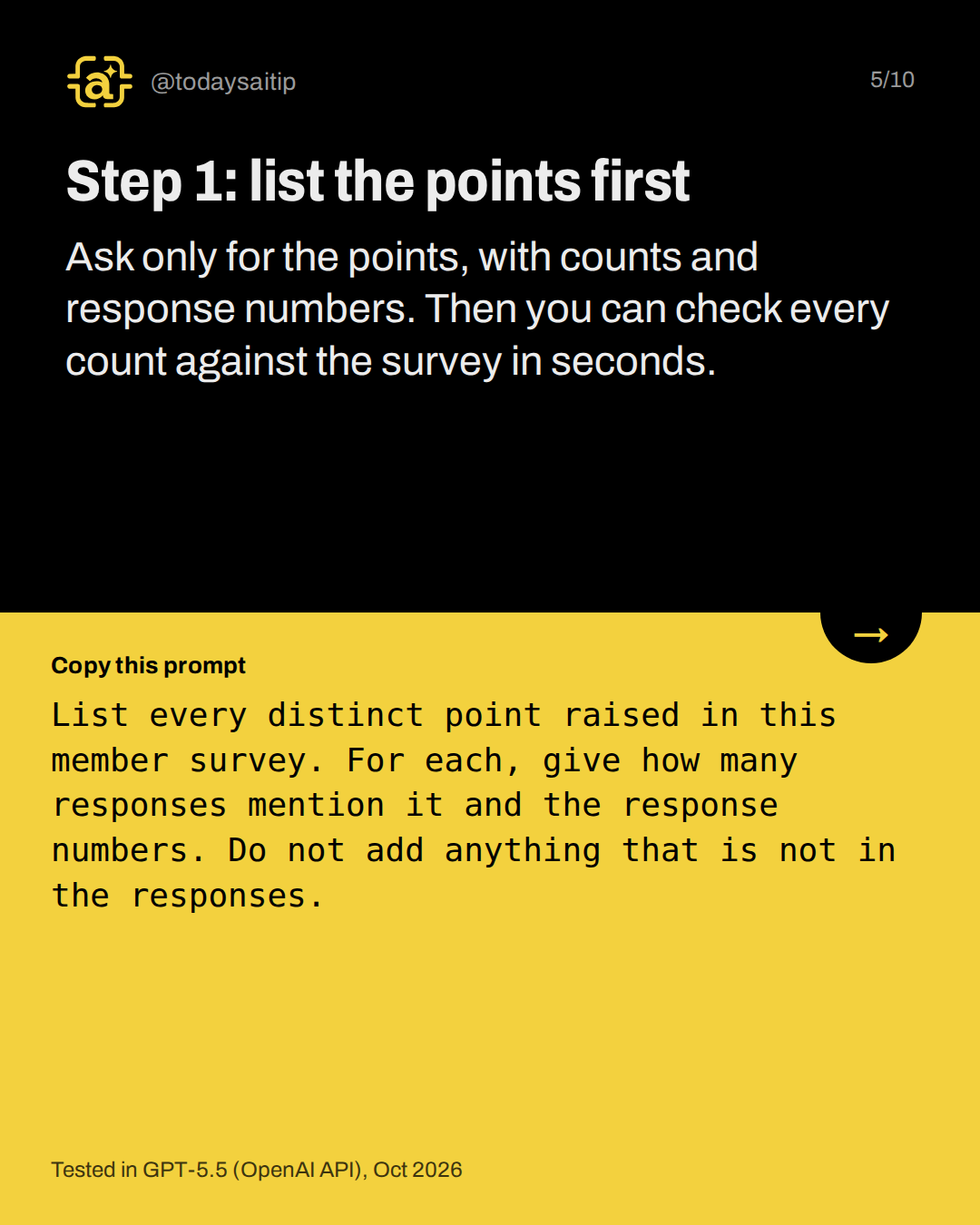
Step 1: list the points first
Tested in GPT-5.5 (OpenAI API), Oct 2026
Ask only for the points, with counts and response numbers. Then you can check every count against the survey in seconds.
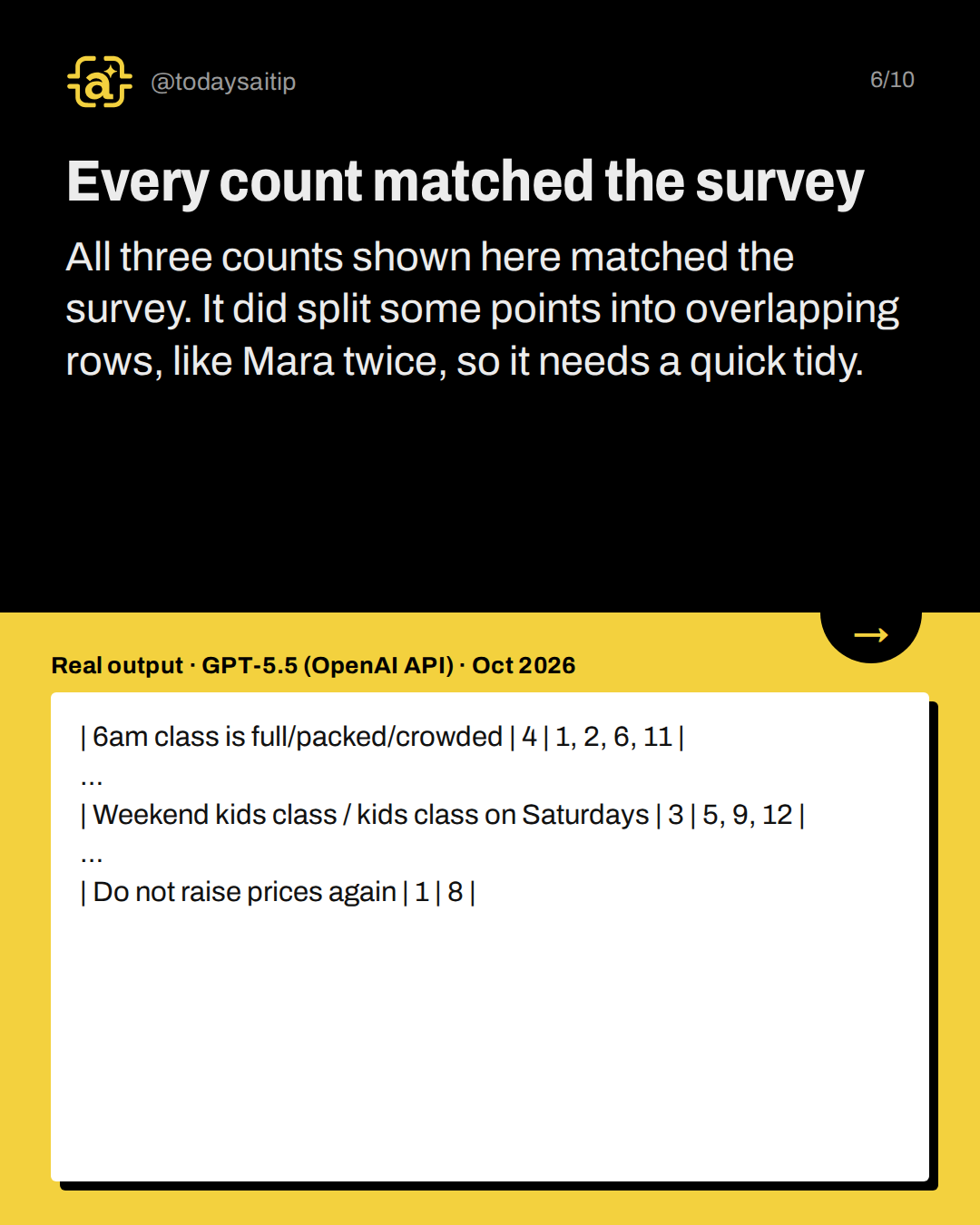
Every count matched the survey
Real output · GPT-5.5 (OpenAI API) · Oct 2026
All three counts shown here matched the survey. It did split some points into overlapping rows, like Mara twice, so it needs a quick tidy.
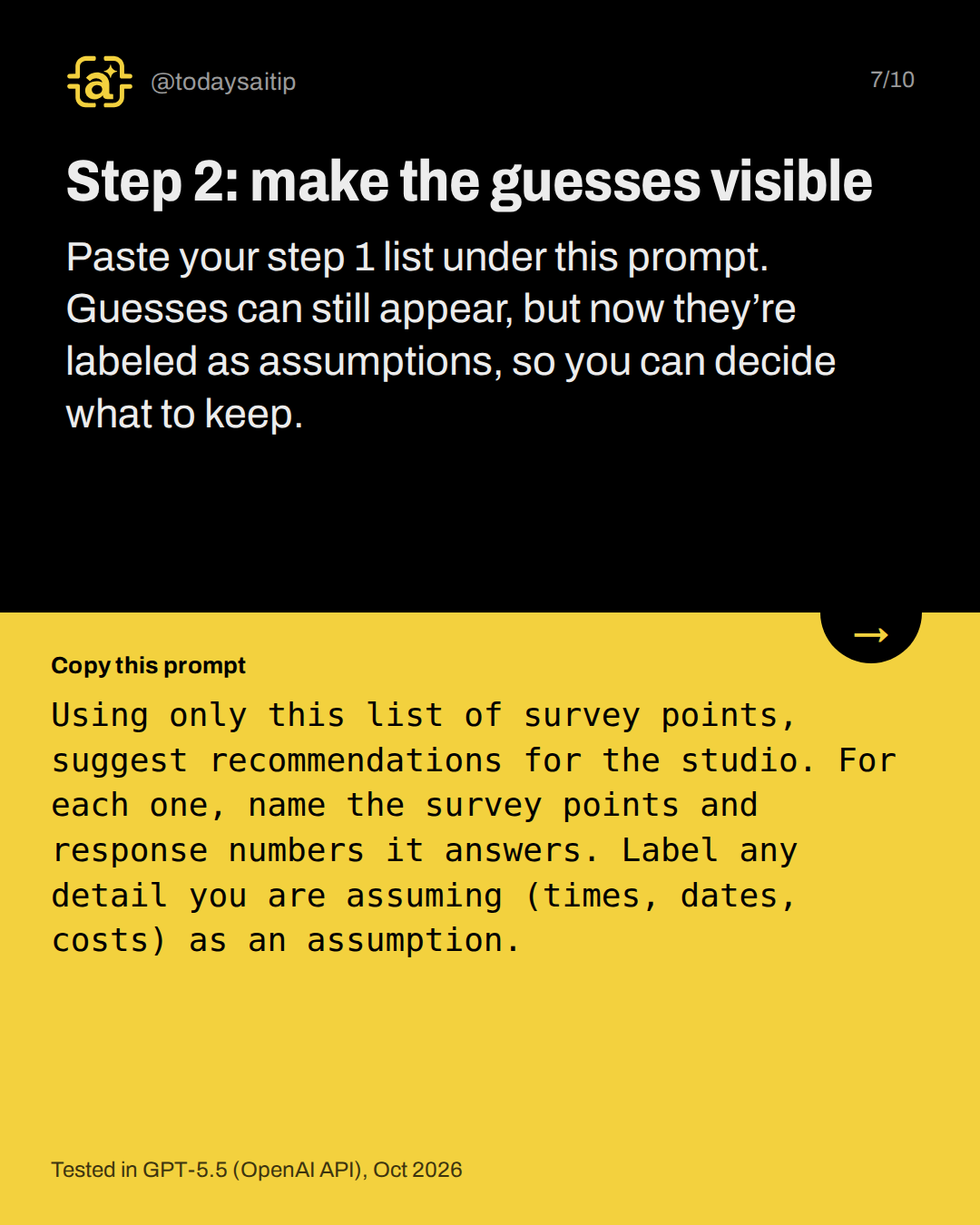
Step 2: make the guesses visible
Tested in GPT-5.5 (OpenAI API), Oct 2026
Paste your step 1 list under this prompt. Guesses can still appear, but now they’re labeled as assumptions, so you can decide what to keep.
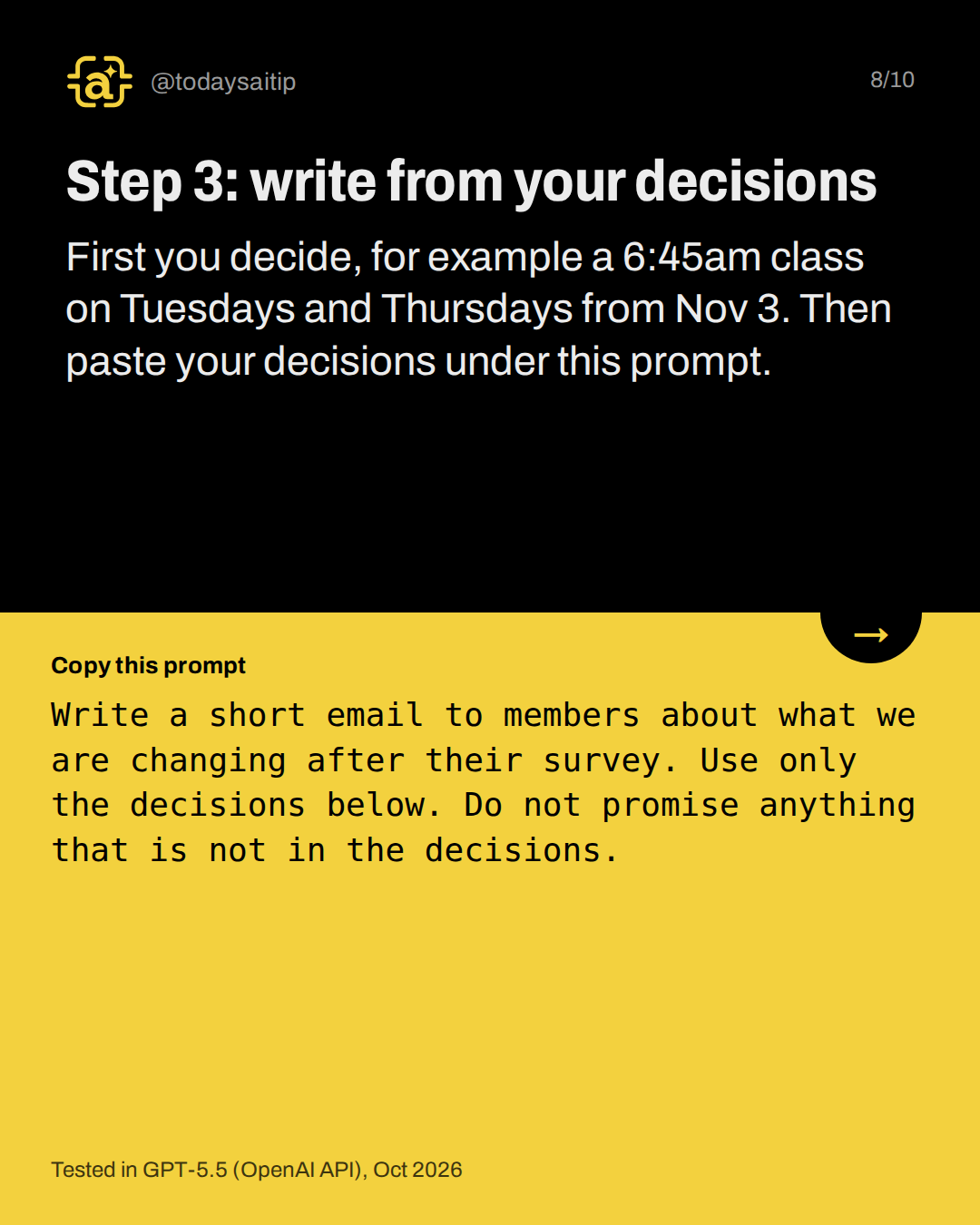
Step 3: write from your decisions
Tested in GPT-5.5 (OpenAI API), Oct 2026
First you decide, for example a 6:45am class on Tuesdays and Thursdays from Nov 3. Then paste your decisions under this prompt.
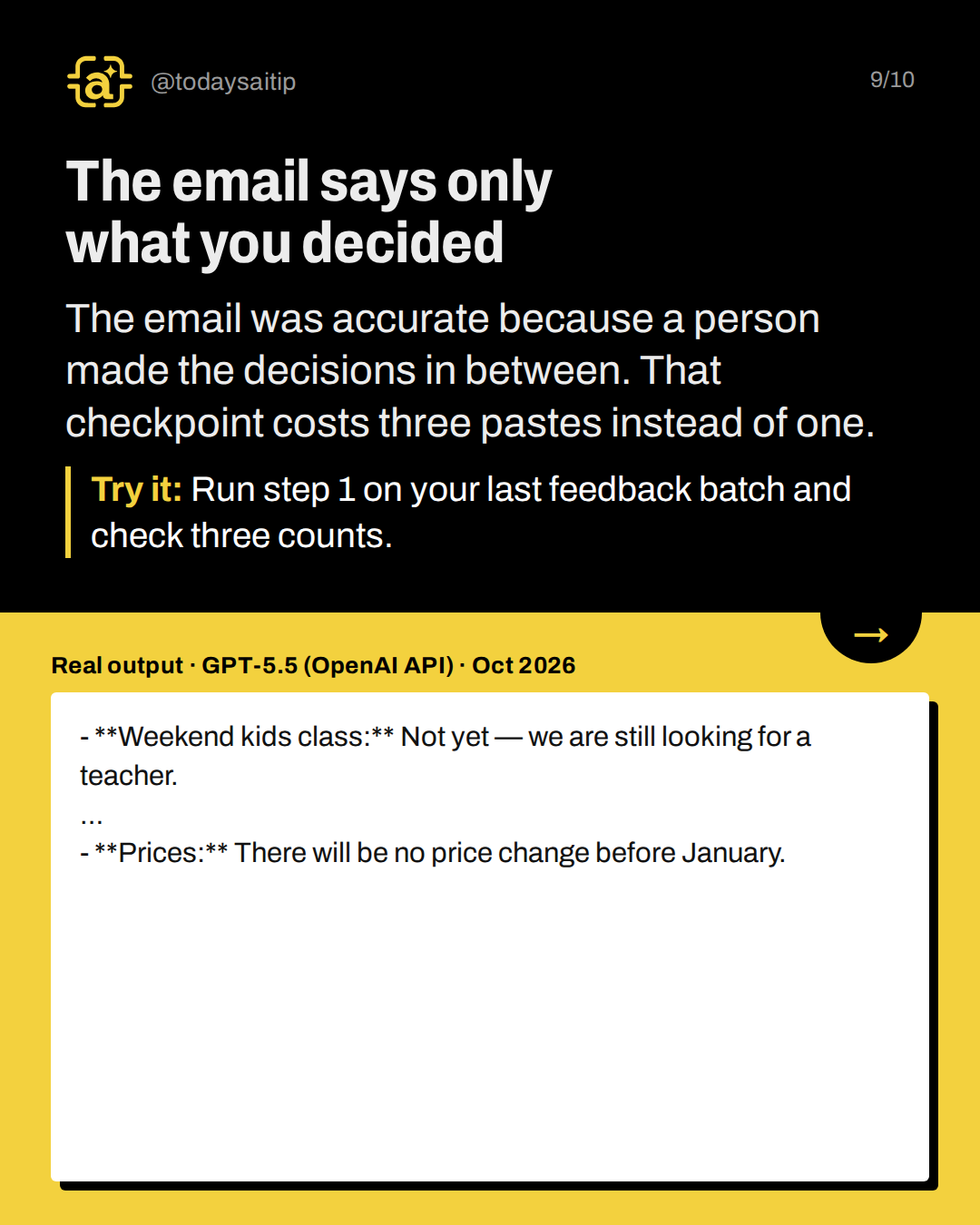
The email says only what you decided
Real output · GPT-5.5 (OpenAI API) · Oct 2026
The email was accurate because a person made the decisions in between. That checkpoint costs three pastes instead of one.
Try it: Run step 1 on your last feedback batch and check three counts.
Sources and assumptions
- Anthropic, Prompting best practices (Claude Platform Docs), section 'Chain complex prompts': Verbatim: 'With adaptive thinking and subagent orchestration, Claude handles most multistep reasoning internally. Explicit prompt chaining (breaking a task into sequential API calls) is still useful when you need to inspect intermediate outputs or enforce a specific pipeline structure.' The docs frame chaining as a way to inspect steps, not as a general accuracy boost. (checked 2026-10-17)
Assumptions:
- The survey is fictional (Brightside Yoga, 12 made-up responses) and was written for this test. No real customer data.
- The decisions given to step 3 are fictional and were written by us after reading steps 1–2. In real use the reader makes those decisions. That is the point of the checkpoint.
- All four tests ran on GPT-5.5 through the OpenAI API (label 'GPT-5.5 (OpenAI API)', Oct 2026), not the ChatGPT app. The Claude runs failed in this research session (claude -p errored, so their outputs are null in tests.json), so no slide may say the prompts were tested in Claude.
- Each chained step was a separate API call with no shared chat history. Steps 2 and 3 got only the text shown in their recorded inputs.
- Nov 3, 2026 is a Tuesday and Oct 22, 2026 is a Thursday, so the fictional dates are consistent.
- One run per prompt. The one-prompt version won't always promise unplanned changes, so the post should say 'in our test'.
The short version
- One request with three jobs invites made-up promises.
- Step 1: list the points with counts.
- Step 2: recommend, and label assumptions.
- Step 3: write only from your decisions.