 Today's AI Tip
Writing copy from a spec sheet? Make AI tag every claim.
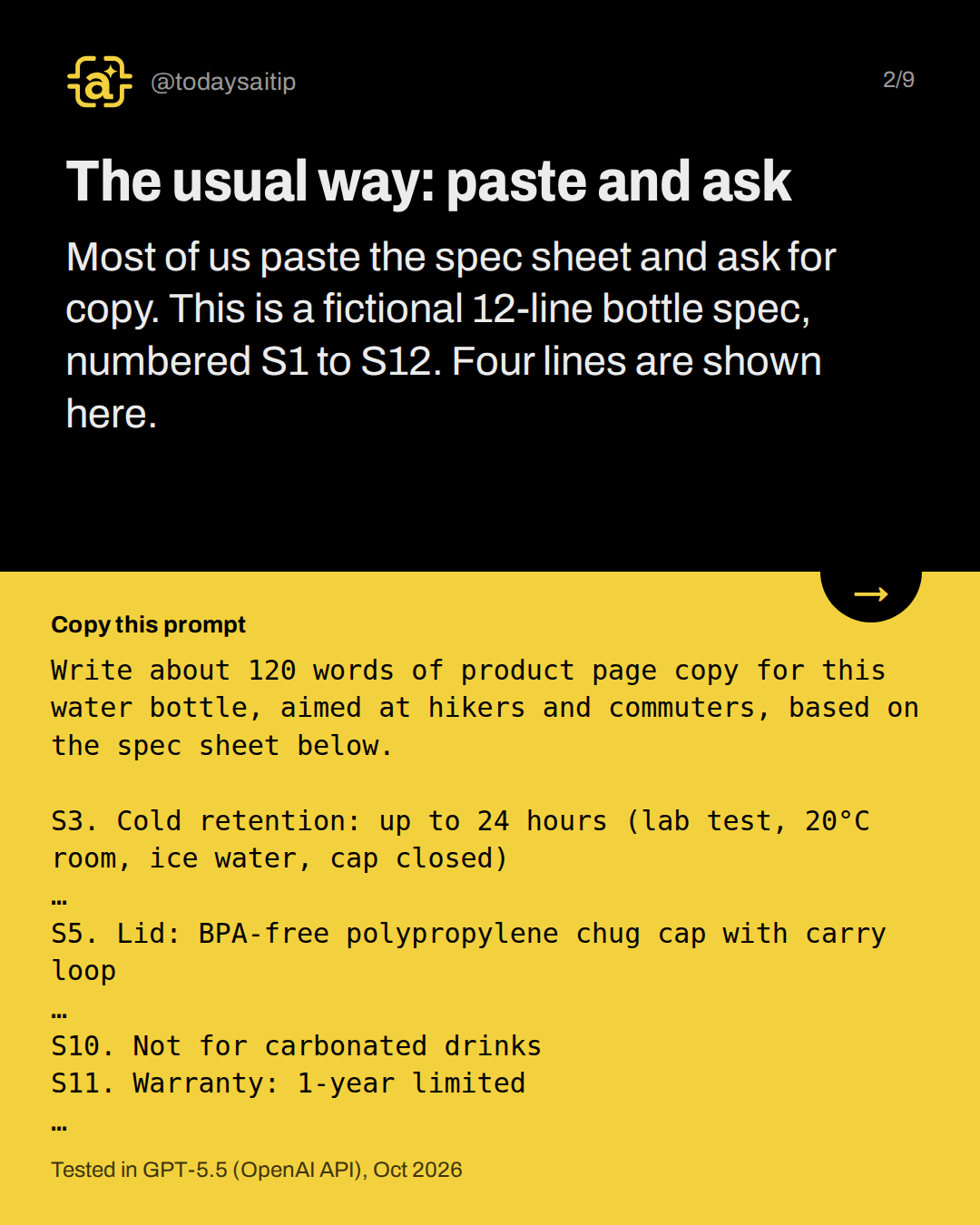
The usual way: paste and ask
Tested in GPT-5.5 (OpenAI API), Oct 2026
Most of us paste the spec sheet and ask for copy. This is a fictional 12-line bottle spec, numbered S1 to S12. Four lines are shown here.
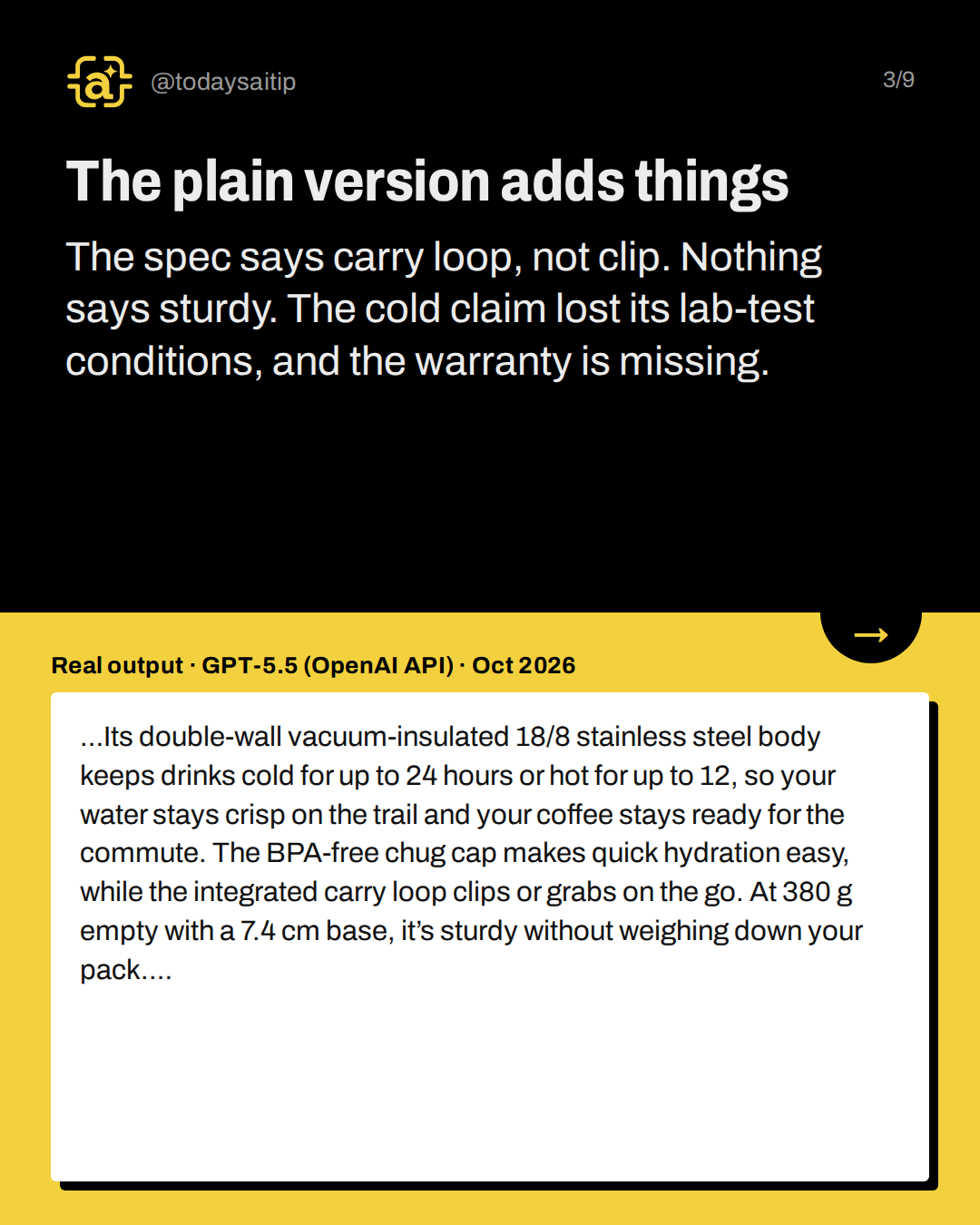
The plain version adds things
Real output · GPT-5.5 (OpenAI API) · Oct 2026
The spec says carry loop, not clip. Nothing says sturdy. The cold claim lost its lab-test conditions, and the warranty is missing.
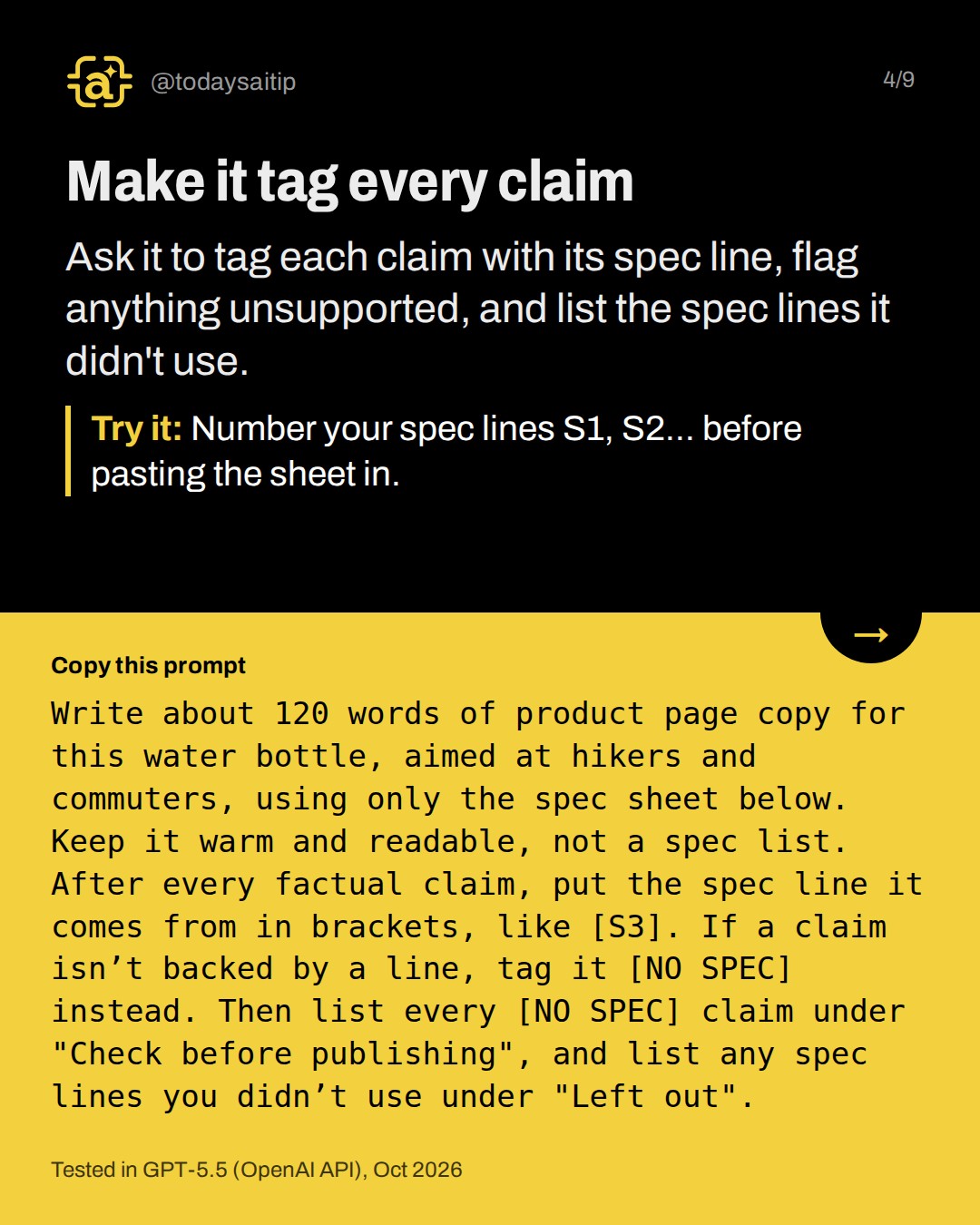
Make it tag every claim
Tested in GPT-5.5 (OpenAI API), Oct 2026
Ask it to tag each claim with its spec line, flag anything unsupported, and list the spec lines it didn't use.
Try it: Number your spec lines S1, S2… before pasting the sheet in.
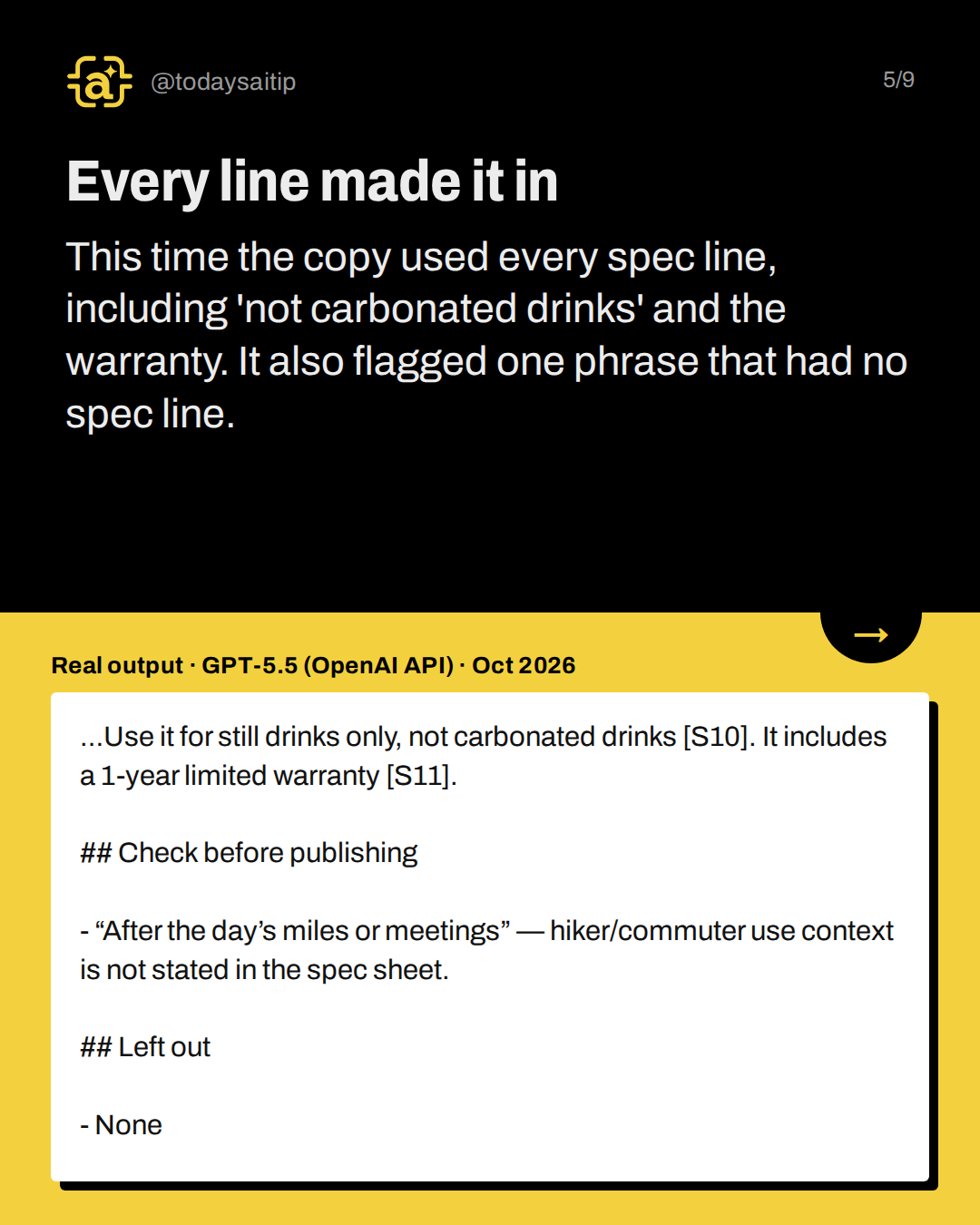
Every line made it in
Real output · GPT-5.5 (OpenAI API) · Oct 2026
This time the copy used every spec line, including 'not carbonated drinks' and the warranty. It also flagged one phrase that had no spec line.
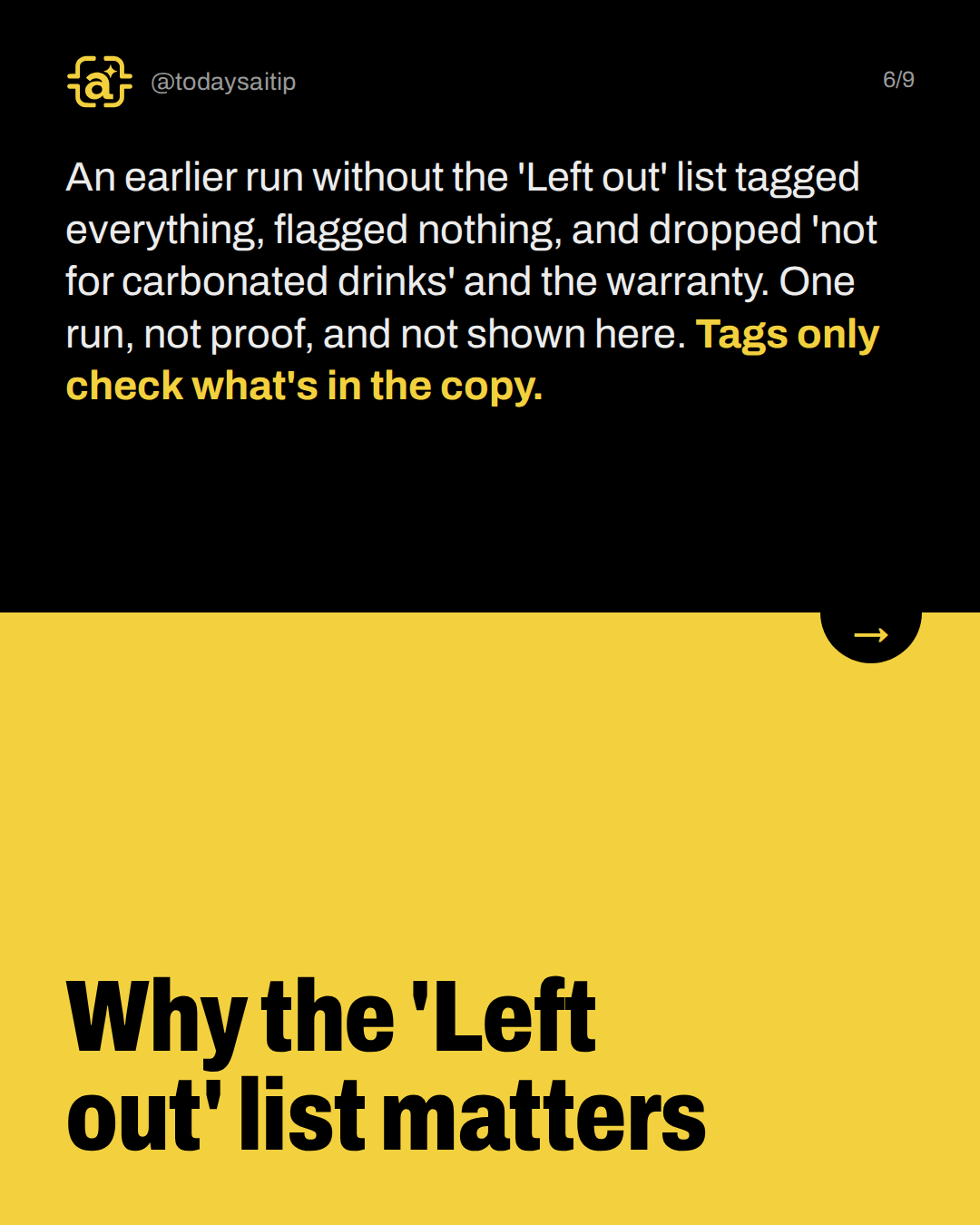
Why the 'Left out' list matters
An earlier run without the 'Left out' list tagged everything, flagged nothing, and dropped 'not for carbonated drinks' and the warranty. One run, not proof, and not shown here. Tags only check what's in the copy.
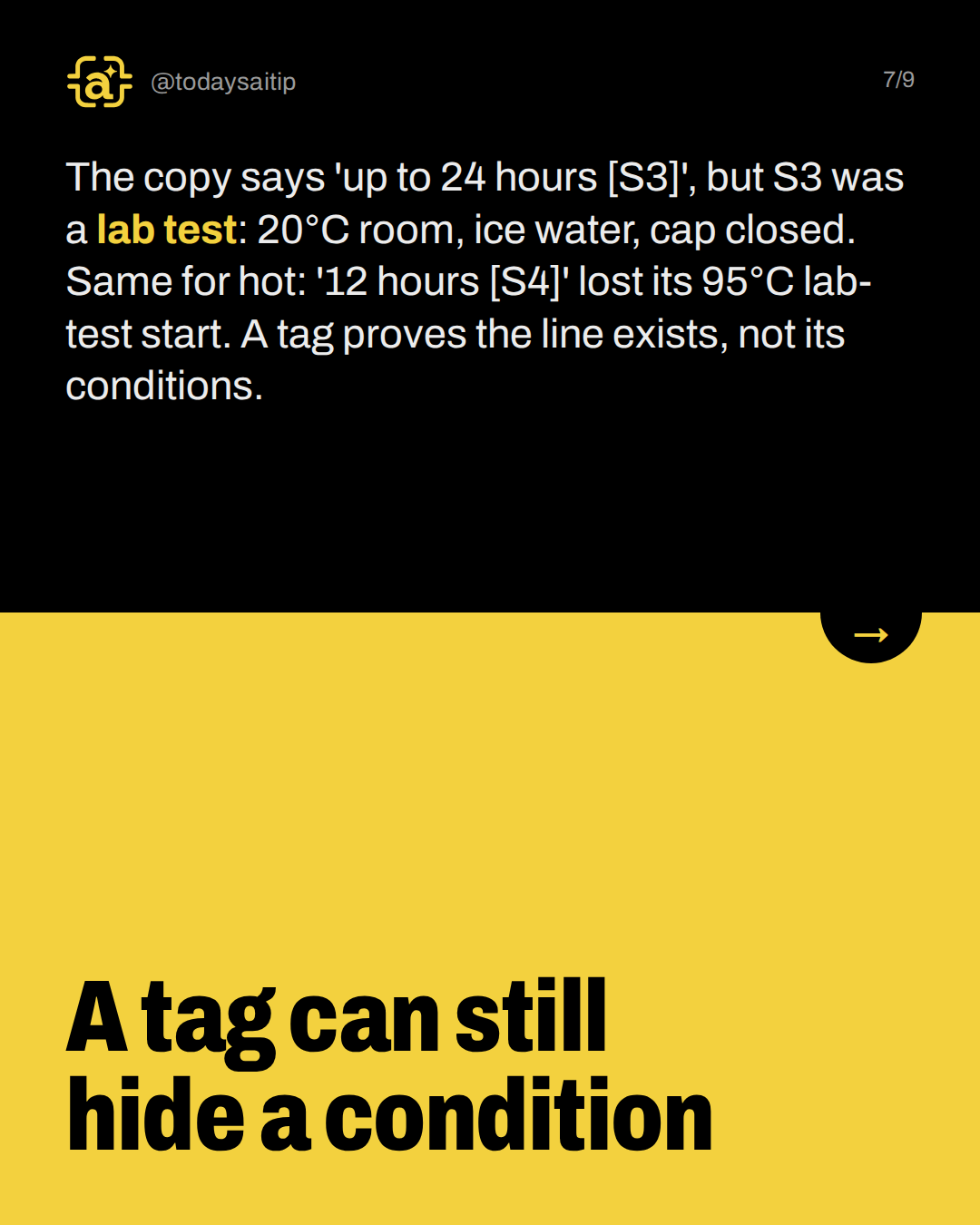
A tag can still hide a condition
The copy says 'up to 24 hours [S3]', but S3 was a lab test: 20°C room, ice water, cap closed. Same for hot: '12 hours [S4]' lost its 95°C lab-test start. A tag proves the line exists, not its conditions.
Why tags matter
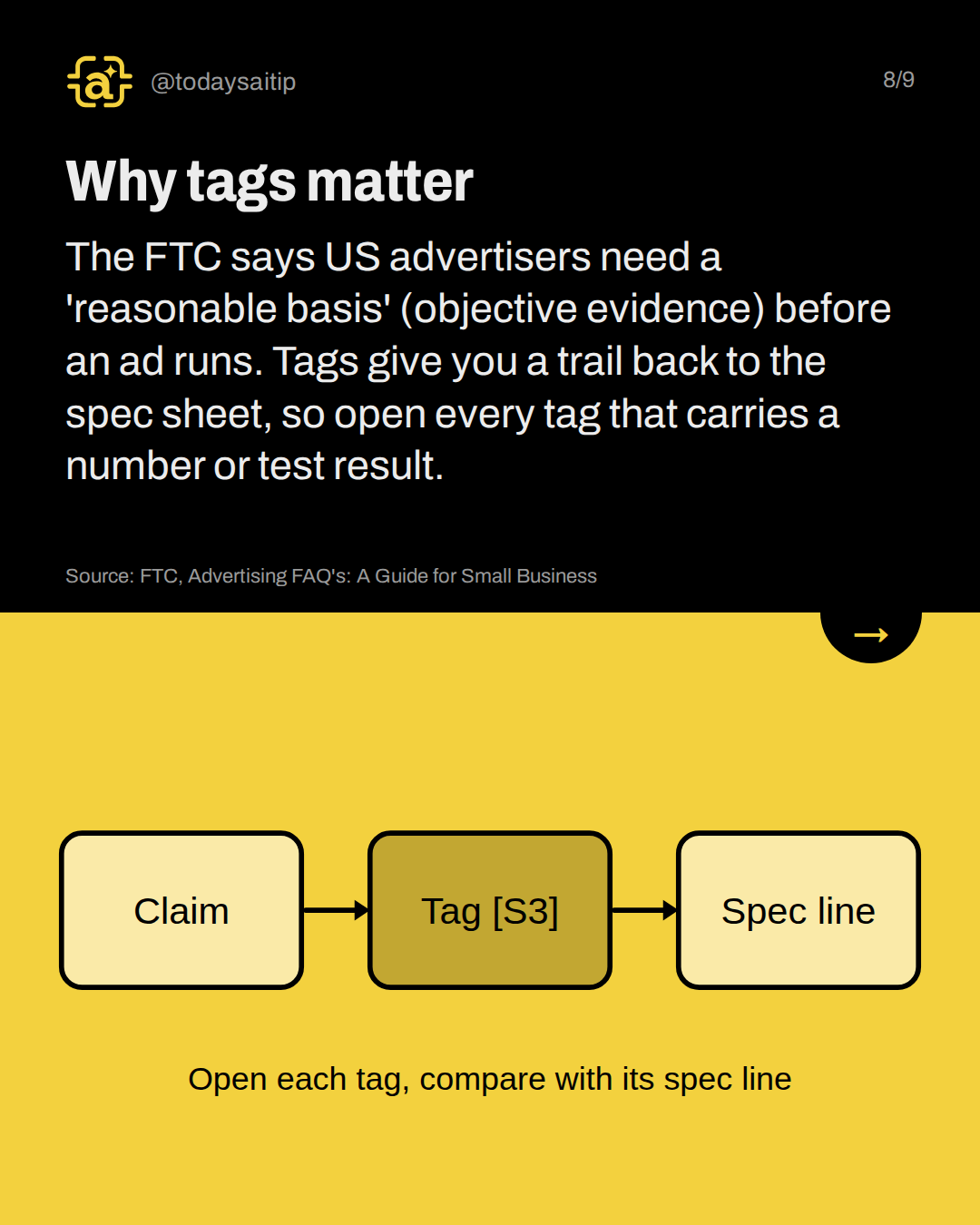
The FTC says US advertisers need a 'reasonable basis' (objective evidence) before an ad runs. Tags give you a trail back to the spec sheet, so open every tag that carries a number or test result.
Source: FTC, Advertising FAQ's: A Guide for Small Business
Sources and assumptions
- FTC: Advertising FAQ's: A Guide for Small Business: 'Before a company runs an ad, it has to have a “reasonable basis” for the claims.' 'A “reasonable basis” means objective evidence that supports the claim.' 'Advertisers must have proof to back up express and implied claims that consumers take from an ad.' Ads must be truthful and non-deceptive. (checked 2026-10-21)
- Anthropic docs: Reduce hallucinations: 'Verify with citations: Make Claude’s response auditable by having it cite quotes and sources for each of its claims… If it can’t find a quote, it must retract the claim.' Its example is a press release drafted 'using only information from these product briefs.' Also: these techniques 'significantly reduce hallucinations, they don’t eliminate them entirely.' (Anthropic's guidance for Claude; the technique was tested here on GPT-5.5 only.) (checked 2026-10-21)
Assumptions:
- The Trailhead 24 oz bottle and its 12-line spec sheet (v3, Oct 2026) are fictional, written for this test. No real brand or product.
- All slide outputs come from GPT-5.5 via the OpenAI API (label: 'GPT-5.5 (OpenAI API)', Oct 2026), not the ChatGPT app. The Claude runs failed to execute in this research session (CLI error, output null), so the post must not claim the prompt was tested in Claude.
- Each prompt was run once. Another run can tag or flag differently. The runs show behavior, not a rate.
- The plain prompt (before-gpt) and the final tagging prompt (after-gpt-3) both name 'hikers and commuters'. after-gpt-2 is the same tagging prompt without 'Keep it warm…' or the 'Left out' list.
- The FTC reference is US law and general background, not legal advice. The post must not claim tagging makes copy legally compliant.
The short version
- Tag every claim with its spec line
- Flag claims that have no spec line
- Ask for the lines it left out
- Open the tags: conditions can still vanish