 Today's AI Tip
Asked AI to make my email nicer. My deadline became a question.
The usual request
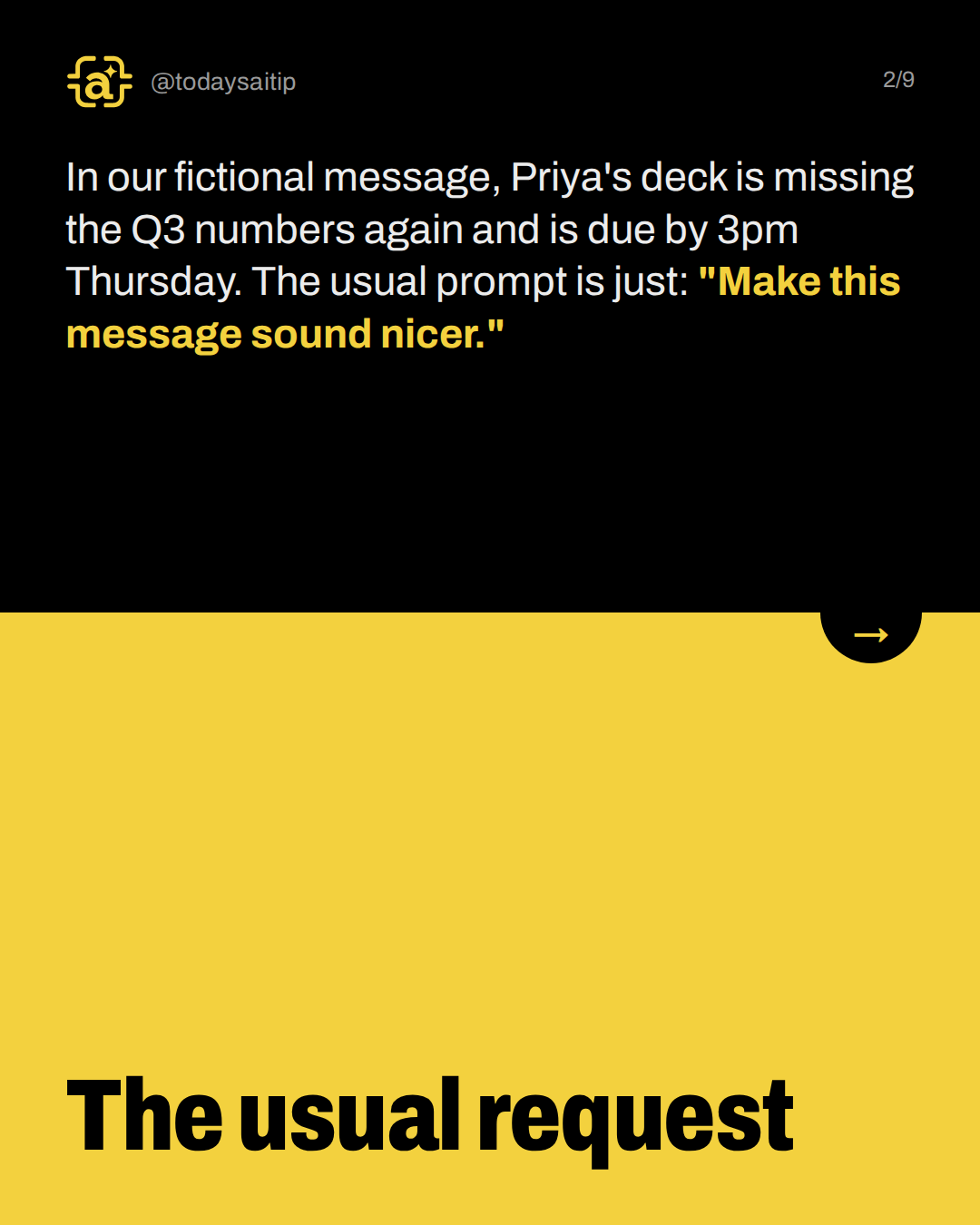
In our fictional message, Priya's deck is missing the Q3 numbers again and is due by 3pm Thursday. The usual prompt is just: "Make this message sound nicer."
The deadline became a question
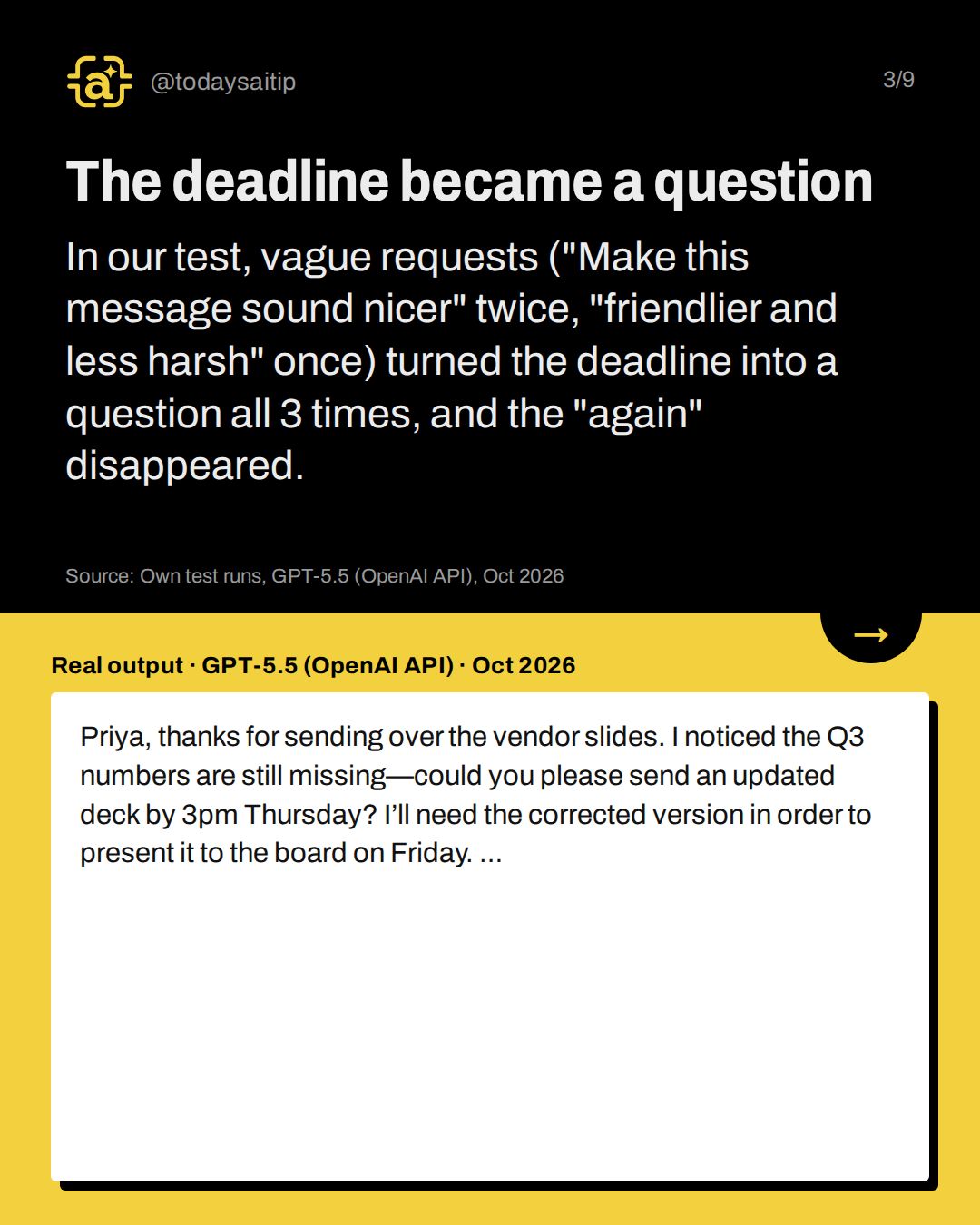
Real output · GPT-5.5 (OpenAI API) · Oct 2026
In our test, vague requests ("Make this message sound nicer" twice, "friendlier and less harsh" once) turned the deadline into a question all 3 times, and the "again" disappeared.
Source: Own test runs, GPT-5.5 (OpenAI API), Oct 2026
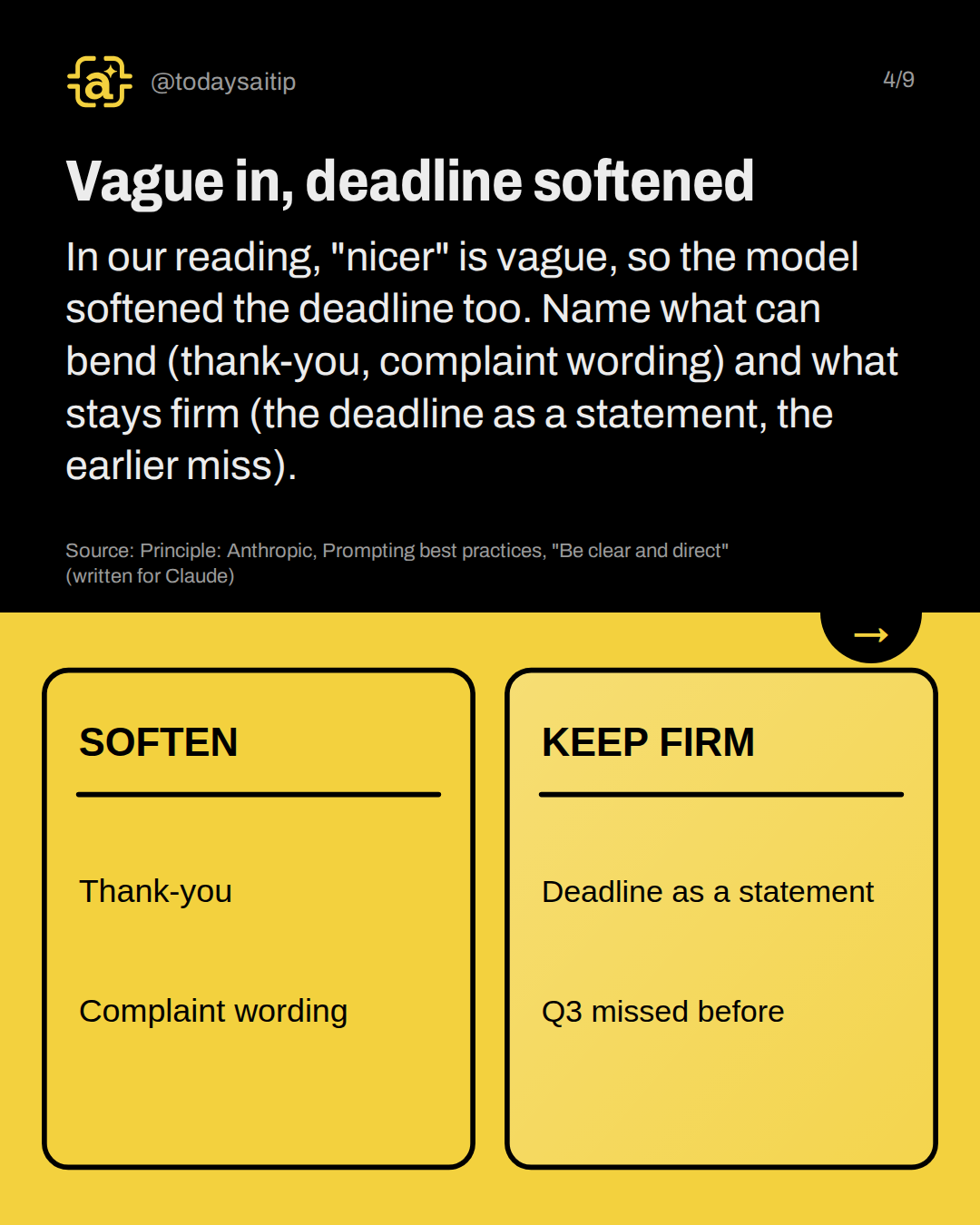
Vague in, deadline softened
In our reading, "nicer" is vague, so the model softened the deadline too. Name what can bend (thank-you, complaint wording) and what stays firm (the deadline as a statement, the earlier miss).
Source: Principle: Anthropic, Prompting best practices, "Be clear and direct" (written for Claude)
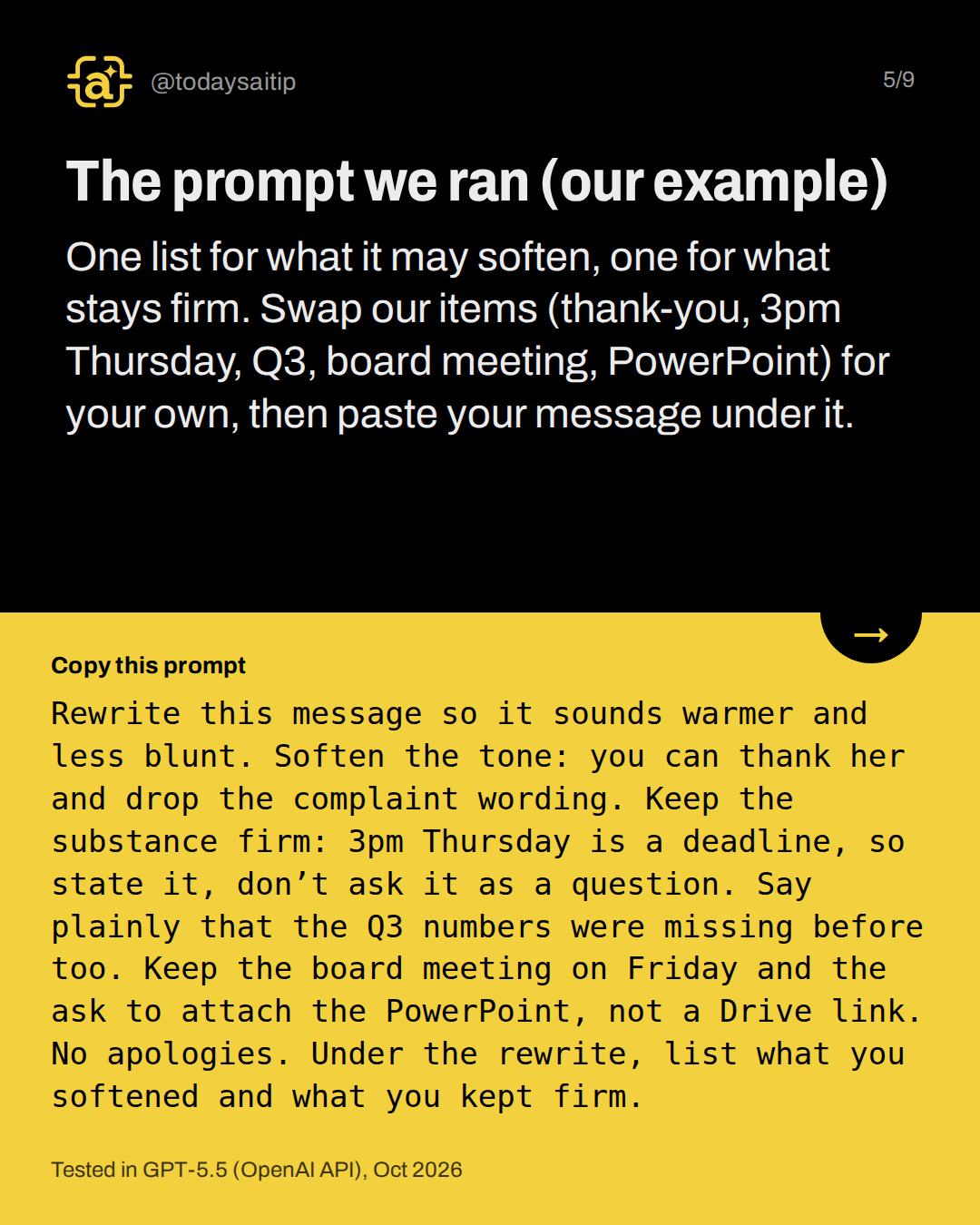
The prompt we ran (our example)
Tested in GPT-5.5 (OpenAI API), Oct 2026
One list for what it may soften, one for what stays firm. Swap our items (thank-you, 3pm Thursday, Q3, board meeting, PowerPoint) for your own, then paste your message under it.
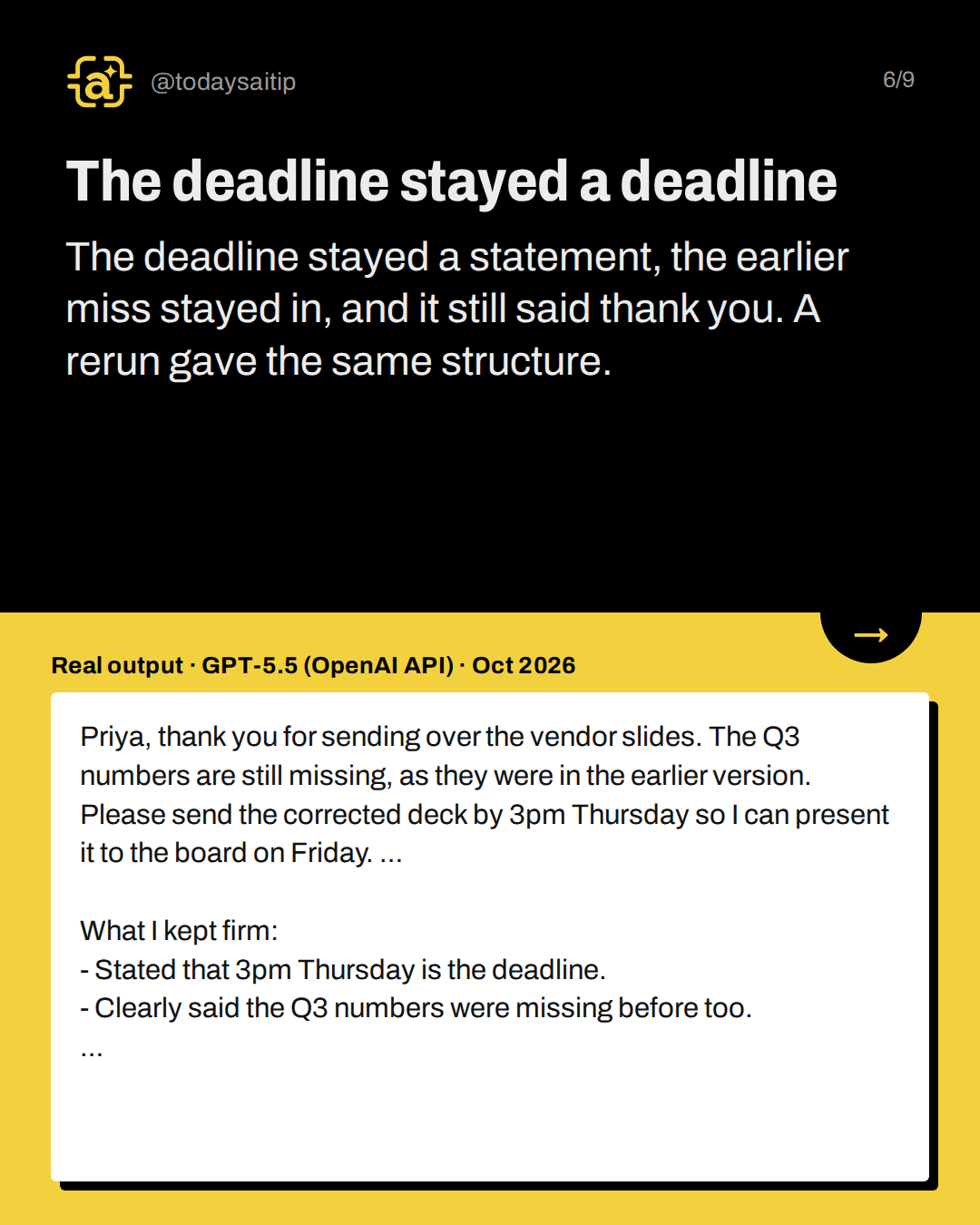
The deadline stayed a deadline
Real output · GPT-5.5 (OpenAI API) · Oct 2026
The deadline stayed a statement, the earlier miss stayed in, and it still said thank you. A rerun gave the same structure.
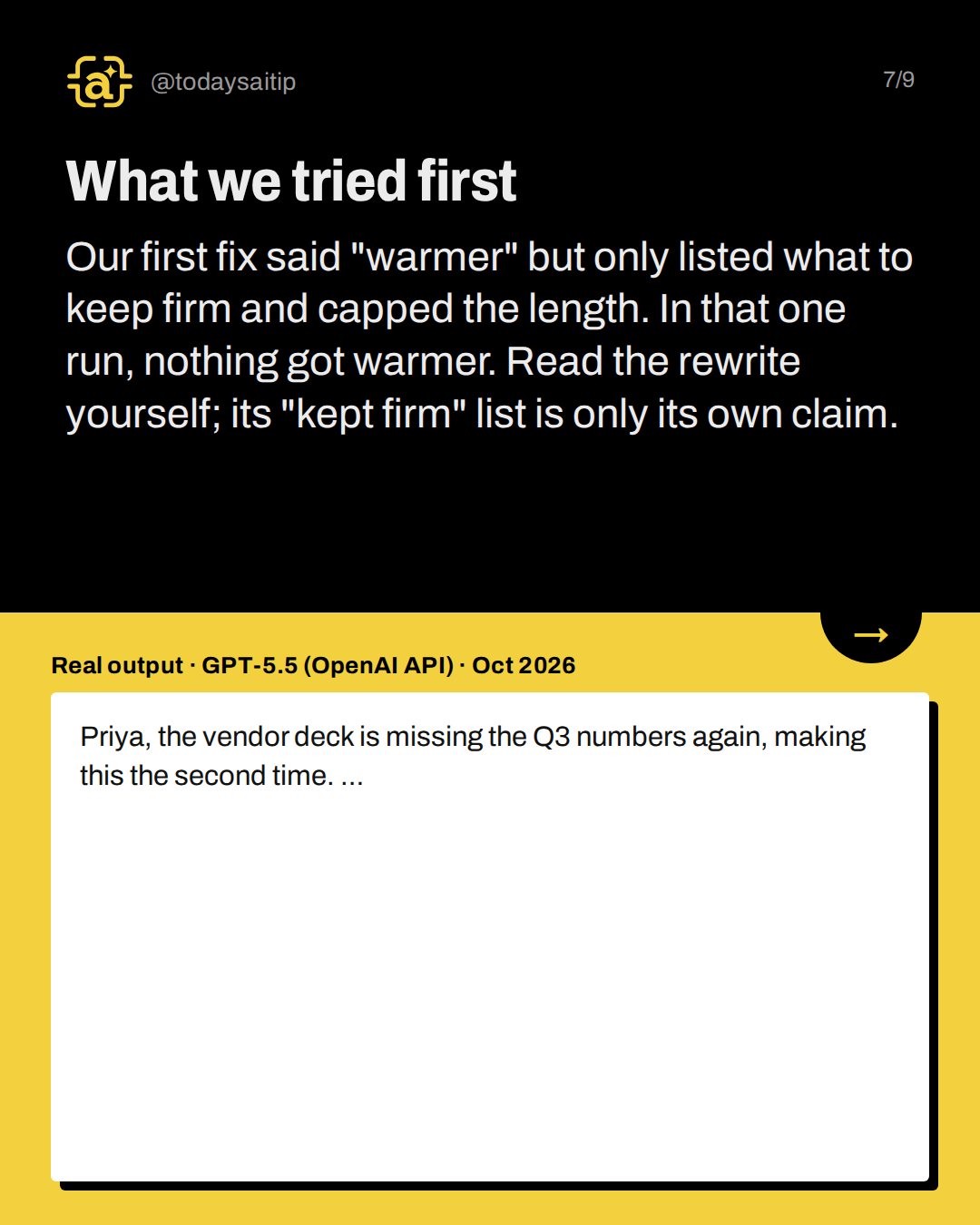
What we tried first
Real output · GPT-5.5 (OpenAI API) · Oct 2026
Our first fix said "warmer" but only listed what to keep firm and capped the length. In that one run, nothing got warmer. Read the rewrite yourself; its "kept firm" list is only its own claim.
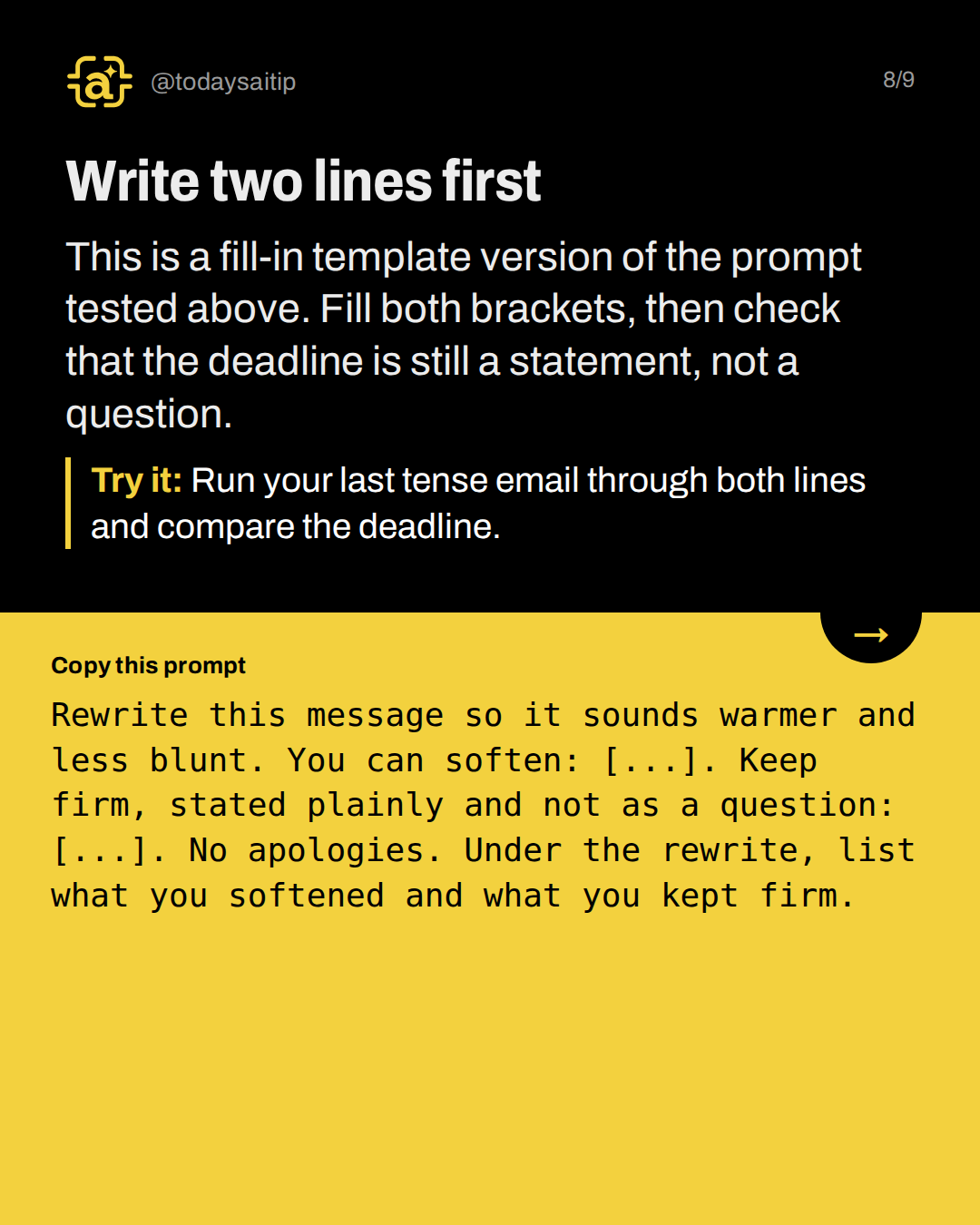
Write two lines first
This is a fill-in template version of the prompt tested above. Fill both brackets, then check that the deadline is still a statement, not a question.
Try it: Run your last tense email through both lines and compare the deadline.
Sources and assumptions
- Anthropic, Prompting best practices: 'Be clear and direct': 'Claude responds well to clear, explicit instructions. Being specific about the output you want can help enhance results.' and 'Be specific about the output format and constraints you want.' This is the general principle behind naming what to soften and what to keep. The doc is about Claude; the tests here ran on GPT-5.5. (checked 2026-10-23)
- Own test runs, engine/ai-test.js (tests.json in this record): Every output quoted on the slides: before-gpt, before-gpt-2, before-gpt-friendly (vague prompts), after-gpt (only the keep-firm list, came out cold), after-gpt-2 and after-gpt-2-rerun (two-list prompt). All GPT-5.5 via the OpenAI API, run 2026-10-24 UTC (evening of 2026-10-23 US). (checked 2026-10-23)
Assumptions:
- The sample message and the name Priya are fictional.
- Only GPT-5.5 (OpenAI API) was tested. The Claude Sonnet 5.5 runs failed with a CLI error and produced no output, so the slides must not claim any Claude result or say the prompt 'works in Claude'.
- 'Three out of three' refers to the three vague-prompt runs recorded (two 'Make this message sound nicer.' and one 'Make this message friendlier and less harsh.'). It is a small test, not a rate.
- Outputs vary between runs; the two after-gpt-2 runs matched in structure, which is all the slides should claim.
The short version
- "Make this nicer" turned a deadline into a question.
- Name what to soften and what stays firm.
- Ask it to list both after the rewrite.
- Read the rewrite before you send.