 Today's AI Tip
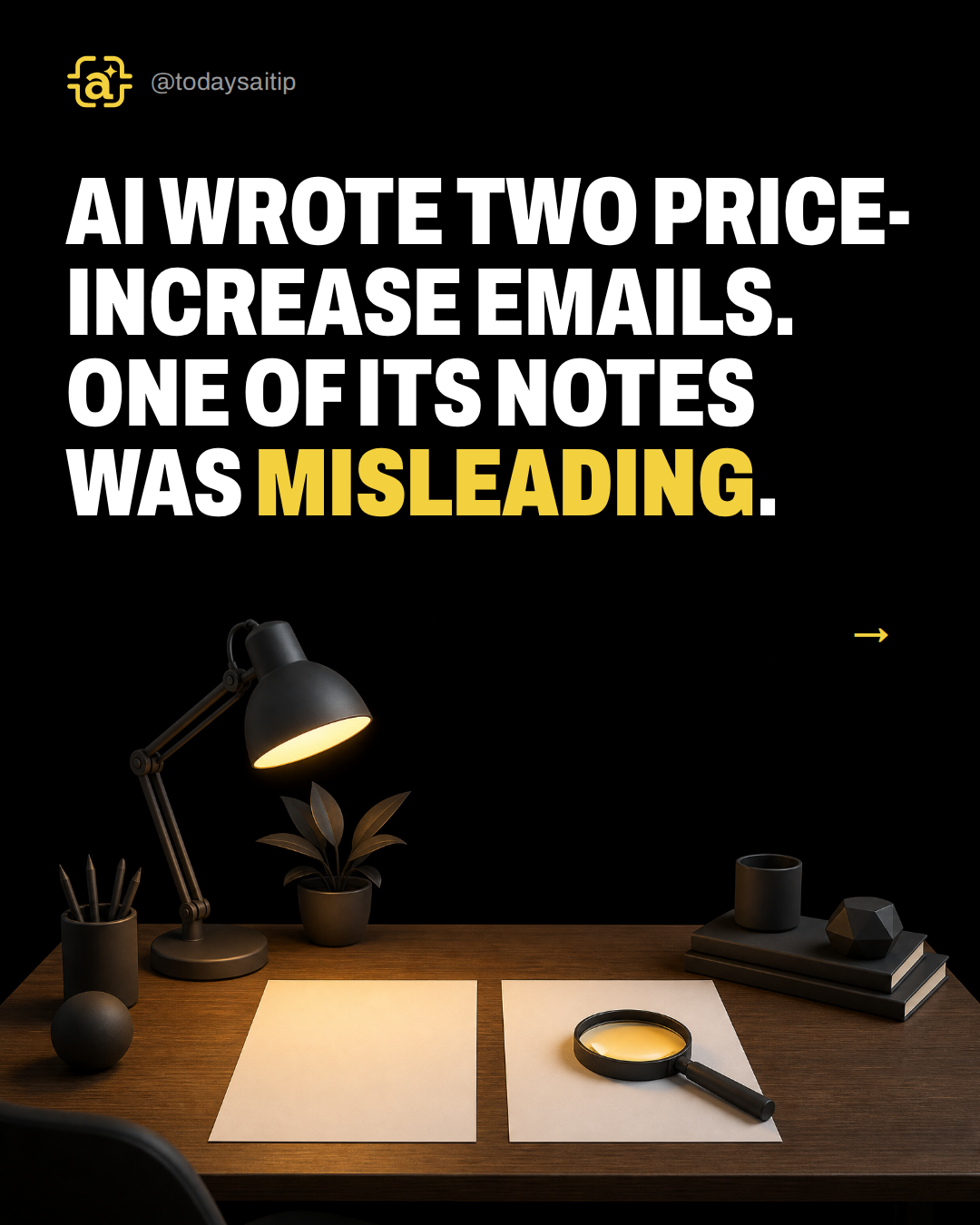
AI wrote two price-increase emails. One of its notes was misleading.
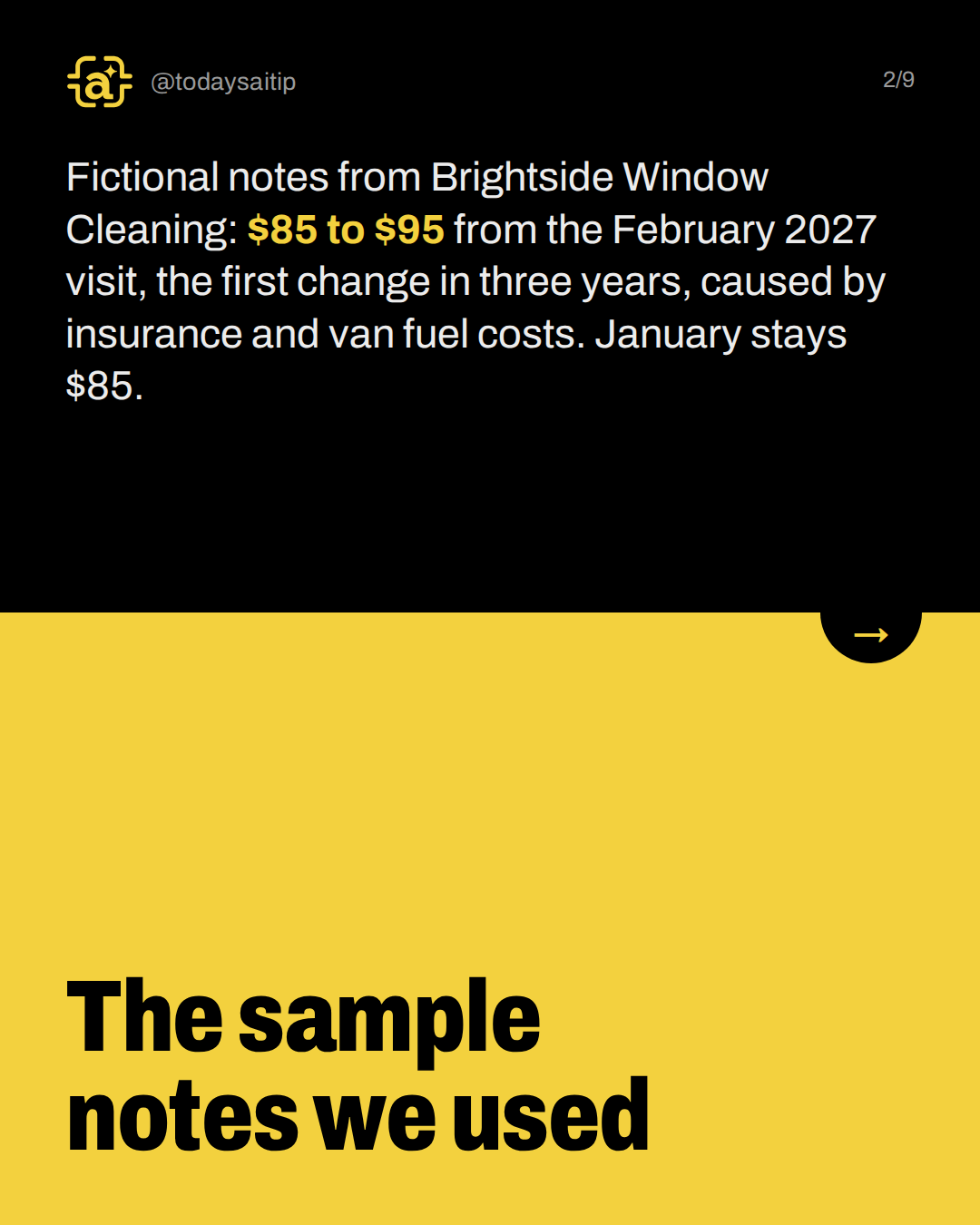
The sample notes we used
Fictional notes from Brightside Window Cleaning: $85 to $95 from the February 2027 visit, the first change in three years, caused by insurance and van fuel costs. January stays $85.
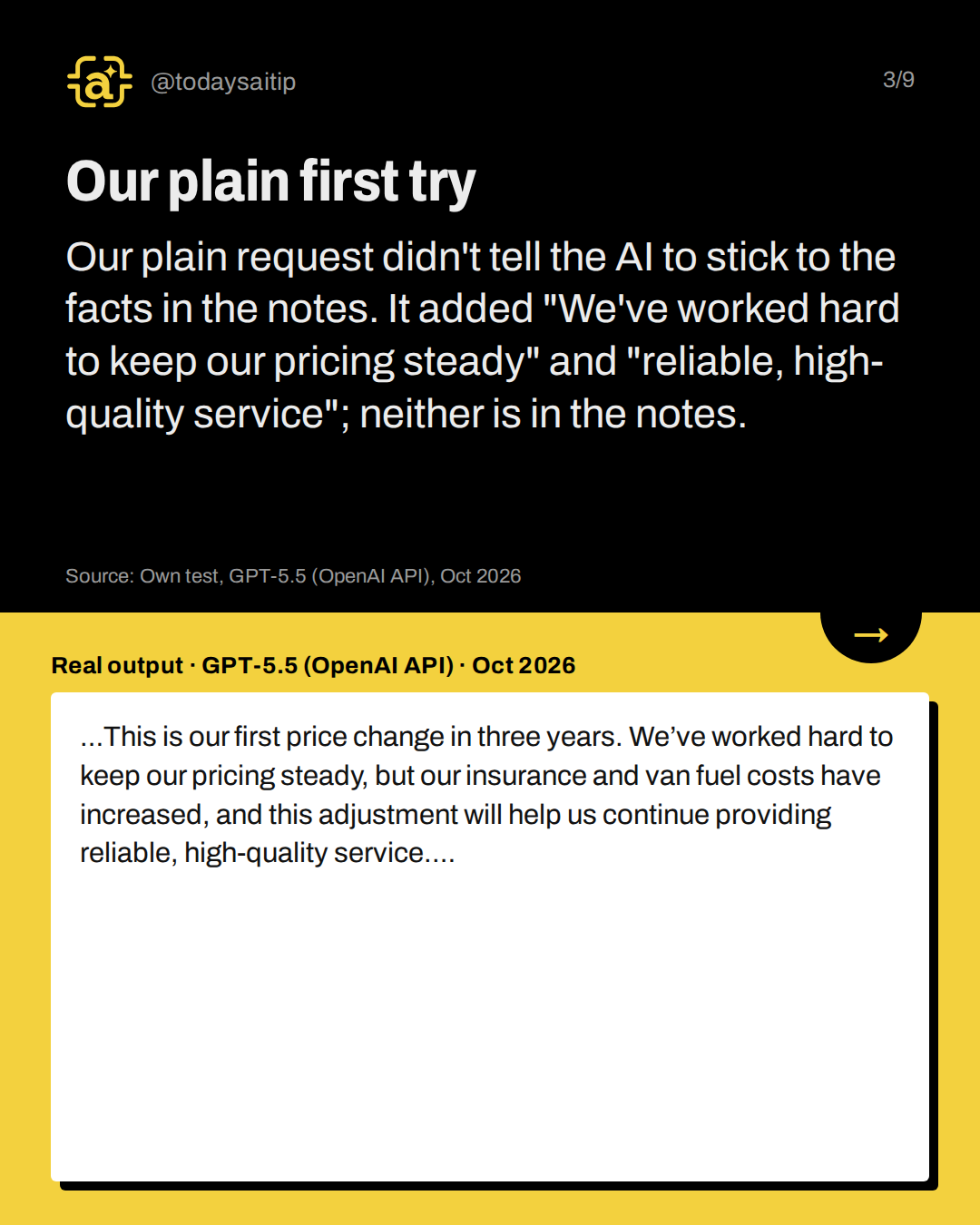
Our plain first try
Real output · GPT-5.5 (OpenAI API) · Oct 2026
Our plain request didn't tell the AI to stick to the facts in the notes. It added "We've worked hard to keep our pricing steady" and "reliable, high-quality service"; neither is in the notes.
Source: Own test, GPT-5.5 (OpenAI API), Oct 2026
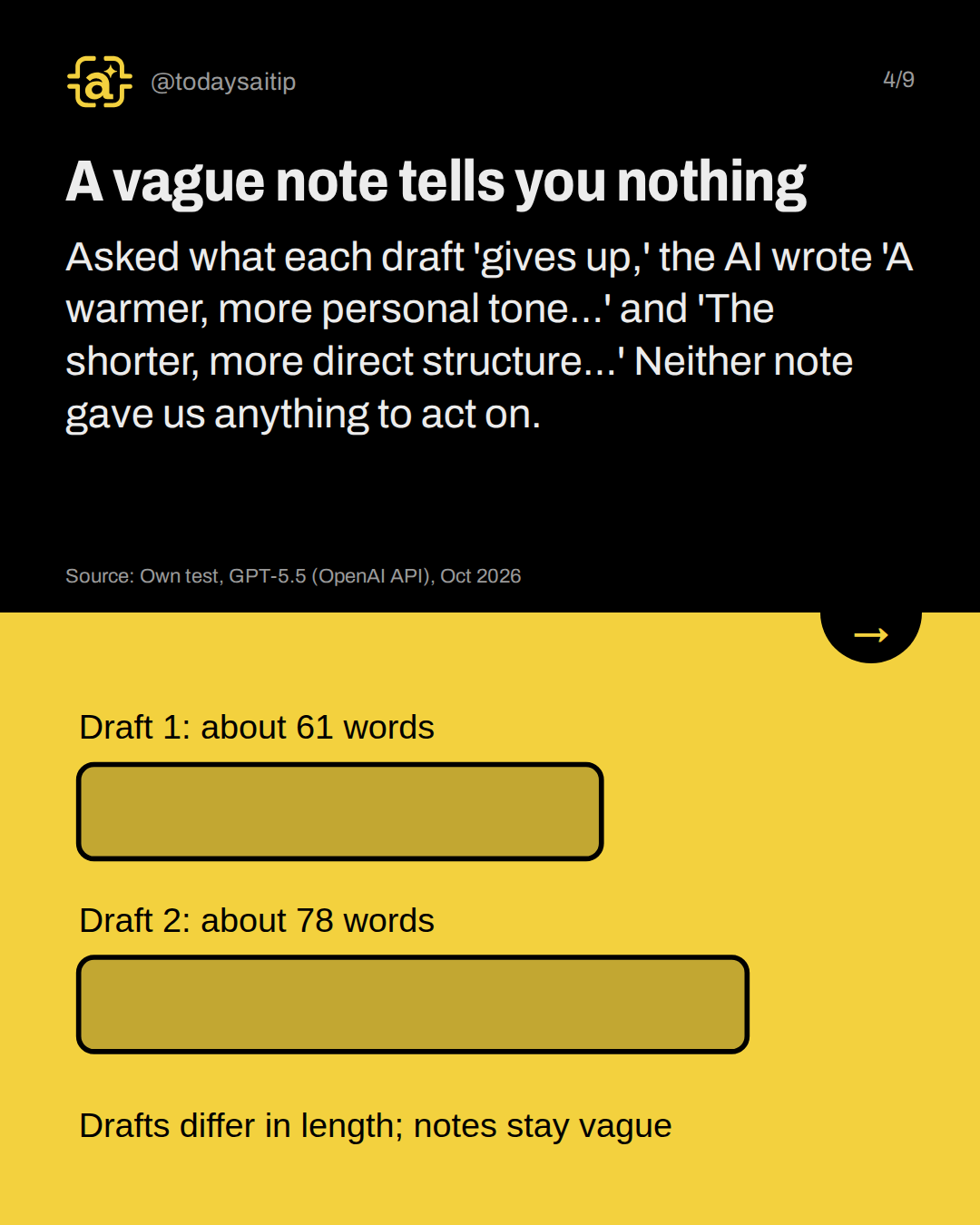
A vague note tells you nothing
Asked what each draft 'gives up,' the AI wrote 'A warmer, more personal tone…' and 'The shorter, more direct structure…' Neither note gave us anything to act on.
Source: Own test, GPT-5.5 (OpenAI API), Oct 2026
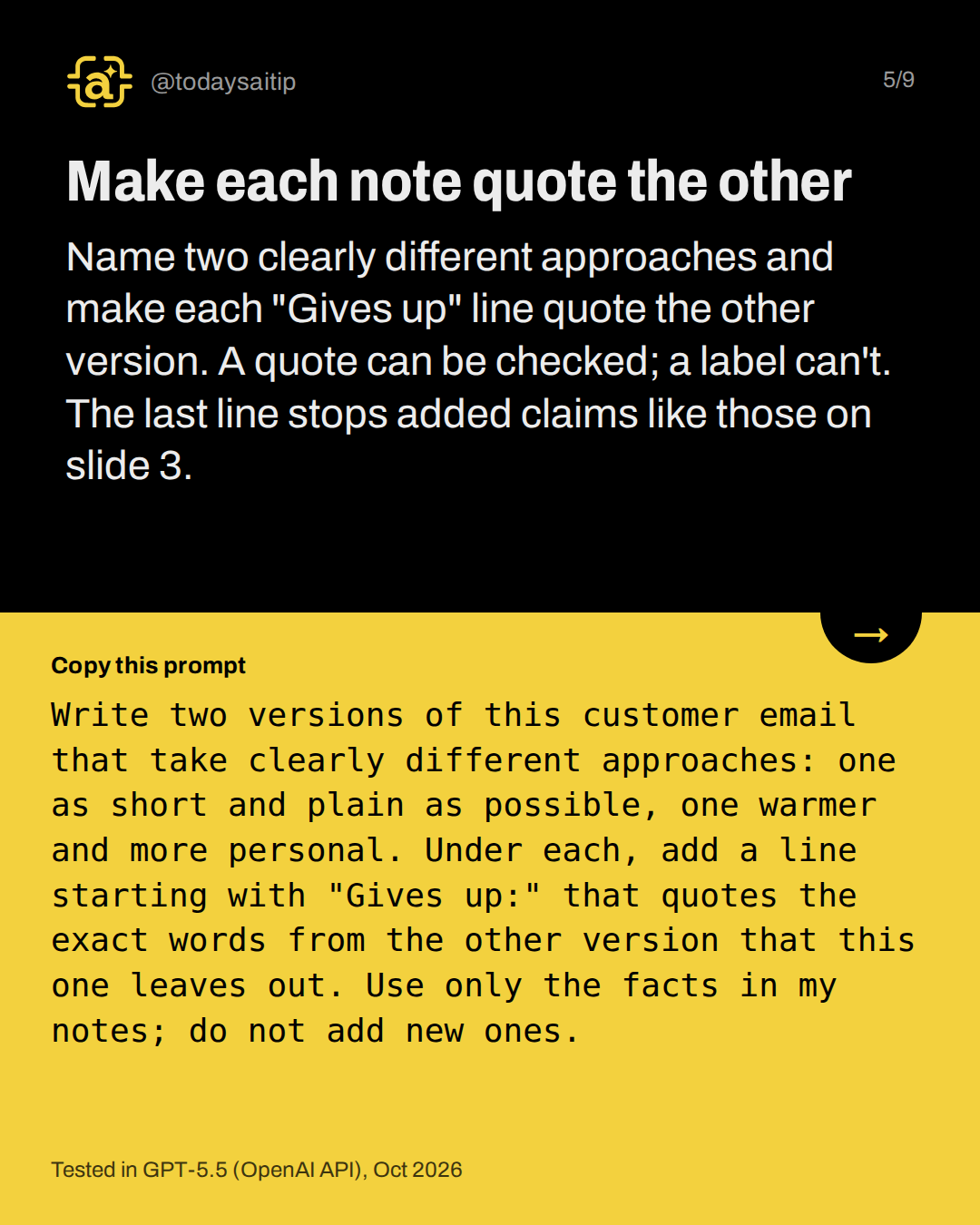
Make each note quote the other
Tested in GPT-5.5 (OpenAI API), Oct 2026
Name two clearly different approaches and make each "Gives up" line quote the other version. A quote can be checked; a label can't. The last line stops added claims like those on slide 3.
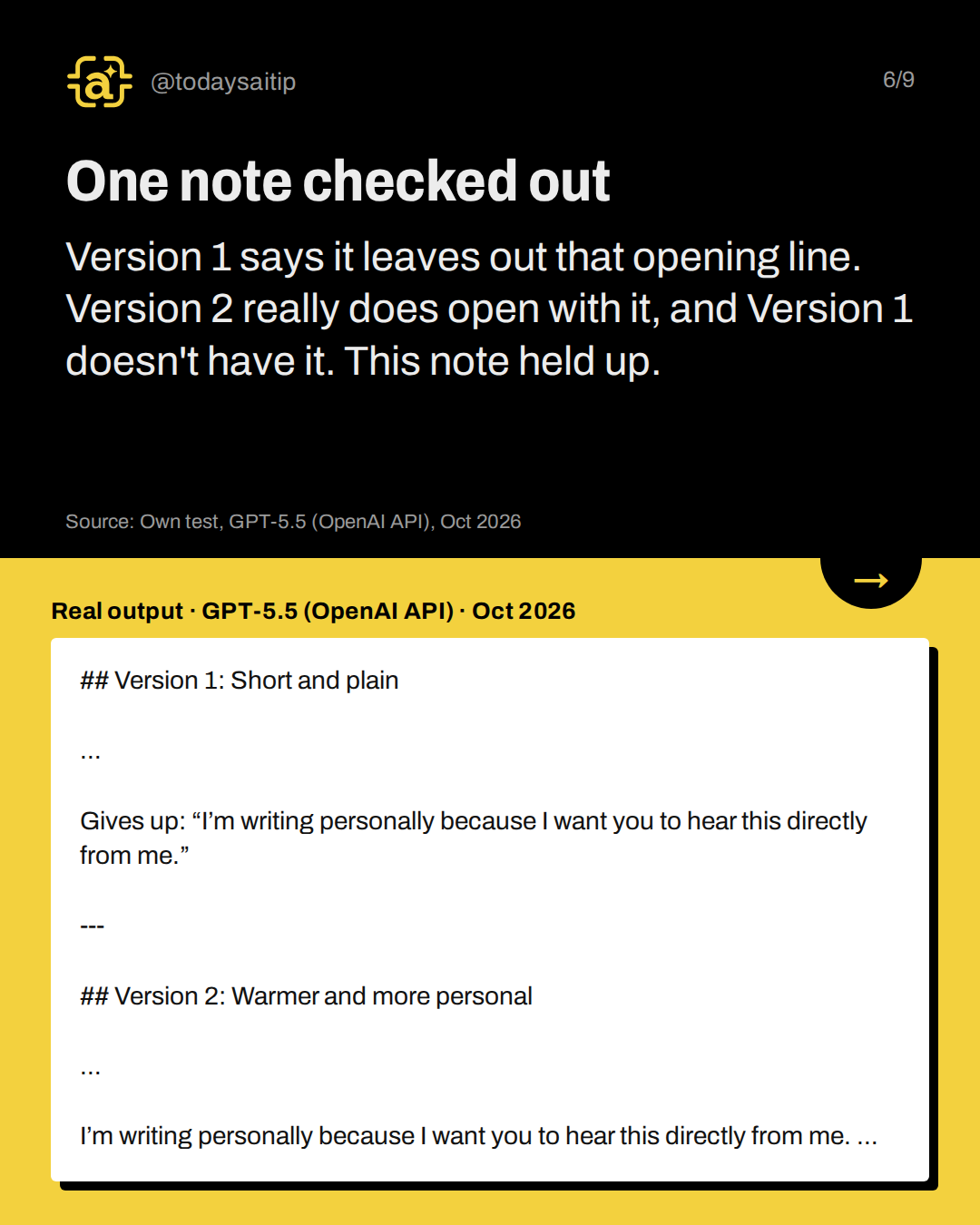
One note checked out
Real output · GPT-5.5 (OpenAI API) · Oct 2026
Version 1 says it leaves out that opening line. Version 2 really does open with it, and Version 1 doesn't have it. This note held up.
Source: Own test, GPT-5.5 (OpenAI API), Oct 2026
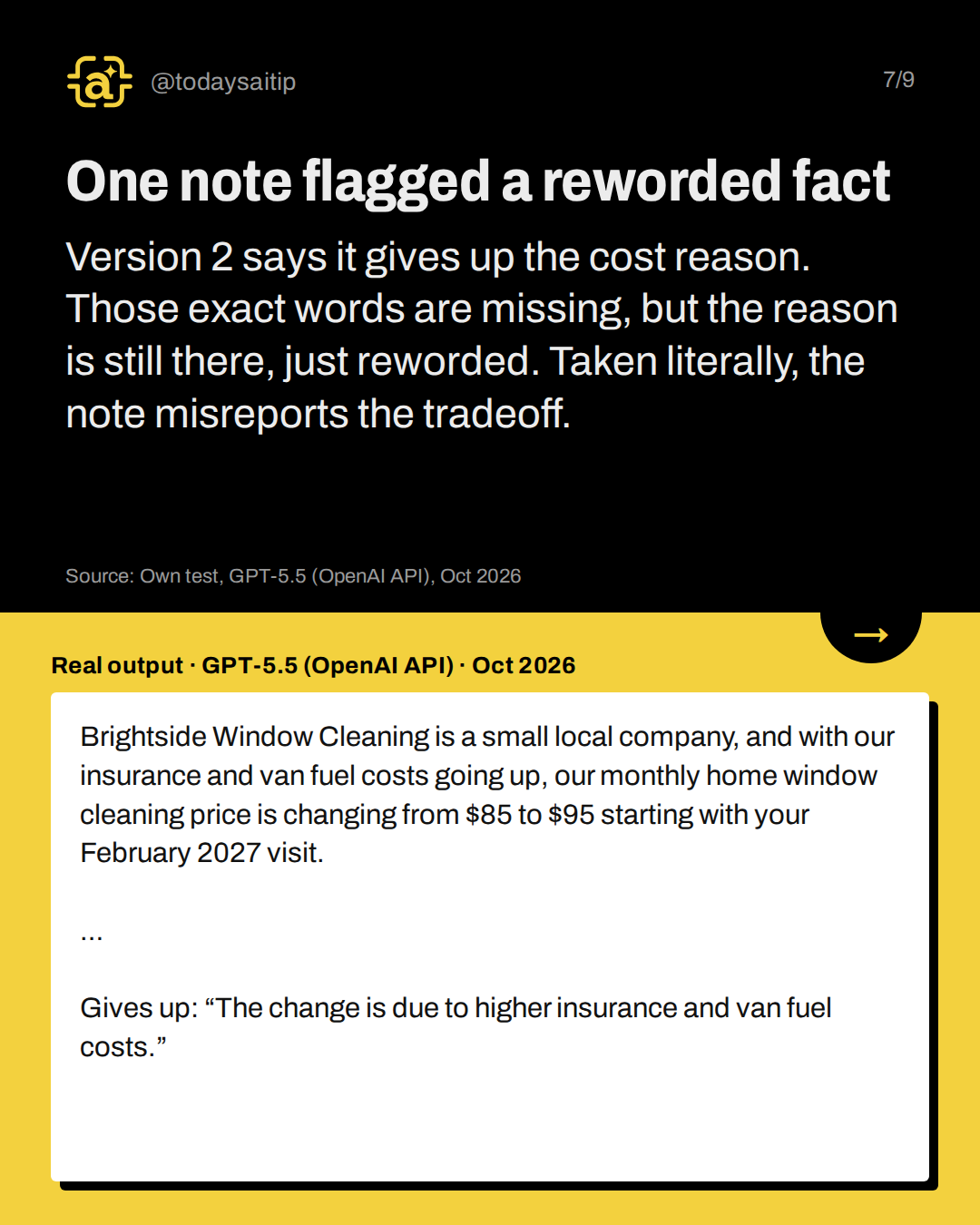
One note flagged a reworded fact
Real output · GPT-5.5 (OpenAI API) · Oct 2026
Version 2 says it gives up the cost reason. Those exact words are missing, but the reason is still there, just reworded. Taken literally, the note misreports the tradeoff.
Source: Own test, GPT-5.5 (OpenAI API), Oct 2026
Check each note against its own draft
Under each version, read its "Gives up" quote, then look for that fact in the same version: is it really missing, or just reworded?
Try it: Paste your notes, run the prompt, then check each quote's fact in its own draft.
Sources and assumptions
- Anthropic, Prompting best practices (Claude Platform Docs), 'Be clear and direct': The general principle behind naming two specific approaches: 'Claude responds well to clear, explicit instructions. Being specific about your desired output can help enhance results.' and 'The more precisely you explain what you want, the better the result.' (Claude's docs; our test ran in GPT-5.5, so don't present it as GPT documentation.) (checked 2026-10-15)
- Our own test runs, engine/ai-test.js, GPT-5.5 (OpenAI API): All four outputs quoted in the outline (before, two-drafts, two-drafts-different, two-drafts-quote), run 2026-10-15 on fictional sample notes (checked 2026-10-15)
Assumptions:
- Brightside Window Cleaning, Dana, and the $85/$95 prices are fictional sample material.
- Every test ran in GPT-5.5 through the OpenAI API, not the ChatGPT app, in Oct 2026. The Claude runs failed to execute in this research session, so slides must not claim the prompt was tested in Claude.
- Each test was run once; another run may give different drafts and notes.
- The 'before' prompt had no 'use only my facts' rule, so its added claims show what an unconstrained one-draft request did in one run, not a controlled comparison.
- Word counts (about 68 vs 94 for the quote test, 61 vs 78 for the first two-draft test) include headings and sign-offs and are approximate.
- The two-drafts-different run is backup evidence: its notes also just echoed the labels ('A warmer, more personal explanation from Dana' / 'The shortest, plainest version of the update').
The short version
- Ask for two clearly different drafts.
- Make each 'Gives up' line quote the other draft.
- Check each quoted fact in its own draft.
- One note in our test flagged a reworded fact.