 Today's AI Tip
Translating a customer email with AI? Back-translate it before you send.
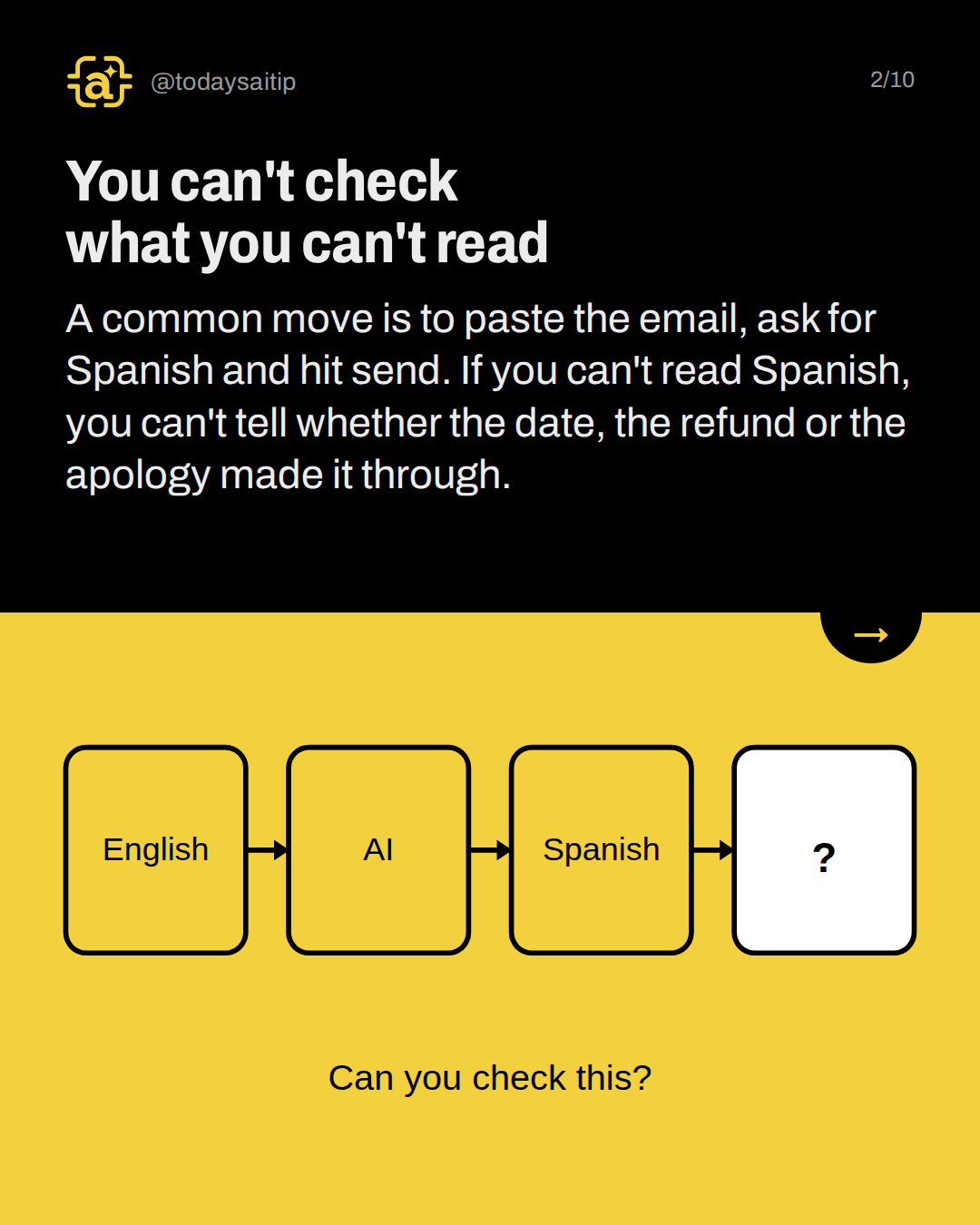
You can't check what you can't read
A common move is to paste the email, ask for Spanish and hit send. If you can't read Spanish, you can't tell whether the date, the refund or the apology made it through.
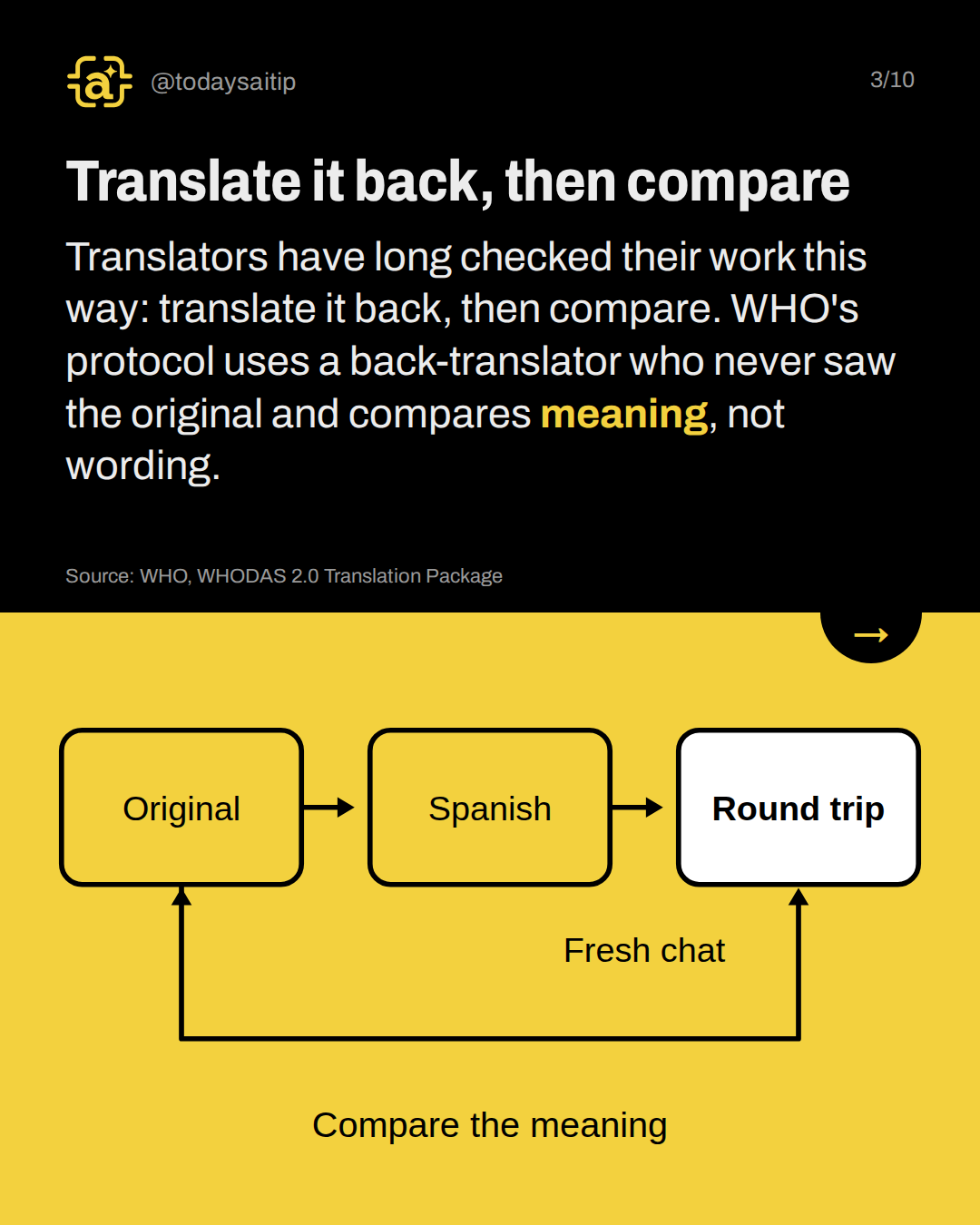
Translate it back, then compare
Translators have long checked their work this way: translate it back, then compare. WHO's protocol uses a back-translator who never saw the original and compares meaning, not wording.
Source: WHO, WHODAS 2.0 Translation Package
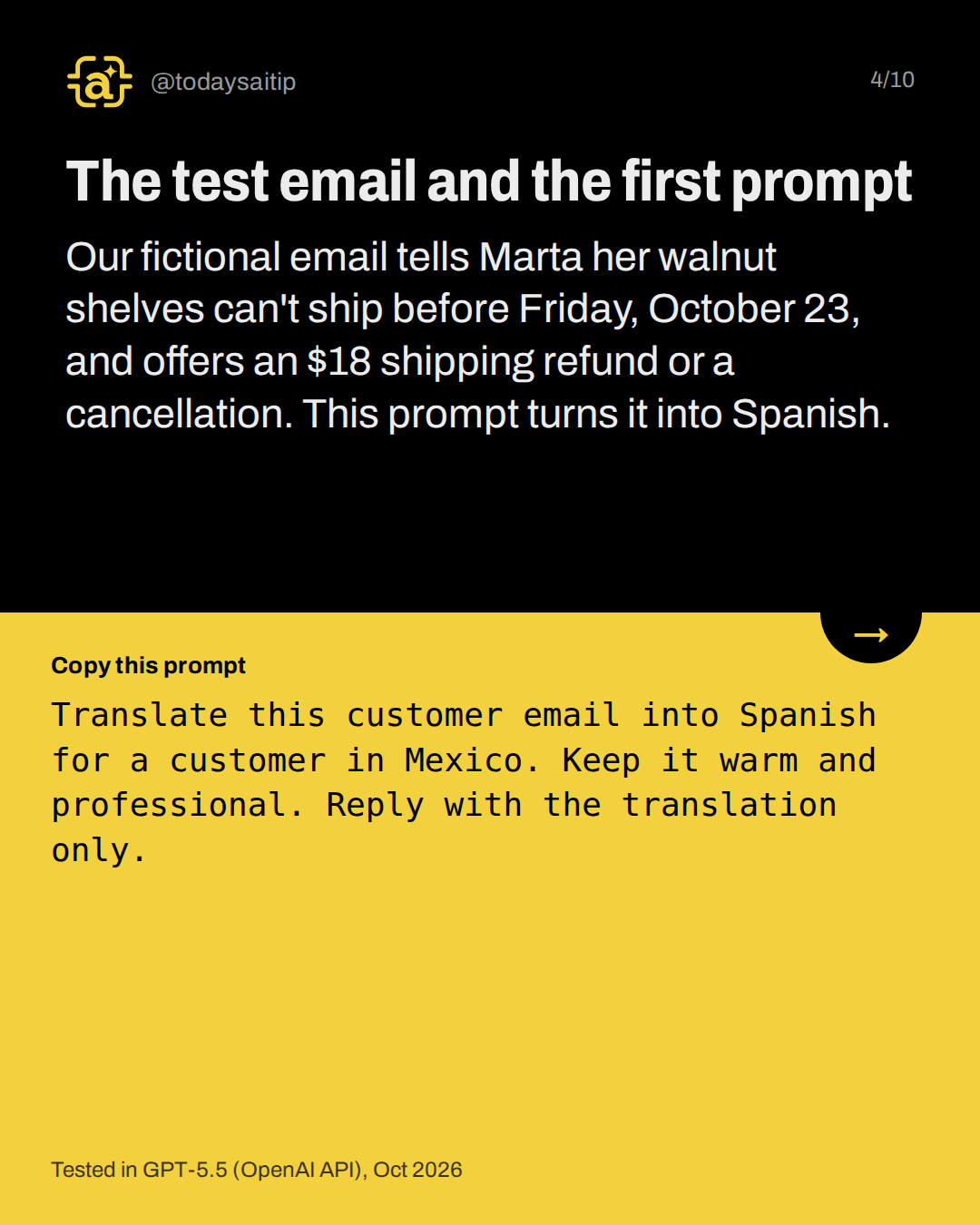
The test email and the first prompt
Tested in GPT-5.5 (OpenAI API), Oct 2026
Our fictional email tells Marta her walnut shelves can't ship before Friday, October 23, and offers an $18 shipping refund or a cancellation. This prompt turns it into Spanish.
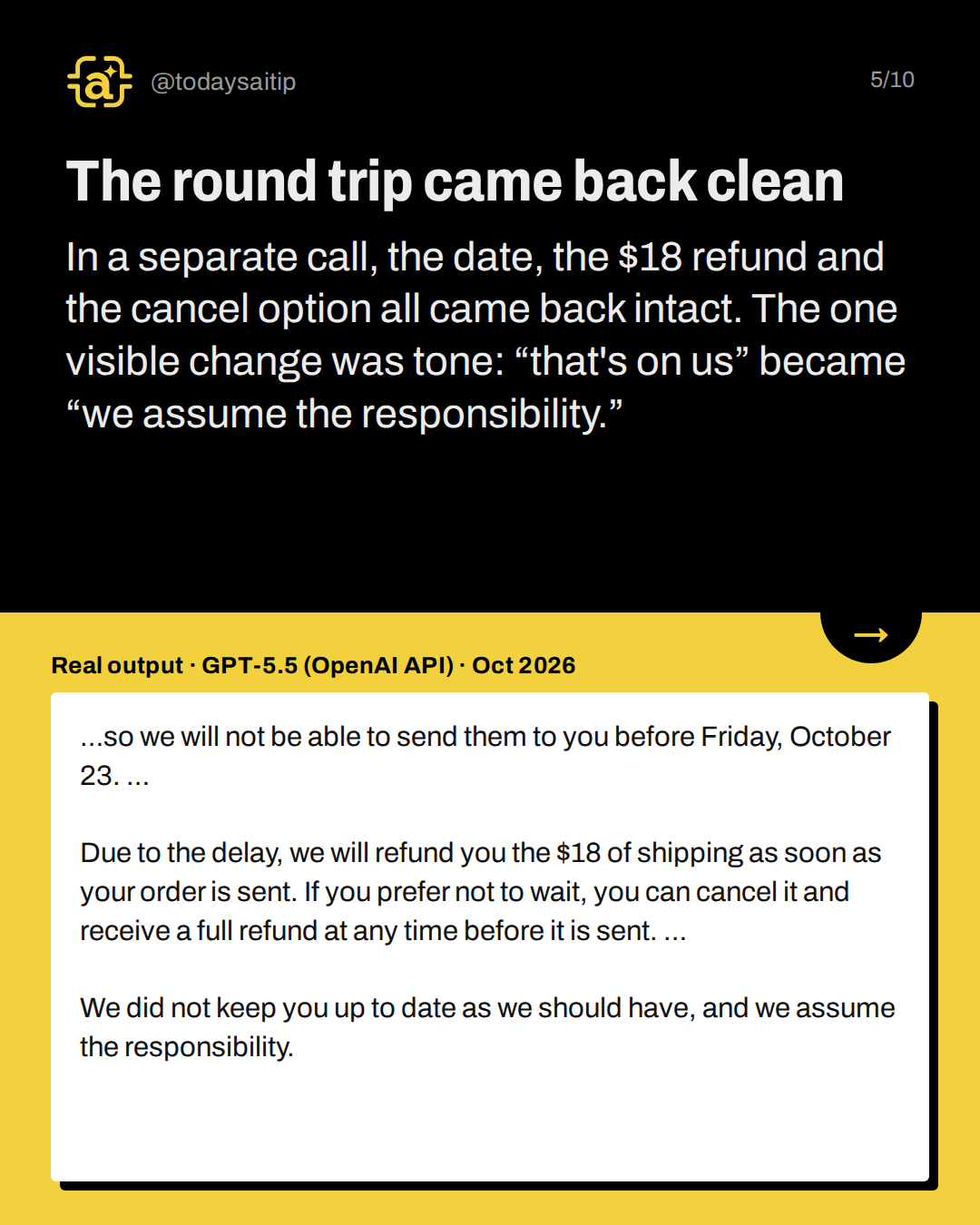
The round trip came back clean
Real output · GPT-5.5 (OpenAI API) · Oct 2026
In a separate call, the date, the $18 refund and the cancel option all came back intact. The one visible change was tone: “that's on us” became “we assume the responsibility.”
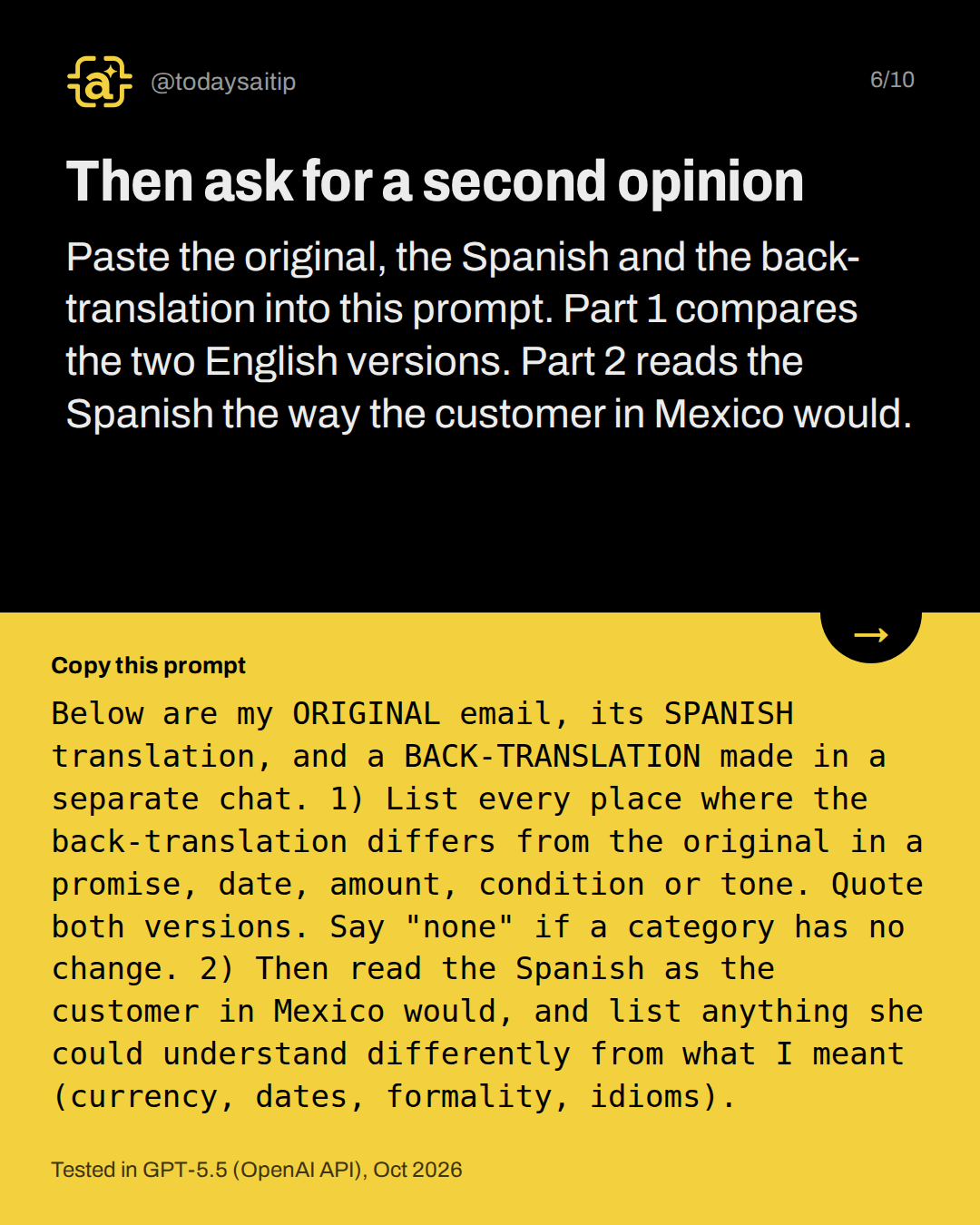
Then ask for a second opinion
Tested in GPT-5.5 (OpenAI API), Oct 2026
Paste the original, the Spanish and the back-translation into this prompt. Part 1 compares the two English versions. Part 2 reads the Spanish the way the customer in Mexico would.
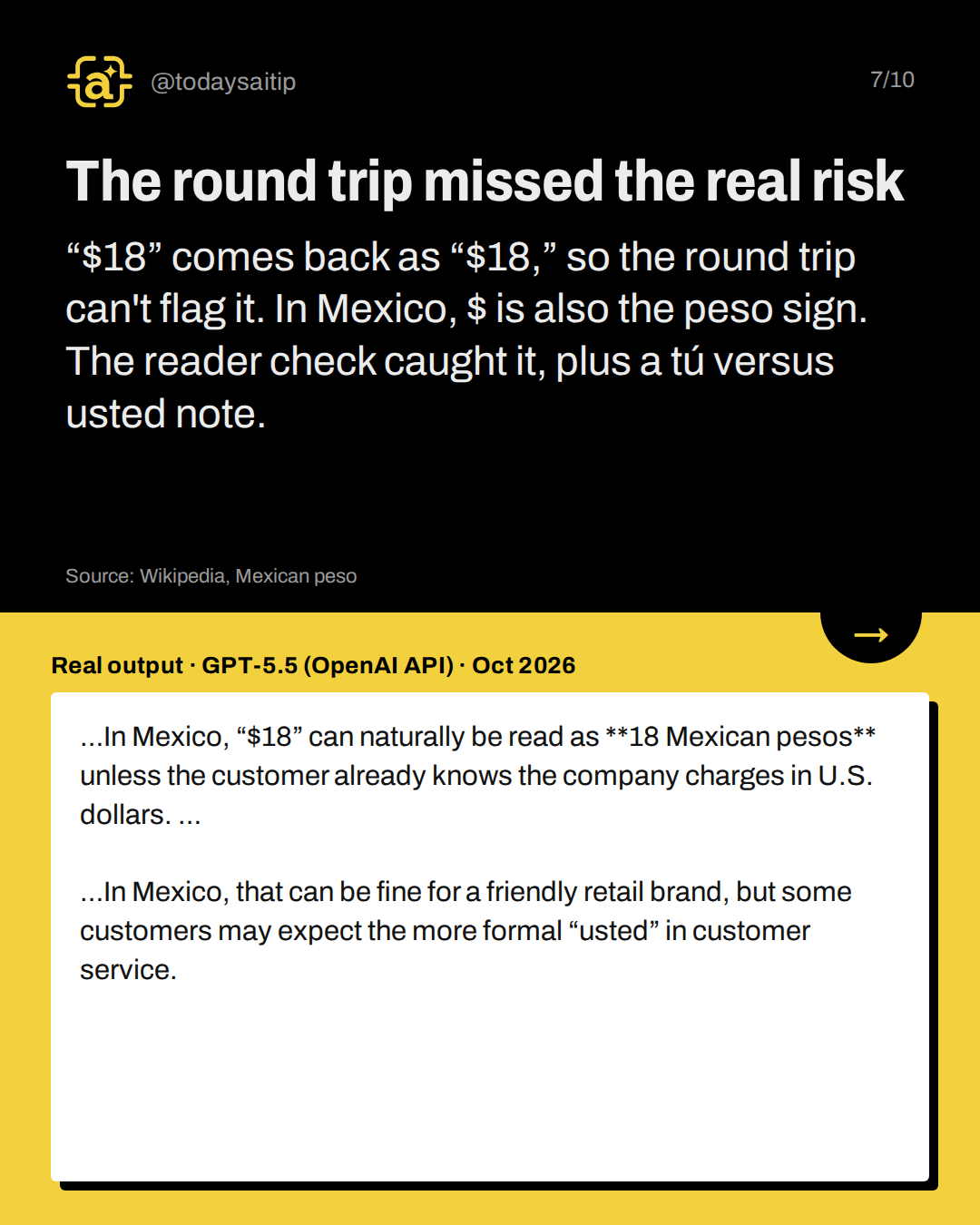
The round trip missed the real risk
Real output · GPT-5.5 (OpenAI API) · Oct 2026
“$18” comes back as “$18,” so the round trip can't flag it. In Mexico, $ is also the peso sign. The reader check caught it, plus a tú versus usted note.
Source: Wikipedia, Mexican peso
What the check can and can't tell you
The round trip can catch a changed date, amount or condition, but not currency or formality. It's the same model family checking itself, so have a native speaker read anything with money or legal terms.
Before you paste a real email
Remove names, account numbers and other personal details first, and check the tool's data policy or your employer's approved tools before uploading real documents.
Try it: Write “US$18” or your currency code before you translate.
Sources and assumptions
- WHO, WHODAS 2.0 Translation Package (Version 1.0), Translation and Linguistic Evaluation Protocol: Translate, back-translate with an independent translator, then compare the back-translation with the original for conceptual equivalence. Quotes: 'Translation of the source language instrument into the target language, back-translation into the source language by an independent translator and comparison of the back-translation with the original has been the commonly used method for a long time. However, the success of this method was uneven, depending on the extent of care exercised during the process.' Step h: back-translators 'should not have been exposed to the original instrument or involved in the earlier translation'. Step i: 'Comparison of the back-translation with the original version for conceptual equivalence.' Recommendation: 'Always aim for a translation that captures the conceptual equivalent of the source language (typically English), not a word-by-word translation'. (checked 2026-10-17)
- Wikipedia, Mexican peso: The Mexican peso's symbol is '$'. It is 'also abbreviated Mex$ to distinguish it from other peso-denominated currencies', so '$18' in a Mexican reader's context can mean 18 pesos. (checked 2026-10-17)
Assumptions:
- The email, the customer 'Marta', order #4471, 'Oakline Home' and 'Sam' are fictional sample material written for this test.
- All three tests ran in GPT-5.5 via the OpenAI API (label 'GPT-5.5 (OpenAI API)', Oct 2026), each as a separate API call with no shared history, which is the API equivalent of a fresh chat. Claude runs were attempted but the claude CLI failed in this research session, so the two failed entries in tests.json have null output. The post must not claim a Claude result.
- The back-translation and the check were made by the same model family that translated, so the check is not independent the way WHO's human back-translator is. The post should say so.
- The back-translation prompt asked for a literal translation, which partly explains why the check listed small tone shifts ('Hi' → 'Hello', 'Best' → 'Regards'). Those are artifacts of the literal step, not real changes in the Spanish.
- Friday, October 23 is correct for 2026 (computed: Jan 1, 2026 is a Thursday, and Oct 23 is day 296, so it is a Friday).
- The '$18 read as pesos' risk applies when the customer is in Mexico and the shop charges in US dollars, which is the scenario in the sample.
The short version
- Translate it back in a fresh chat.
- Compare promises, dates, amounts and conditions.
- Then ask how the customer will read it.
- A clean round trip can still hide a “$.”